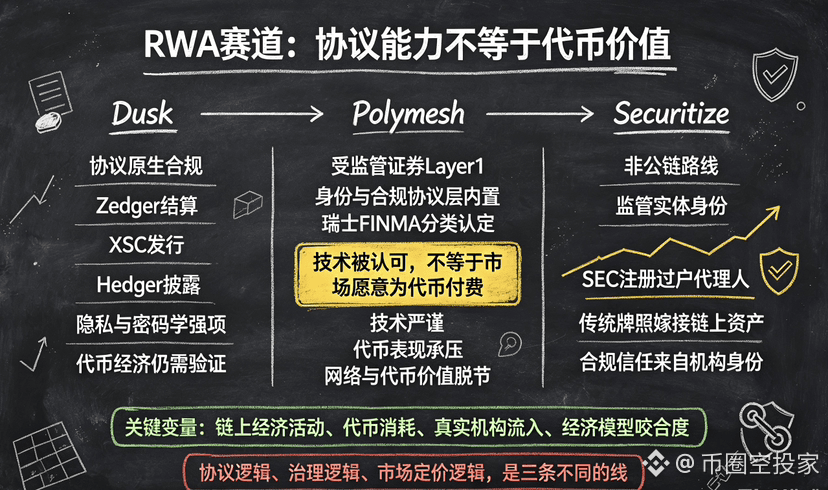
While researching, I happened to compare the competitive landscape of the entire RWA-dedicated ecosystem by placing Dusk alongside it. What stands out most isn’t Dusk’s own data, but the current situation of another project in the same space: Polymesh—something worth mentioning separately.
Polymesh is one of the projects in this arena that’s positioned most similarly to Dusk. Like Dusk, it’s a permissioned Layer1 built specifically for regulated securities. Identity verification and compliance rules are built directly into the protocol layer, and it has even received a Swiss FINMA classification determination. Industry commentary describes it as “one of the most rigorous attempts at tokenizing securities.” However, the data I found shows that its native token, POLYX, has already fallen by roughly 94% from its 2024 peak, and its liquidity is also rather thin. One line from the original assessment is quite painfully to-the-point: “there is a disconnect between the network itself and the value of the token.” Having solid technical foundations doesn’t automatically mean the market is willing to pay for that token.
I think this case offers especially useful context for looking at Dusk. We’ve previously discussed how Dusk’s technical modules (Zedger, XSC, Hedger) are designed quite solidly, and the team’s credentials are strong. But Polymesh’s lesson is right there: protocol-level compliance capability and cryptography design address the question of “whether this chain can be accepted by institutions,” which doesn’t directly translate into “whether the token will rise.” These are two logic lines that only partially overlap. In between them are variables such as whether the token economics model is well designed and whether there is real on-chain economic activity that consumes and drives value for that token.
Another point worth mentioning is that in the same space, Securitize is taking a completely different route. It doesn’t build its own public chain—instead, it wraps compliance using regulated entities (an SEC-registered transfer agent and broker-dealer). In essence, it directly bridges the traditional finance licensing framework onto on-chain asset management. That’s a different philosophy from the “protocol-native compliance” approach taken by Polymesh and Dusk. As to which is easier to be accepted by mainstream institutions, there’s still no clear conclusion.
Getting the technical route right doesn’t mean the market’s acceptance will arrive at the same time. Polymesh’s price performance can be seen as a warning to the whole sector. For Dusk to avoid repeating the same mistake, relying on technical hard strength alone probably isn’t enough—it also has to see whether the token economics model and real on-chain activity can truly align and match up.
@Dusk #dusk $DUSK
Polymesh is one of the projects in this arena that’s positioned most similarly to Dusk. Like Dusk, it’s a permissioned Layer1 built specifically for regulated securities. Identity verification and compliance rules are built directly into the protocol layer, and it has even received a Swiss FINMA classification determination. Industry commentary describes it as “one of the most rigorous attempts at tokenizing securities.” However, the data I found shows that its native token, POLYX, has already fallen by roughly 94% from its 2024 peak, and its liquidity is also rather thin. One line from the original assessment is quite painfully to-the-point: “there is a disconnect between the network itself and the value of the token.” Having solid technical foundations doesn’t automatically mean the market is willing to pay for that token.
I think this case offers especially useful context for looking at Dusk. We’ve previously discussed how Dusk’s technical modules (Zedger, XSC, Hedger) are designed quite solidly, and the team’s credentials are strong. But Polymesh’s lesson is right there: protocol-level compliance capability and cryptography design address the question of “whether this chain can be accepted by institutions,” which doesn’t directly translate into “whether the token will rise.” These are two logic lines that only partially overlap. In between them are variables such as whether the token economics model is well designed and whether there is real on-chain economic activity that consumes and drives value for that token.
Another point worth mentioning is that in the same space, Securitize is taking a completely different route. It doesn’t build its own public chain—instead, it wraps compliance using regulated entities (an SEC-registered transfer agent and broker-dealer). In essence, it directly bridges the traditional finance licensing framework onto on-chain asset management. That’s a different philosophy from the “protocol-native compliance” approach taken by Polymesh and Dusk. As to which is easier to be accepted by mainstream institutions, there’s still no clear conclusion.
Getting the technical route right doesn’t mean the market’s acceptance will arrive at the same time. Polymesh’s price performance can be seen as a warning to the whole sector. For Dusk to avoid repeating the same mistake, relying on technical hard strength alone probably isn’t enough—it also has to see whether the token economics model and real on-chain activity can truly align and match up.
@Dusk #dusk $DUSK