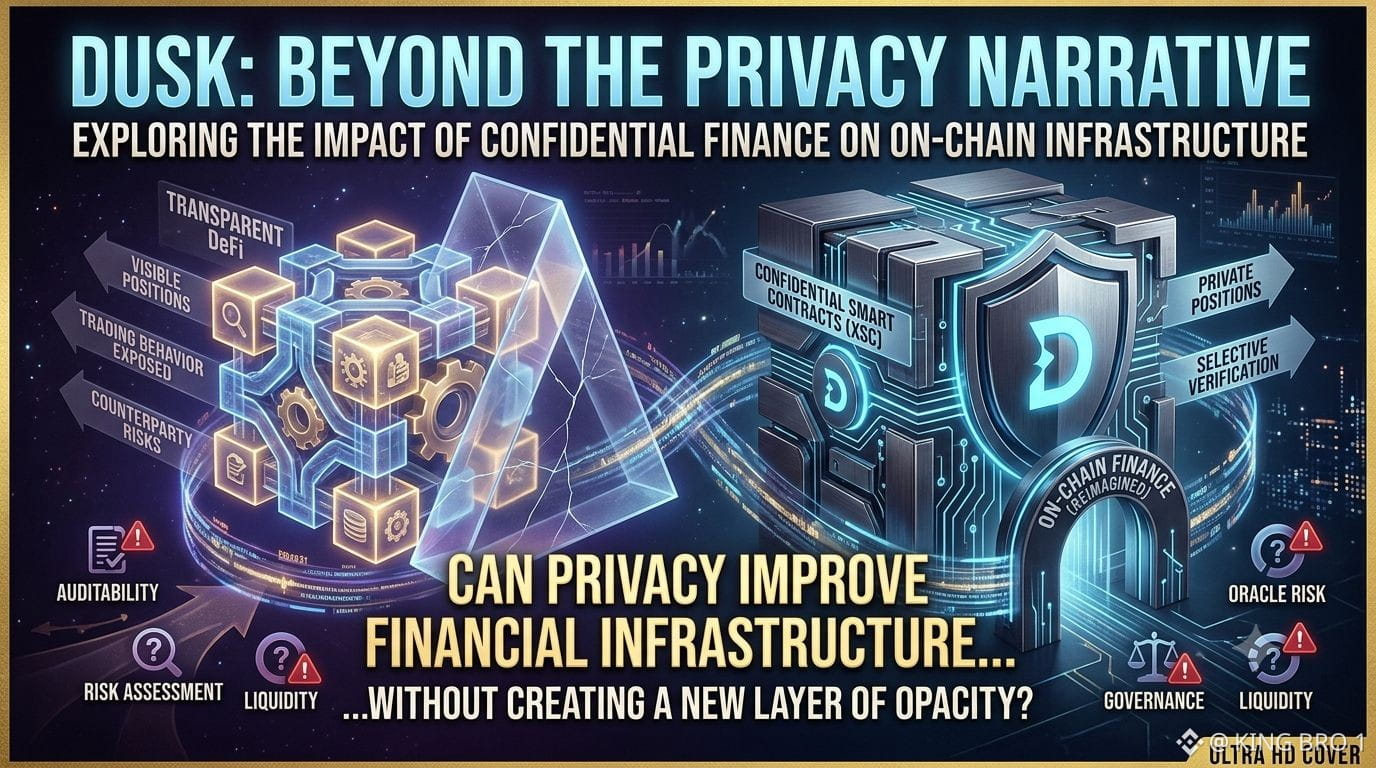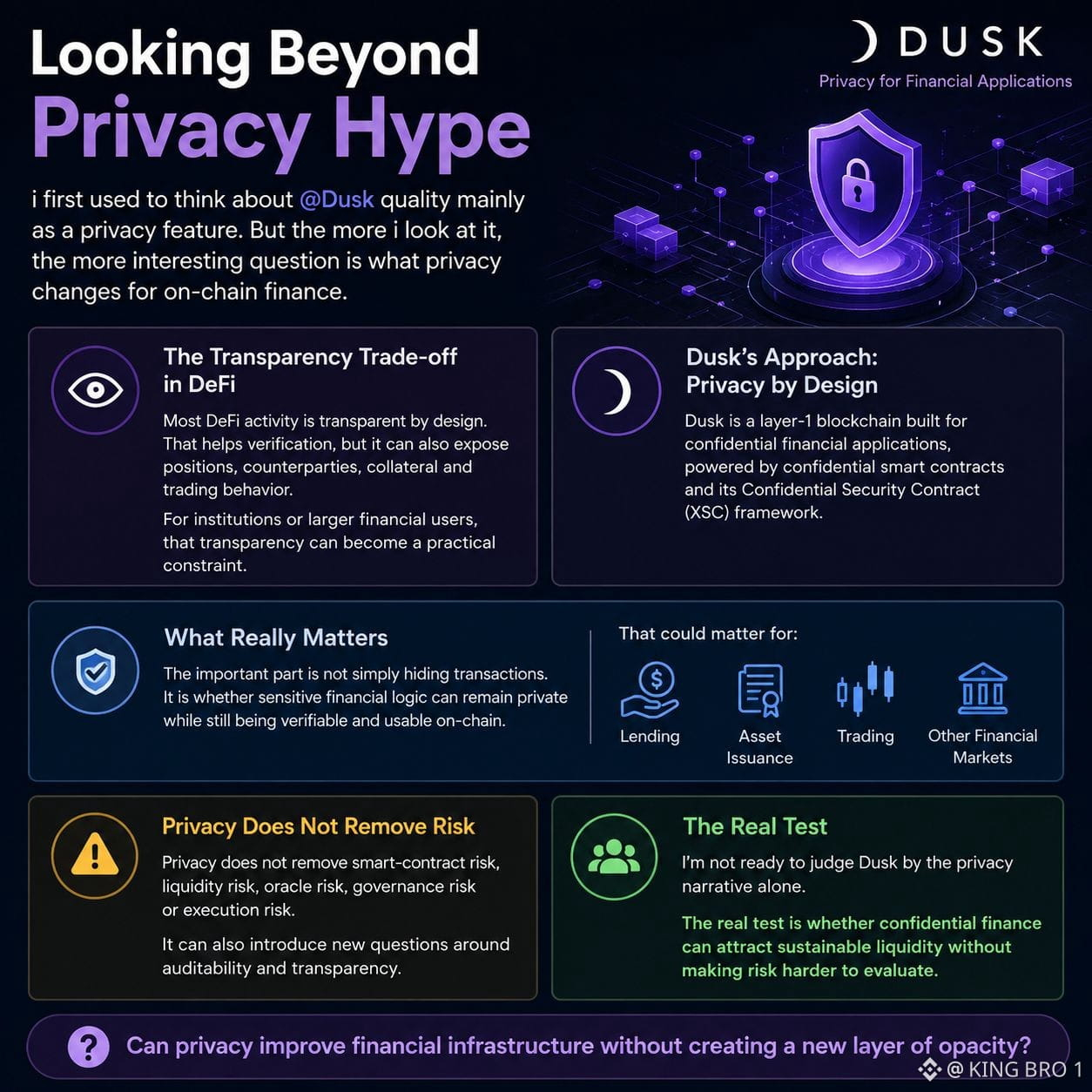

i first used to think about @Dusk quality mainly as a privacy feature. But the more i look at it, the more interesting question is what privacy changes for on-chain finance.
Most DeFi activity is transparent by design. That helps verification, but it can also expose positions, counterparties, collateral and trading behavior. For institutions or larger financial users, that transparency can become a practical constraint.
Dusk approaches this through a layer-1 designed for confidential financial applications, with confidential smart contracts and its Confidential Security Contract (XSC) framework.
The important part is not simply hiding transactions. It is whether sensitive financial logic can remain private while still being verifiable and usable on-chain.
That could matter for lending, asset issuance, trading and other financial markets where revealing every position is undesirable.
But privacy does not remove smart-contract risk, liquidity risk, oracle risk, governance risk or execution risk. It can also introduce new questions around auditability and transparency.
So i’m not ready to judge Dusk by the privacy narrative alone.
The real test is whether confidential finance can attract sustainable liquidity without making risk harder to evaluate.
Can privacy improve financial infrastructure without creating a new layer of opacity?
@Dusk #dusk $DUSK
Most DeFi activity is transparent by design. That helps verification, but it can also expose positions, counterparties, collateral and trading behavior. For institutions or larger financial users, that transparency can become a practical constraint.
Dusk approaches this through a layer-1 designed for confidential financial applications, with confidential smart contracts and its Confidential Security Contract (XSC) framework.
The important part is not simply hiding transactions. It is whether sensitive financial logic can remain private while still being verifiable and usable on-chain.
That could matter for lending, asset issuance, trading and other financial markets where revealing every position is undesirable.
But privacy does not remove smart-contract risk, liquidity risk, oracle risk, governance risk or execution risk. It can also introduce new questions around auditability and transparency.
So i’m not ready to judge Dusk by the privacy narrative alone.
The real test is whether confidential finance can attract sustainable liquidity without making risk harder to evaluate.
Can privacy improve financial infrastructure without creating a new layer of opacity?
@Dusk #dusk $DUSK