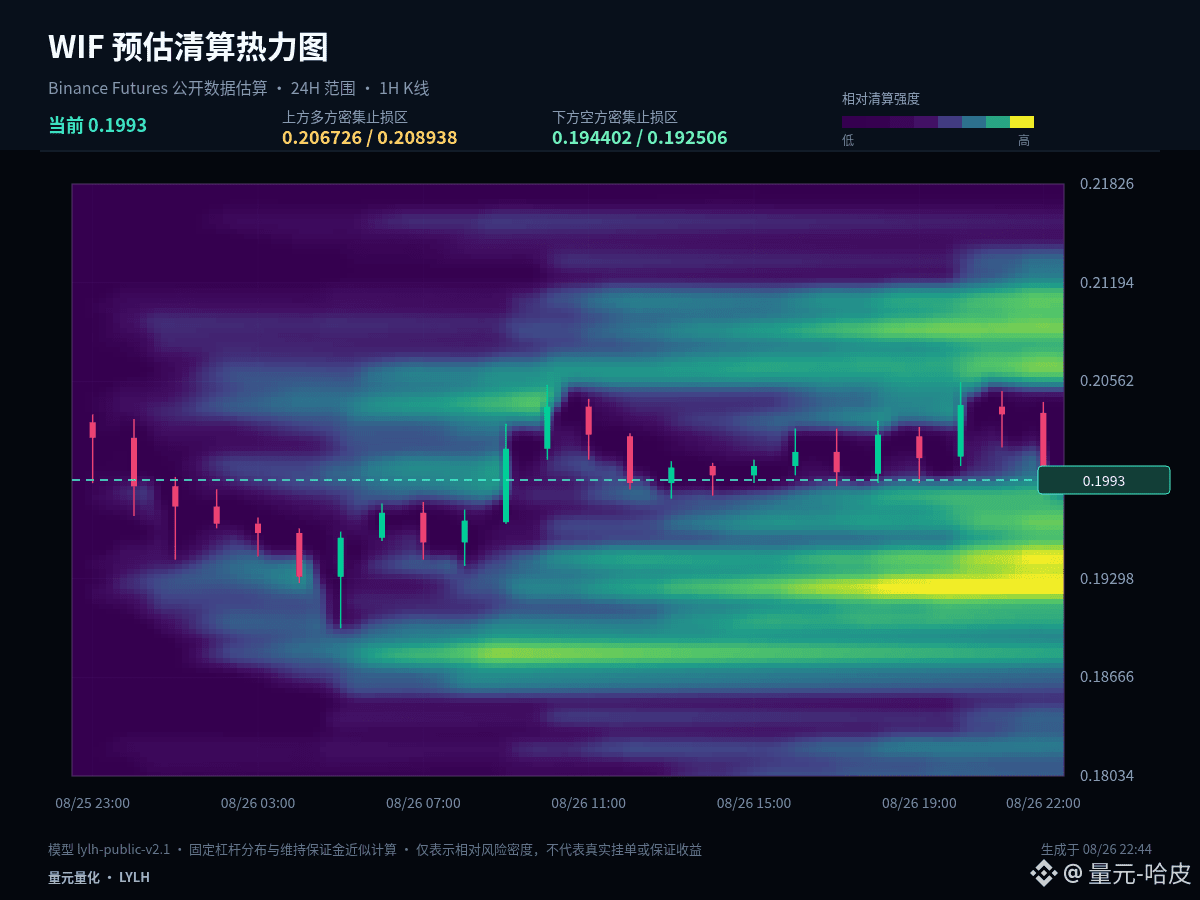
$WIF #WIF Current price 0.1993, 1 hour -2.11%, 24 hours -1.68%. Instead of setting longs or shorts first, it’s better to list the possible paths and the corresponding actions clearly.
Right now, the 1-hour (-2.11%) and 24-hour (-1.68%) cycles have not formed a sufficiently clear alignment in the same direction. In a range-bound market, the tolerance for chasing and killing trades is low. It’s more suitable to confirm the direction using the upper boundary, confirm the pullback using the lower boundary, and treat the midline only as a boundary between strength and weakness.
The first path is upward: the price needs to break above 0.2055 and form a stable close above it; only then does a subsequent retest that does not break confirm the move. The second path is downward: once 0.1899 is lost and any rebound fails to reclaim it, that indicates insufficient support. In that case, prioritize defense rather than rushing to add positions.
If the price continues to stay between 0.2055 and 0.1899, 0.1977 should only be used as a short-term reference for initiative. In the middle of the range there is no clear edge—don’t force entries just for the feeling of being involved. Wait for the market to show its direction.
For those who already have positions, the key is to manage based on whether support fails, rather than being carried around by every fluctuation. For those who are flat, prioritize waiting for a breakout with a retest or for support confirmation. For spot, you can scale in batches; for futures, you should shorten the decision chain—first set the stop-loss level, then decide whether to participate.
The focus of futures trading is not to predict every candlestick, but to ensure that entry, trimming, and exit all have a rationale. Do less without confirmation; if a key level fails, redo the plan. Control the risk of each trade first, then discuss the potential upside/downside later.
#KoreaMemoryChipStocksReverseLate
Right now, the 1-hour (-2.11%) and 24-hour (-1.68%) cycles have not formed a sufficiently clear alignment in the same direction. In a range-bound market, the tolerance for chasing and killing trades is low. It’s more suitable to confirm the direction using the upper boundary, confirm the pullback using the lower boundary, and treat the midline only as a boundary between strength and weakness.
The first path is upward: the price needs to break above 0.2055 and form a stable close above it; only then does a subsequent retest that does not break confirm the move. The second path is downward: once 0.1899 is lost and any rebound fails to reclaim it, that indicates insufficient support. In that case, prioritize defense rather than rushing to add positions.
If the price continues to stay between 0.2055 and 0.1899, 0.1977 should only be used as a short-term reference for initiative. In the middle of the range there is no clear edge—don’t force entries just for the feeling of being involved. Wait for the market to show its direction.
For those who already have positions, the key is to manage based on whether support fails, rather than being carried around by every fluctuation. For those who are flat, prioritize waiting for a breakout with a retest or for support confirmation. For spot, you can scale in batches; for futures, you should shorten the decision chain—first set the stop-loss level, then decide whether to participate.
The focus of futures trading is not to predict every candlestick, but to ensure that entry, trimming, and exit all have a rationale. Do less without confirmation; if a key level fails, redo the plan. Control the risk of each trade first, then discuss the potential upside/downside later.
#KoreaMemoryChipStocksReverseLate