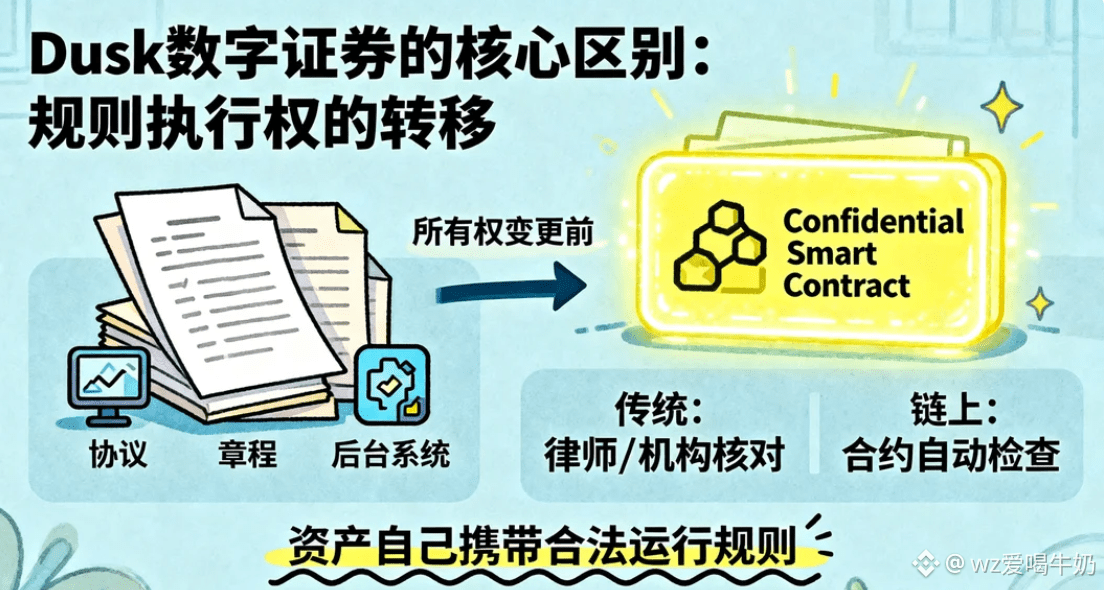
When I looked at Dusk’s Digital Share Registry this time, what truly felt interesting wasn’t “putting stocks on-chain,” but a tougher detail: why does Dusk make the smart contract execute the rights and obligations written in the shareholder agreement again before any ownership change?
In traditional equity registries, the rules are written into the agreement, the bylaws, and the backend systems.
After moving to the chain, what Dusk wants to do isn’t simply to copy these documents onto the blockchain to store them, but to put the shareholders’ rights and obligations directly into the Confidential Smart Contract that manages the shares. The official documentation explicitly states that before ownership changes, the contract can first check these rules, and only if the conditions are met will it write the new share status into the registry.
What really changes here isn’t “where the records are,” but “who ensures the rules are actually executed.”
I think this distinction is crucial.
If the rules are only written in documents, then after a transfer, you still have to rely on lawyers, the registry organization, and backend staff to verify them.
If the rules are inside the asset itself, the transfer action and the rule checks can be placed into the same process.
For the issuer, that means less repeated reconciliation and manual verification.
For shareholders, it means clearer boundaries of rights: which transfers can be made, and which cannot be done when conditions aren’t satisfied.
But the trade-off is here too.
Once the rules are written into the contract, updating the rules and handling exceptions are no longer just a matter of changing a single document—they will involve already deployed asset systems.
And I think that’s exactly what makes Dusk’s digital securities truly different:
It’s not trying to replicate securities as tokens—it’s attempting to make the securities themselves carry some of the rules for how they can legally run.
If what you hold is a typical crypto asset, of course I want transfers to be as free as possible.
But if it represents real equity, would you rather keep the rules in the contract—or have the asset itself execute the rules at the time of transfer? @Dusk
#dusk $DUSK
In traditional equity registries, the rules are written into the agreement, the bylaws, and the backend systems.
After moving to the chain, what Dusk wants to do isn’t simply to copy these documents onto the blockchain to store them, but to put the shareholders’ rights and obligations directly into the Confidential Smart Contract that manages the shares. The official documentation explicitly states that before ownership changes, the contract can first check these rules, and only if the conditions are met will it write the new share status into the registry.
What really changes here isn’t “where the records are,” but “who ensures the rules are actually executed.”
I think this distinction is crucial.
If the rules are only written in documents, then after a transfer, you still have to rely on lawyers, the registry organization, and backend staff to verify them.
If the rules are inside the asset itself, the transfer action and the rule checks can be placed into the same process.
For the issuer, that means less repeated reconciliation and manual verification.
For shareholders, it means clearer boundaries of rights: which transfers can be made, and which cannot be done when conditions aren’t satisfied.
But the trade-off is here too.
Once the rules are written into the contract, updating the rules and handling exceptions are no longer just a matter of changing a single document—they will involve already deployed asset systems.
And I think that’s exactly what makes Dusk’s digital securities truly different:
It’s not trying to replicate securities as tokens—it’s attempting to make the securities themselves carry some of the rules for how they can legally run.
If what you hold is a typical crypto asset, of course I want transfers to be as free as possible.
But if it represents real equity, would you rather keep the rules in the contract—or have the asset itself execute the rules at the time of transfer? @Dusk
#dusk $DUSK