This time when I read Dusk’s development documentation, it wasn’t ZK or privacy that made me stop.
It was a small interface detail:
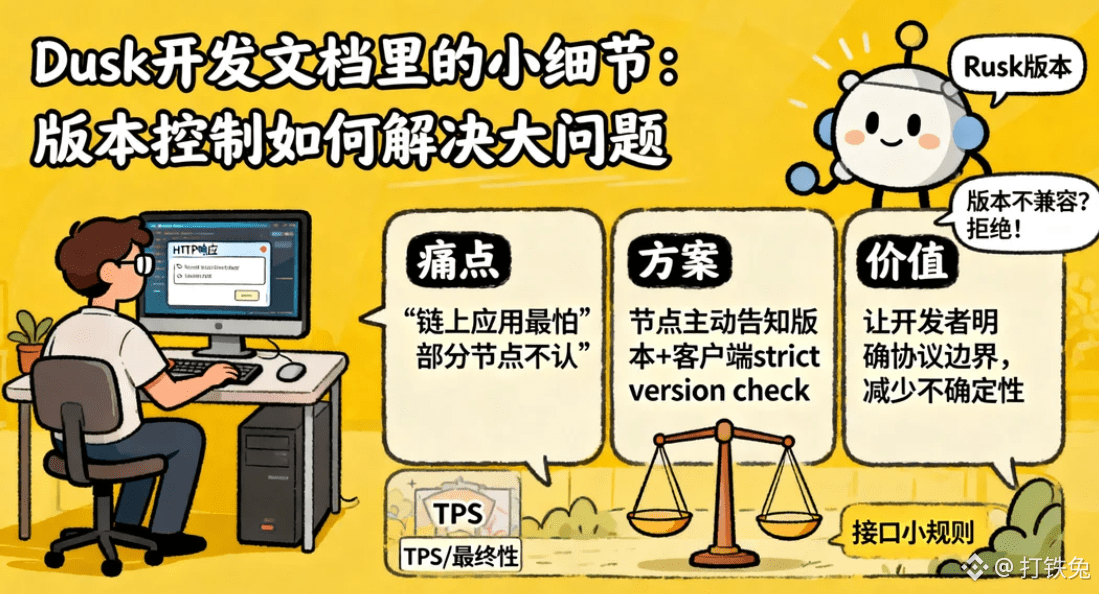
**A node will tell the client its own Rusk version, and the client can also proactively request a supported version range.**
If the versions aren’t compatible, it just rejects the request.
At first glance, this has nothing to do with the big blockchain narratives.
But once I put it into a real development workflow, I found it pretty interesting.
Because what most on-chain applications fear isn’t that the interface is a bit slow.
It’s this:
Today it works, and after an upgrade, suddenly you start seeing “some nodes recognize it, while others don’t.”
If developers don’t know what version the node they’re connected to is actually running, it’s hard to tell whether the issue comes from the code, the node, or the protocol itself.
Now Dusk puts this version information directly into the HTTP response, and also allows the client to do a strict version check.
In the past, I was more used to judging whether an L1 is usable by its TPS and finality.
But now I feel that these small interface-layer rules reveal whether a network has seriously considered the kinds of problems developers will truly run into.
Because infrastructure fears more than complexity.
It fears **uncertainty**.
If an application depends on some node capability, and after a node upgrade the behavior changes, the most unfortunate party is often not the protocol team—but the applications that are already live.
So this version control, which looks very “engineer-like,” actually solves a very real problem:
It lets developers know exactly which set of protocol rules they’re talking to.
This is also something about Dusk that I think is worth studying.
A truly mature L1 isn’t just about getting the chain running.
It also has to make sure that when others connect, they know where the boundaries are.
#dusk $DUSK @Dusk