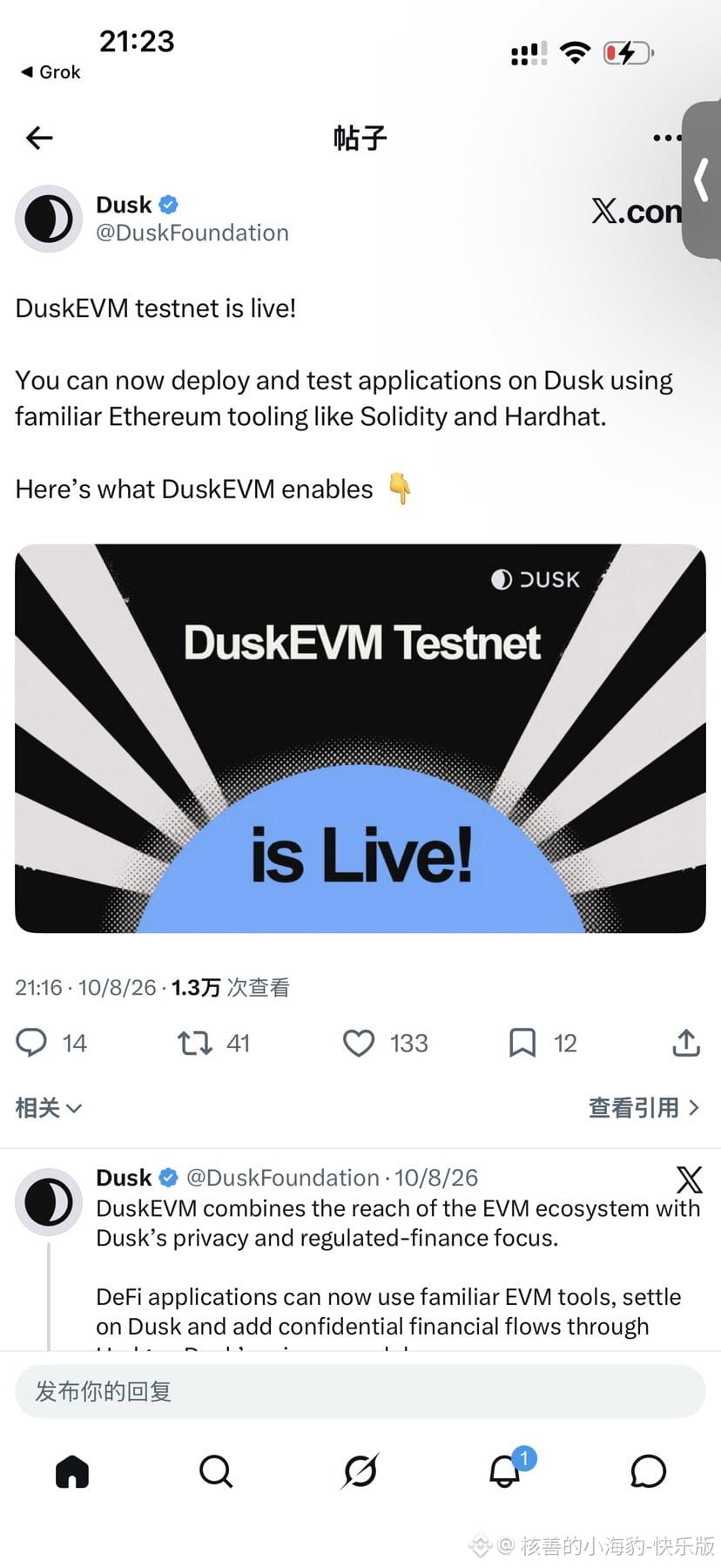

🔥🔥I tracked the progress of DuskEVM today for @Dusk , and the more I look, the more I feel this design is actually quite crucial for $DUSK token holders.
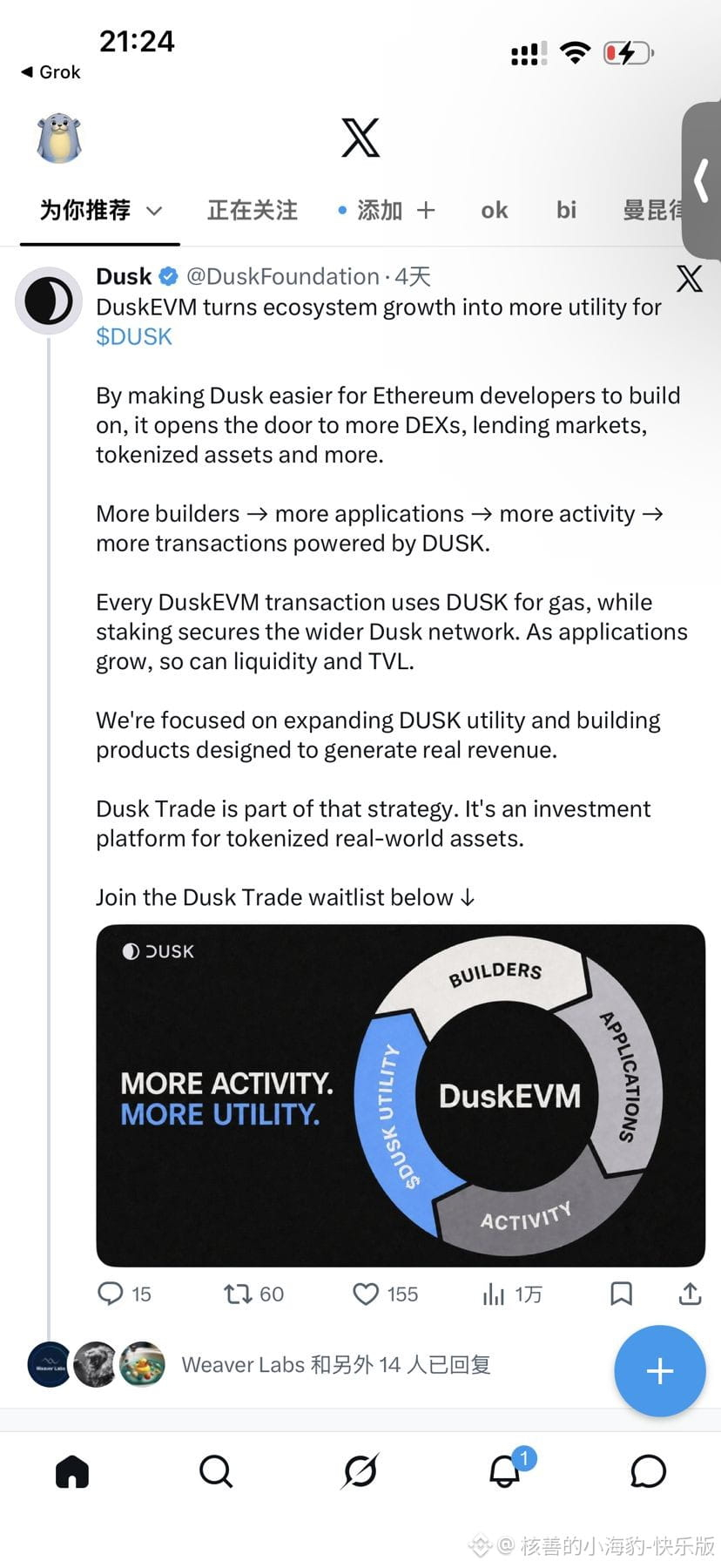
The official side has repeatedly emphasized one thing: DuskEVM’s Gas is paid directly with $DUSK , with no separate execution-layer token issued. Developers use Solidity and Hardhat to deploy applications; ultimately, the transactions they generate will flow back to the demand of $DUSK . More builders → more applications → more on-chain activity → more Dusk being used to pay Gas.
As a retired programmer, I find this logic clear in terms of design—I fully agree. Many on-chain EVM layers will issue another set of Gas tokens, splitting the demand into two halves, and in the end the native coin and the execution-layer token end up competing for value. That’s what’s called “fragmentation.” @Dusk unifies execution demand under $DUSK . From my programmer perspective, it really feels clean and restrained.
But the problem is timing.
DuskEVM testnet went live in early August, and the official is also continuously pushing the idea that “EVM compatibility will open up the ecosystem.” However, to this day, the #dusk mainnet’s daily transaction volume still remains around just a couple hundred. The fact that the testnet can run doesn’t mean the mainnet will quickly have enough real applications and institutional transaction volume.
Between the testnet and the moment when the mainnet can truly generate enough Gas consumption to noticeably offset the daily newly minted supply, there’s a real vacuum period. At the moment, Dusk is still in the first emission phase: each block releases about 19.86 $DUSK . Roughly counting over 8,000+ blocks per day, the daily new issuance could reach around 170,000 DUSK. If that vacuum period is stretched too long—if activity doesn’t really ramp up—then $DUSK token holders will have to keep facing dilution pressure from this additional supply.
So, a clean design doesn’t mean it will be兑现—realized—immediately. I’ve also seen projects that rolled out EVM compatibility layers. For example, Evmos: when it launched in 2022, it marketed the “EVM + IBC” narrative, but its early inflation design was fairly aggressive. Developers came in, but real transaction volume and native token Gas consumption couldn’t really take off long-term. Emissions continued, and token holders had to bear it first.
So what I care about more is: how long will this much-anticipated DuskEVM demand engine likely take before it can truly pull on-chain activity up for the Dusk chain? Once @Dusk provides a clearer time window for the DuskEVM mainnet rollout, I’ll reassess this design’s actual impact on pulling $DUSK forward.
The official side has repeatedly emphasized one thing: DuskEVM’s Gas is paid directly with $DUSK , with no separate execution-layer token issued. Developers use Solidity and Hardhat to deploy applications; ultimately, the transactions they generate will flow back to the demand of $DUSK . More builders → more applications → more on-chain activity → more Dusk being used to pay Gas.
As a retired programmer, I find this logic clear in terms of design—I fully agree. Many on-chain EVM layers will issue another set of Gas tokens, splitting the demand into two halves, and in the end the native coin and the execution-layer token end up competing for value. That’s what’s called “fragmentation.” @Dusk unifies execution demand under $DUSK . From my programmer perspective, it really feels clean and restrained.
But the problem is timing.
DuskEVM testnet went live in early August, and the official is also continuously pushing the idea that “EVM compatibility will open up the ecosystem.” However, to this day, the #dusk mainnet’s daily transaction volume still remains around just a couple hundred. The fact that the testnet can run doesn’t mean the mainnet will quickly have enough real applications and institutional transaction volume.
Between the testnet and the moment when the mainnet can truly generate enough Gas consumption to noticeably offset the daily newly minted supply, there’s a real vacuum period. At the moment, Dusk is still in the first emission phase: each block releases about 19.86 $DUSK . Roughly counting over 8,000+ blocks per day, the daily new issuance could reach around 170,000 DUSK. If that vacuum period is stretched too long—if activity doesn’t really ramp up—then $DUSK token holders will have to keep facing dilution pressure from this additional supply.
So, a clean design doesn’t mean it will be兑现—realized—immediately. I’ve also seen projects that rolled out EVM compatibility layers. For example, Evmos: when it launched in 2022, it marketed the “EVM + IBC” narrative, but its early inflation design was fairly aggressive. Developers came in, but real transaction volume and native token Gas consumption couldn’t really take off long-term. Emissions continued, and token holders had to bear it first.
So what I care about more is: how long will this much-anticipated DuskEVM demand engine likely take before it can truly pull on-chain activity up for the Dusk chain? Once @Dusk provides a clearer time window for the DuskEVM mainnet rollout, I’ll reassess this design’s actual impact on pulling $DUSK forward.