There's a frosted glass partition at my accountant's office. From the waiting room you can see shapes moving, hear murmurs through the wall - but nothing readable. Only the person behind the desk, holding the right file, ever gets to see the actual numbers.
I kept thinking about that partition while reading how Hedger works on @Dusk DuskEVM. Most people hear "confidential smart contracts" and picture something sealed shut entirely - a vault nobody gets into, not even the people who'd need to.
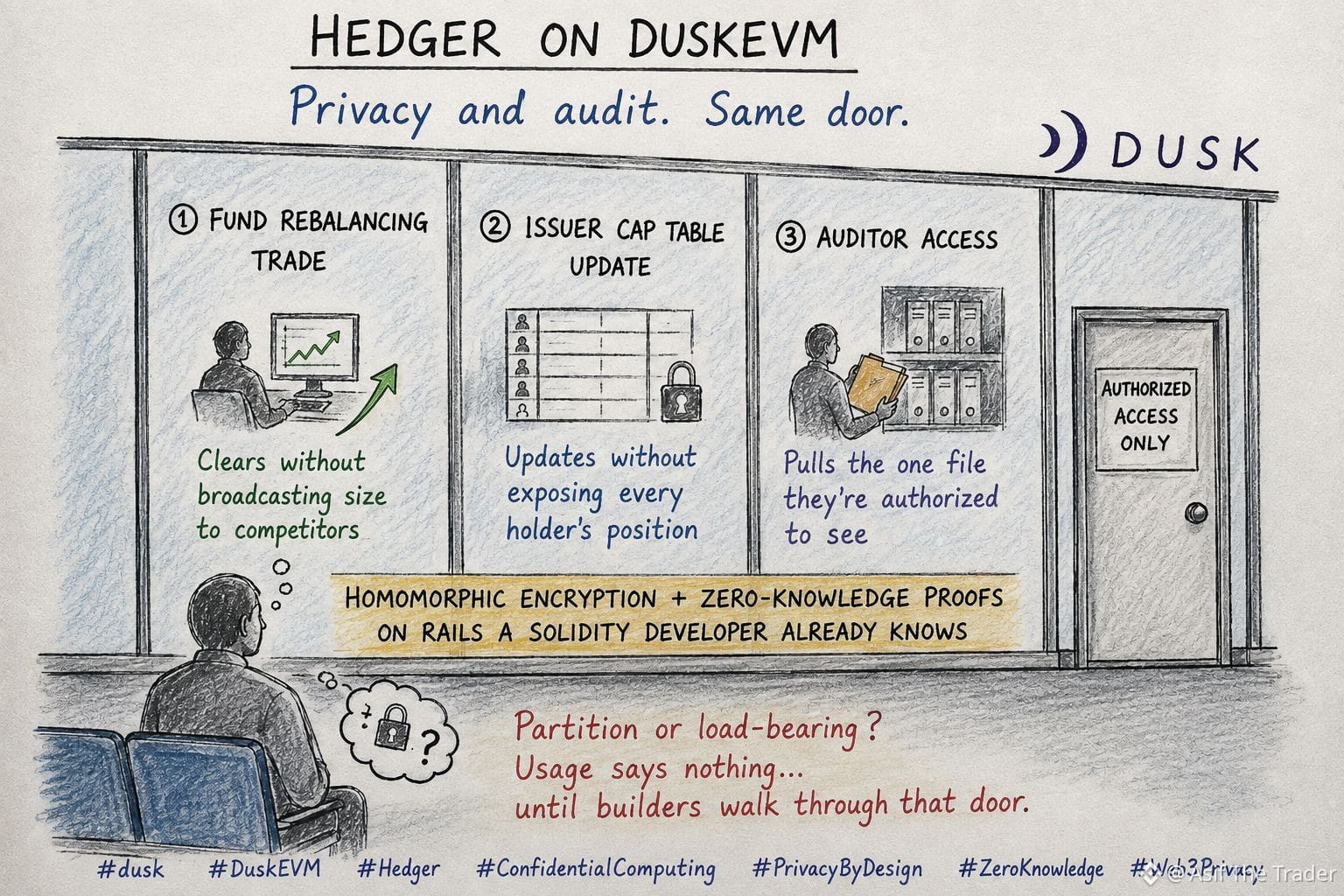
That's the part that sat with me longer than I expected. Hedger isn't one wall, it's the partition doing three jobs at once: a fund's rebalancing trade clears without broadcasting its size to competitors, an issuer's cap table updates without exposing every holder's position, an auditor pulls the one file they're authorized to see without touching the rest. Homomorphic encryption plus zero-knowledge proofs, running on rails a Solidity developer already knows. Privacy and audit aren't fighting each other here. They're routed through the same door.
What's easy to skip past is how early this still is. DuskEVM mainnet is arriving, Hedger is the pitch - but a pitch isn't the same as volume. Nobody's published how many contracts are actually live through it yet, or whether any regulated desk has routed real flow through the confidential path versus just testing it in a sandbox. "Reviewable privacy" is a strong claim to make before anyone's reviewed anything.
So is the partition actually load-bearing, or is it just glass hung on a frame, waiting for someone on the other side to show up? $DUSK usage says nothing until builders actually walk through that door. Not yet.
#dusk
I kept thinking about that partition while reading how Hedger works on @Dusk DuskEVM. Most people hear "confidential smart contracts" and picture something sealed shut entirely - a vault nobody gets into, not even the people who'd need to.
That's the part that sat with me longer than I expected. Hedger isn't one wall, it's the partition doing three jobs at once: a fund's rebalancing trade clears without broadcasting its size to competitors, an issuer's cap table updates without exposing every holder's position, an auditor pulls the one file they're authorized to see without touching the rest. Homomorphic encryption plus zero-knowledge proofs, running on rails a Solidity developer already knows. Privacy and audit aren't fighting each other here. They're routed through the same door.
What's easy to skip past is how early this still is. DuskEVM mainnet is arriving, Hedger is the pitch - but a pitch isn't the same as volume. Nobody's published how many contracts are actually live through it yet, or whether any regulated desk has routed real flow through the confidential path versus just testing it in a sandbox. "Reviewable privacy" is a strong claim to make before anyone's reviewed anything.
So is the partition actually load-bearing, or is it just glass hung on a frame, waiting for someone on the other side to show up? $DUSK usage says nothing until builders actually walk through that door. Not yet.
#dusk