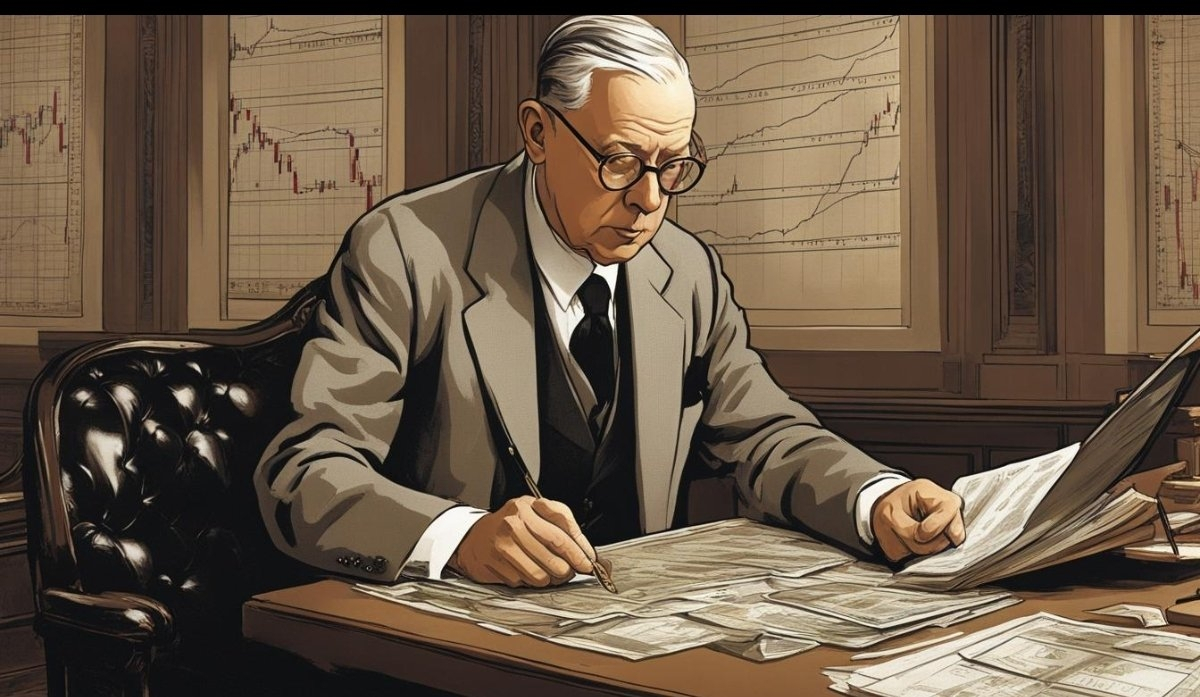
In 1907, the American markets saw one of the most dangerous financial crises in their history, known as the «Panic of 1907» or «Bankers’ Panic». Confidence collapsed, depositors rushed to withdraw their money from banks and credit companies, and stock prices on Wall Street plunged sharply. Amid this chaos, there was a young trader—barely over thirty—who quietly bet on the crash before it actually began.
✨His name was Jesse Livermore.✨
Background of the Crisis
Signs of weakness began to show in the markets as early as 1907, after years of credit expansion and speculation. A failed attempt by a group of speculators to control shares of «United Copper» led to the bankruptcy of some brokerage firms and sparked a wave of panic. The «Knickerbocker Trust» collapsed, and the contagion spread to banks and credit companies, leaving the stock market facing a severe shortage of liquidity. At that time, there was no central bank in the United States, so the crisis threatened the entire financial system.
In such circumstances, most traders and investors tried to save themselves or flee. Livermore, however—who began his career at fourteen, working as a boy who wrote prices on a chalkboard in brokerage offices in Boston—read the market differently. He relied on analyzing price behavior and overall economic conditions, and decided to conduct extensive short selling.
The day the legend was made.
Livermore kept increasing his short positions as the weakness worsened. On one of the peak days, he amassed more than a million dollars in a single day. That amount was unbelievable at the time, equivalent to tens of millions in today’s dollars. His profit wasn’t a coincidence or a fleeting stroke of luck—it was the result of a precise reading of the market and calculated timing.
After the crisis reached its peak, the legendary banker J. P. Morgan stepped in personally to save Wall Street, gathering top bankers and injecting liquidity to rescue the banks and companies. It was said that Morgan sent a message to Livermore asking him to stop short selling to preserve market and national stability. Livermore agreed: he closed his short positions, then switched to buying, benefiting from the subsequent rebound and raising his fortune to around three million dollars.
From the «Great Bear» to 💥the Legend💥
Livermore’s nickname after this deal was «The Great Bear of Wall Street» because he mastered profiting from declines more than many others mastered profiting from rises. His story became a symbol of the trader who thinks against the current—watching price behavior, liquidity, and overall conditions instead of being swept along by collective emotions.
But Jesse Livermore’s life was not just a string of wins. He gained and lost fortunes several times over the course of his career, including massive profits during the 1929 crash. His life ended tragically, yet his lessons in risk management, patience, and independent reading of the market remained alive in books such as «Reminiscences of a Stock Operator».
The Panic of 1907 was not just a passing financial crisis; it directly helped create the U.S. Federal Reserve System in 1913. And Jesse Livermore proved that year that a real trader doesn’t fear a crash—he reads it and prepares for it.
The story of a man in his thirties who made a million dollars in a single day betting on a crash… it remains one of the most inspiring and thrilling tales in the history of markets.
What do you think? Share your opinions with us, please—not as an obligation.