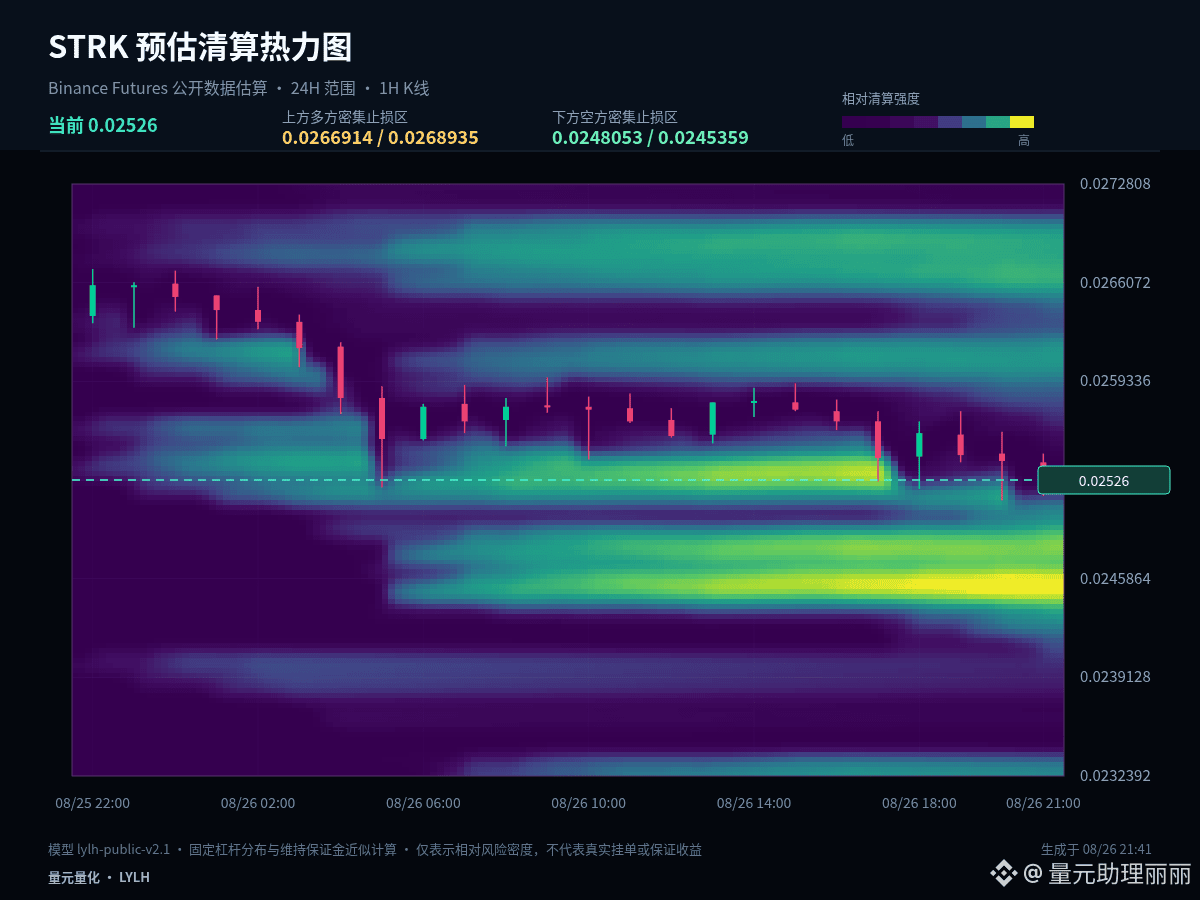
$STRK #STRK This time, we break down the market from a position perspective. The same chart shows different key points depending on whether you already have a position or are in cash. Current price: 0.02528. 1 hour: -0.43%, 24 hours: -4.64%.
The current price is close to the lower end of the past 24-hour range: 1 hour -0.43%, 24 hours -4.64%. The core of low-level analysis is not trying to bottom-pick early, but observing whether it can quickly rebound after a breakdown. If it can rebound, it indicates sell pressure is being absorbed. If it remains below the lower end for a prolonged period, it means weakness likely hasn’t ended yet.
For holders of positions, watch whether 0.02515 is lost. If it breaks, reduce risk exposure first. For those in cash, wait for the low to stop moving lower, and confirm that the price returns above 0.025915—do not catch falling structures prematurely.
Execution requires clear conditions. After a breakout above 0.02668, you need confirmation—not simply chasing because of a momentary surge. After a dip to 0.02515, you need to see whether it can quickly rebound—not automatically buy just because it looks bearish. When the middle zone doesn’t offer sufficient reward-to-risk, waiting itself is part of the strategy.
Positioning must distinguish between spot and futures. Existing spot positions can be managed in stages around key levels without frequently flipping direction based on a single 1-hour candlestick. Those in cash can be more composed when scaling in after confirmation. Futures matter more about entry location and invalidation conditions; when volatility increases, actively reduce position size to prevent short-term judgments from turning into passive holding.
Risk control still comes before the conclusion: execute only when conditions are met; if the price invalidates the setup, reassess promptly. The greater the volatility, the more restrained each position should be. The above is a scenario walkthrough based on current 1-hour and 24-hour data, and does not constitute a promise of returns.
#USIranReportedlyReachCeasefireConsensus
The current price is close to the lower end of the past 24-hour range: 1 hour -0.43%, 24 hours -4.64%. The core of low-level analysis is not trying to bottom-pick early, but observing whether it can quickly rebound after a breakdown. If it can rebound, it indicates sell pressure is being absorbed. If it remains below the lower end for a prolonged period, it means weakness likely hasn’t ended yet.
For holders of positions, watch whether 0.02515 is lost. If it breaks, reduce risk exposure first. For those in cash, wait for the low to stop moving lower, and confirm that the price returns above 0.025915—do not catch falling structures prematurely.
Execution requires clear conditions. After a breakout above 0.02668, you need confirmation—not simply chasing because of a momentary surge. After a dip to 0.02515, you need to see whether it can quickly rebound—not automatically buy just because it looks bearish. When the middle zone doesn’t offer sufficient reward-to-risk, waiting itself is part of the strategy.
Positioning must distinguish between spot and futures. Existing spot positions can be managed in stages around key levels without frequently flipping direction based on a single 1-hour candlestick. Those in cash can be more composed when scaling in after confirmation. Futures matter more about entry location and invalidation conditions; when volatility increases, actively reduce position size to prevent short-term judgments from turning into passive holding.
Risk control still comes before the conclusion: execute only when conditions are met; if the price invalidates the setup, reassess promptly. The greater the volatility, the more restrained each position should be. The above is a scenario walkthrough based on current 1-hour and 24-hour data, and does not constitute a promise of returns.
#USIranReportedlyReachCeasefireConsensus