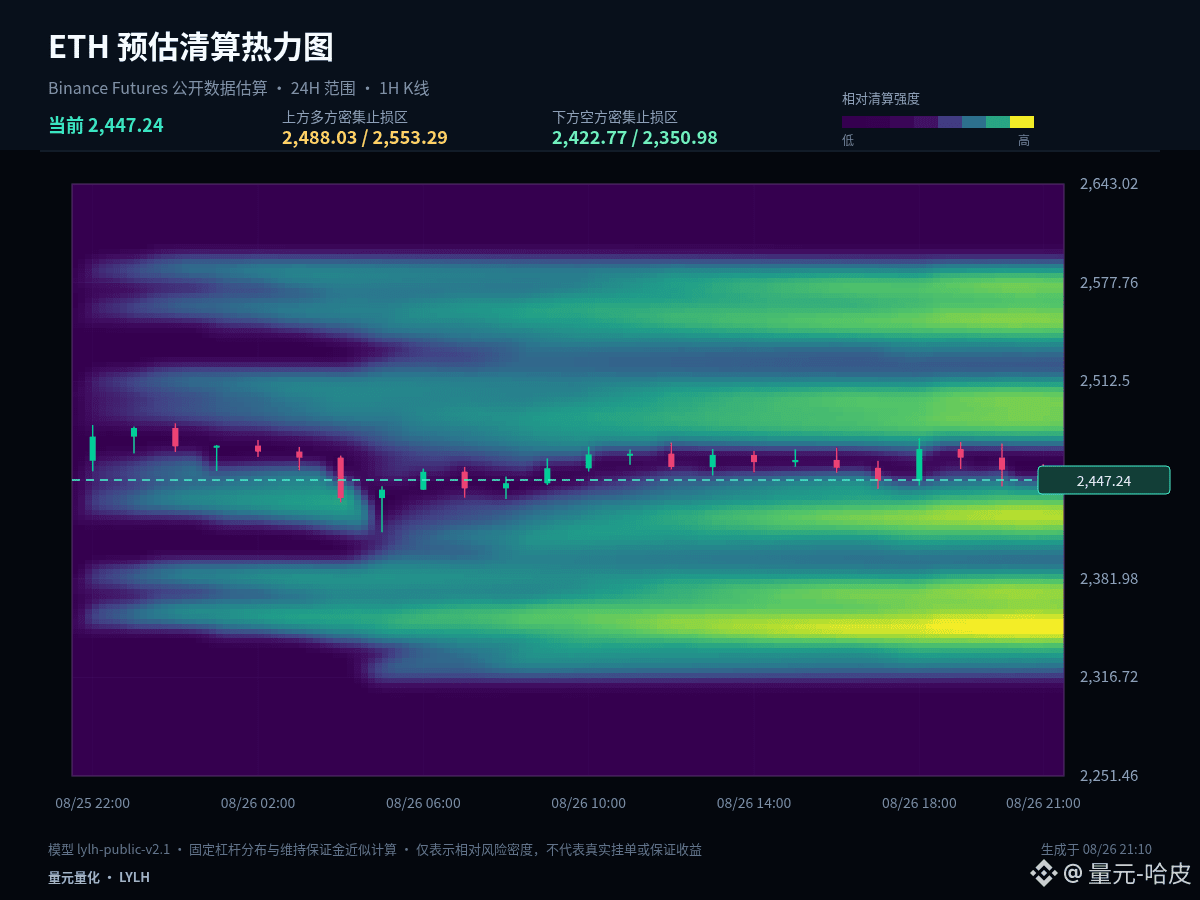
$ETH #ETH Over the past 24 hours, the high-low amplitude is about 2.9%, and the current price is 2,445.15. This is not a calm range suitable for opening a position on a whim. When volatility expands, you should first adjust your position size, then discuss direction.
$ETH #ETH A clear one-way trend has not formed yet; the 1-hour and 24-hour rhythms are still tugging at each other. At this stage, focus on the range boundaries rather than the color of every single candlestick.
For the moment, the 1-hour change is -0.40% and the 24-hour change is -0.91%. The two cycles have not yet formed sufficiently clear alignment in the same direction. In range-bound conditions, the tolerance for chasing and killing trades is lower. It’s more suitable to use upper-bound confirmation for direction and lower-bound confirmation for acceptance, with the midline only serving as the line separating strength and weakness.
For key price levels, 2,450.12 is the midline that weak repair must reclaim. If price cannot move back above and hold here, any rebound should still be treated as a technical repair. Below that, 2,414.64 still has the potential to be tested again. Only after reclaiming the midline is it worth further observing 2,485.6.
In high-volatility phases, the execution principles are to reduce single-trade exposure, avoid repeatedly chasing prices back and forth in the middle of the range, and write the invalidation conditions before entering. If the market does not provide confirmation, it’s better to do less than to compensate for uncertainty with a larger position size.
There are three ways the next path can be handled: if price holds effectively above 2,485.6 and you wait to reassess after a pullback that does not break; if price breaks down below 2,414.64, prioritize risk control and wait for new support; if it continues to oscillate around 2,450.12, treat it as turnover within the range and don’t repeatedly chase direction in the middle.
The focus of the contract is not to predict every candlestick, but to ensure there is a basis for entry, reducing exposure, and exiting. If there’s no confirmation, do less. If key levels fail, redo the plan. Control single-trade risk first, then talk about the potential ahead.
#USIranReportedlyReachCeasefireConsensus
$ETH #ETH A clear one-way trend has not formed yet; the 1-hour and 24-hour rhythms are still tugging at each other. At this stage, focus on the range boundaries rather than the color of every single candlestick.
For the moment, the 1-hour change is -0.40% and the 24-hour change is -0.91%. The two cycles have not yet formed sufficiently clear alignment in the same direction. In range-bound conditions, the tolerance for chasing and killing trades is lower. It’s more suitable to use upper-bound confirmation for direction and lower-bound confirmation for acceptance, with the midline only serving as the line separating strength and weakness.
For key price levels, 2,450.12 is the midline that weak repair must reclaim. If price cannot move back above and hold here, any rebound should still be treated as a technical repair. Below that, 2,414.64 still has the potential to be tested again. Only after reclaiming the midline is it worth further observing 2,485.6.
In high-volatility phases, the execution principles are to reduce single-trade exposure, avoid repeatedly chasing prices back and forth in the middle of the range, and write the invalidation conditions before entering. If the market does not provide confirmation, it’s better to do less than to compensate for uncertainty with a larger position size.
There are three ways the next path can be handled: if price holds effectively above 2,485.6 and you wait to reassess after a pullback that does not break; if price breaks down below 2,414.64, prioritize risk control and wait for new support; if it continues to oscillate around 2,450.12, treat it as turnover within the range and don’t repeatedly chase direction in the middle.
The focus of the contract is not to predict every candlestick, but to ensure there is a basis for entry, reducing exposure, and exiting. If there’s no confirmation, do less. If key levels fail, redo the plan. Control single-trade risk first, then talk about the potential ahead.
#USIranReportedlyReachCeasefireConsensus