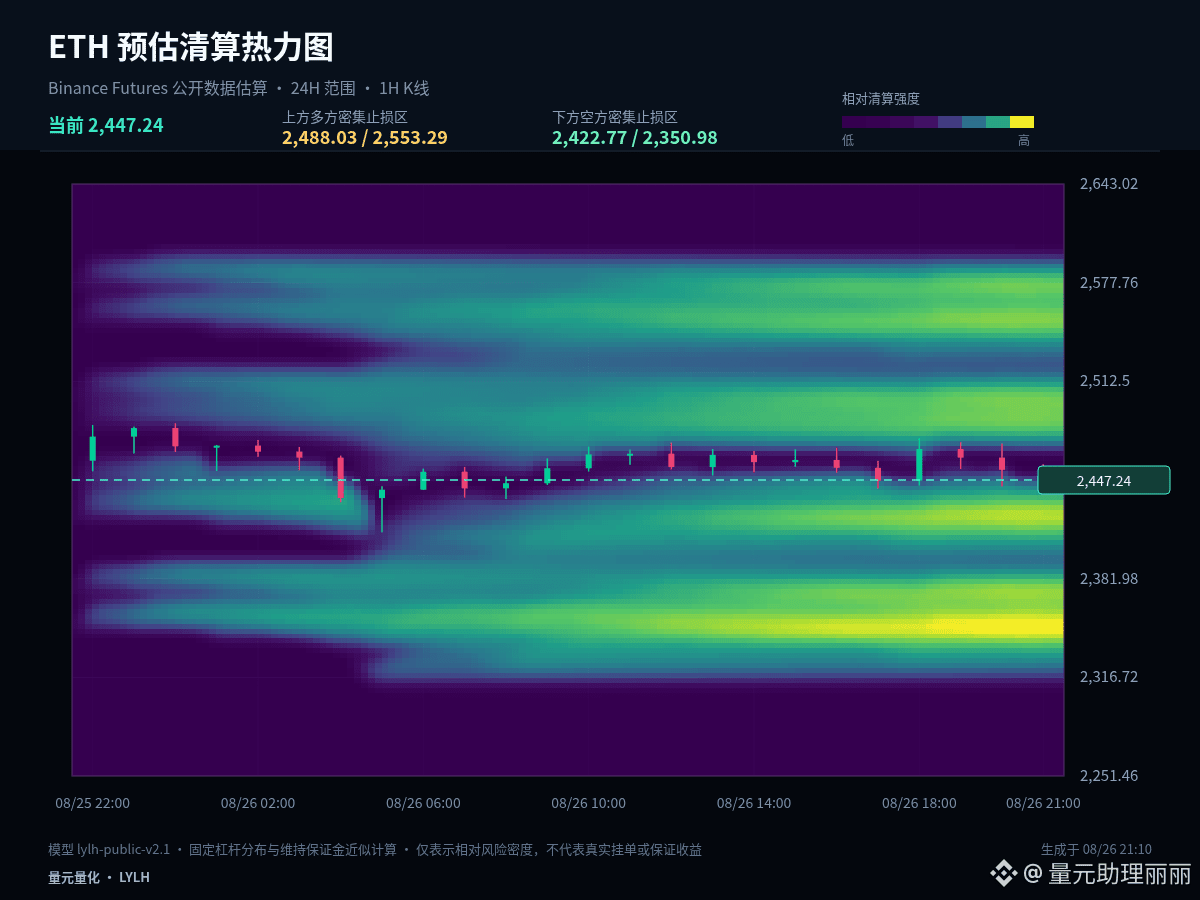
$ETH #ETH In a strong market trend, pullbacks often reveal the true underlying support better than rapid upward moves. The current 1-hour change is -0.30%, and the 24-hour change is -1.02%. We need to judge whether this is a normal cooldown or a weakening structure.
The current 1-hour change is -0.30% and the 24-hour change is -1.02%. The two timeframes have not formed a sufficiently clear same-direction alignment. In a ranging market, chasing strength and selling weakness has a low margin for error. It is better to use the upper boundary to confirm direction, the lower boundary to confirm support, and the midline only as the dividing line between strength and weakness.
A pullback has already appeared on the 1-hour chart, so first watch whether 2,414.64 forms stable support. If price can quickly recover above 2,450.12, it means the pullback is still controllable; if the rebound is weak and the lows continue to move lower, then the strong-trend logic can no longer be used.
My projection does not rely on a single direction. If price breaks above 2,485.6 and can hold there, it means the upside space has reopened; if it falls below 2,414.64 and fails to rebound, it means the structure is weakening further; if it trades between the two, continue to observe the closing behavior on both sides of 2,450.12.
For those already holding positions, the focus is on managing based on whether support fails, rather than being driven by every fluctuation; for those with no position, priority should be given to waiting for a breakout retest or support confirmation. Spot positions can be built in stages, while contracts should shorten the decision chain: first determine the stop-loss level, then decide whether to participate.
A trading plan must include invalidation conditions. If your judgment is correct, you can take profits in stages; if it is wrong, you must allow yourself to exit. You cannot use adding to a position to cover up the fact that the original logic has already changed. The market will update, and your view should also adjust based on price evidence.
#KoreaMemoryChipStocksReverseLate
The current 1-hour change is -0.30% and the 24-hour change is -1.02%. The two timeframes have not formed a sufficiently clear same-direction alignment. In a ranging market, chasing strength and selling weakness has a low margin for error. It is better to use the upper boundary to confirm direction, the lower boundary to confirm support, and the midline only as the dividing line between strength and weakness.
A pullback has already appeared on the 1-hour chart, so first watch whether 2,414.64 forms stable support. If price can quickly recover above 2,450.12, it means the pullback is still controllable; if the rebound is weak and the lows continue to move lower, then the strong-trend logic can no longer be used.
My projection does not rely on a single direction. If price breaks above 2,485.6 and can hold there, it means the upside space has reopened; if it falls below 2,414.64 and fails to rebound, it means the structure is weakening further; if it trades between the two, continue to observe the closing behavior on both sides of 2,450.12.
For those already holding positions, the focus is on managing based on whether support fails, rather than being driven by every fluctuation; for those with no position, priority should be given to waiting for a breakout retest or support confirmation. Spot positions can be built in stages, while contracts should shorten the decision chain: first determine the stop-loss level, then decide whether to participate.
A trading plan must include invalidation conditions. If your judgment is correct, you can take profits in stages; if it is wrong, you must allow yourself to exit. You cannot use adding to a position to cover up the fact that the original logic has already changed. The market will update, and your view should also adjust based on price evidence.
#KoreaMemoryChipStocksReverseLate