Went down a $DUSK rabbit hole this weekend. Brain hurts. But I keep circling back to their consensus—not the ZK privacy stuff everyone's hyping.
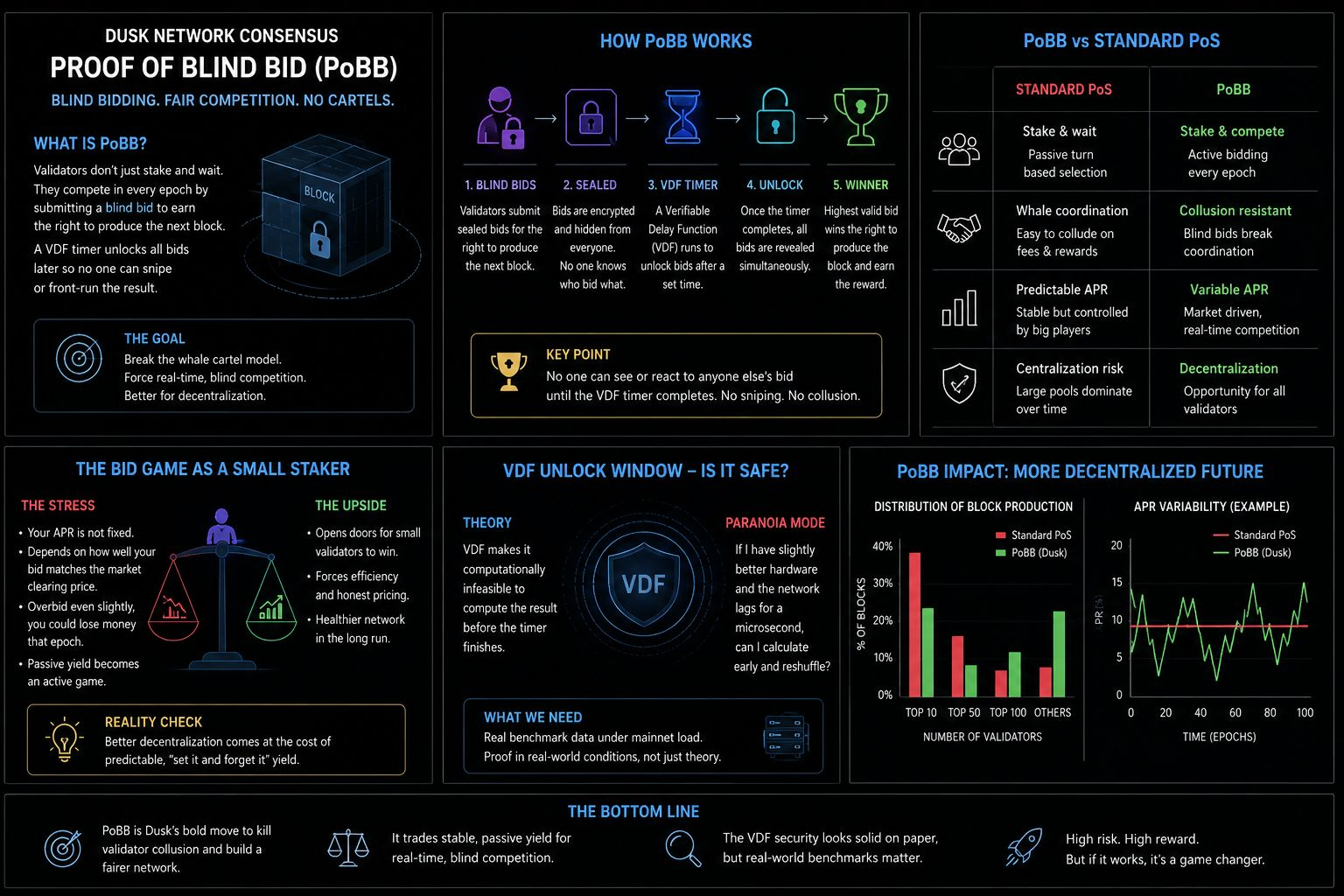
So, "Proof of Blind Bid" (PoBB). You don't just stake and passively wait for your turn. You actually have to bid blind against every other validator for the right to produce that block. A VDF timer unlocks the bids later so no one can snipe.
Here's where my brain got stuck: this basically breaks the standard "whale cartel" playbook entirely. On most PoS chains, the big pools just coordinate fee percentages and split the pie. No drama. But with sealed bids? You can't trust the other guy's promise because you can't see his bid until the clock runs out. It forces real-time, blind competition.
But man... as a small staker, isn't that kinda stressful? Your APR isn't a stable, boring number anymore. It fluctuates based on whether your validator guessed the market clearing price right that epoch. Overbid even a little and poof—they're actually losing money on that block. Passive yield just turned into a guessing game. Is that better for decentralization? Probably. But try explaining this to your friends who just want to park their USDC and chill.
Also, I’m slightly paranoid about that VDF unlock window. The docs say it's computationally infeasible to cheat, but if I've got slightly better hardware and the network lags for a microsecond, can I calculate the outcome early and reshuffle? I’d kill to see actual benchmark data under mainnet load instead of just the theoretical math.
Idk, maybe I'm reading too much into it. But it feels like they deliberately sacrificed "set it and forget it" yield to kill validator collusion. Refreshing, but definitely a wild bet. Anyone here actually run a node on their testnet? Curious how sweaty that bid window actually feels in real-time.
@Dusk #dusk #DUSK $DUSK
So, "Proof of Blind Bid" (PoBB). You don't just stake and passively wait for your turn. You actually have to bid blind against every other validator for the right to produce that block. A VDF timer unlocks the bids later so no one can snipe.
Here's where my brain got stuck: this basically breaks the standard "whale cartel" playbook entirely. On most PoS chains, the big pools just coordinate fee percentages and split the pie. No drama. But with sealed bids? You can't trust the other guy's promise because you can't see his bid until the clock runs out. It forces real-time, blind competition.
But man... as a small staker, isn't that kinda stressful? Your APR isn't a stable, boring number anymore. It fluctuates based on whether your validator guessed the market clearing price right that epoch. Overbid even a little and poof—they're actually losing money on that block. Passive yield just turned into a guessing game. Is that better for decentralization? Probably. But try explaining this to your friends who just want to park their USDC and chill.
Also, I’m slightly paranoid about that VDF unlock window. The docs say it's computationally infeasible to cheat, but if I've got slightly better hardware and the network lags for a microsecond, can I calculate the outcome early and reshuffle? I’d kill to see actual benchmark data under mainnet load instead of just the theoretical math.
Idk, maybe I'm reading too much into it. But it feels like they deliberately sacrificed "set it and forget it" yield to kill validator collusion. Refreshing, but definitely a wild bet. Anyone here actually run a node on their testnet? Curious how sweaty that bid window actually feels in real-time.
@Dusk #dusk #DUSK $DUSK