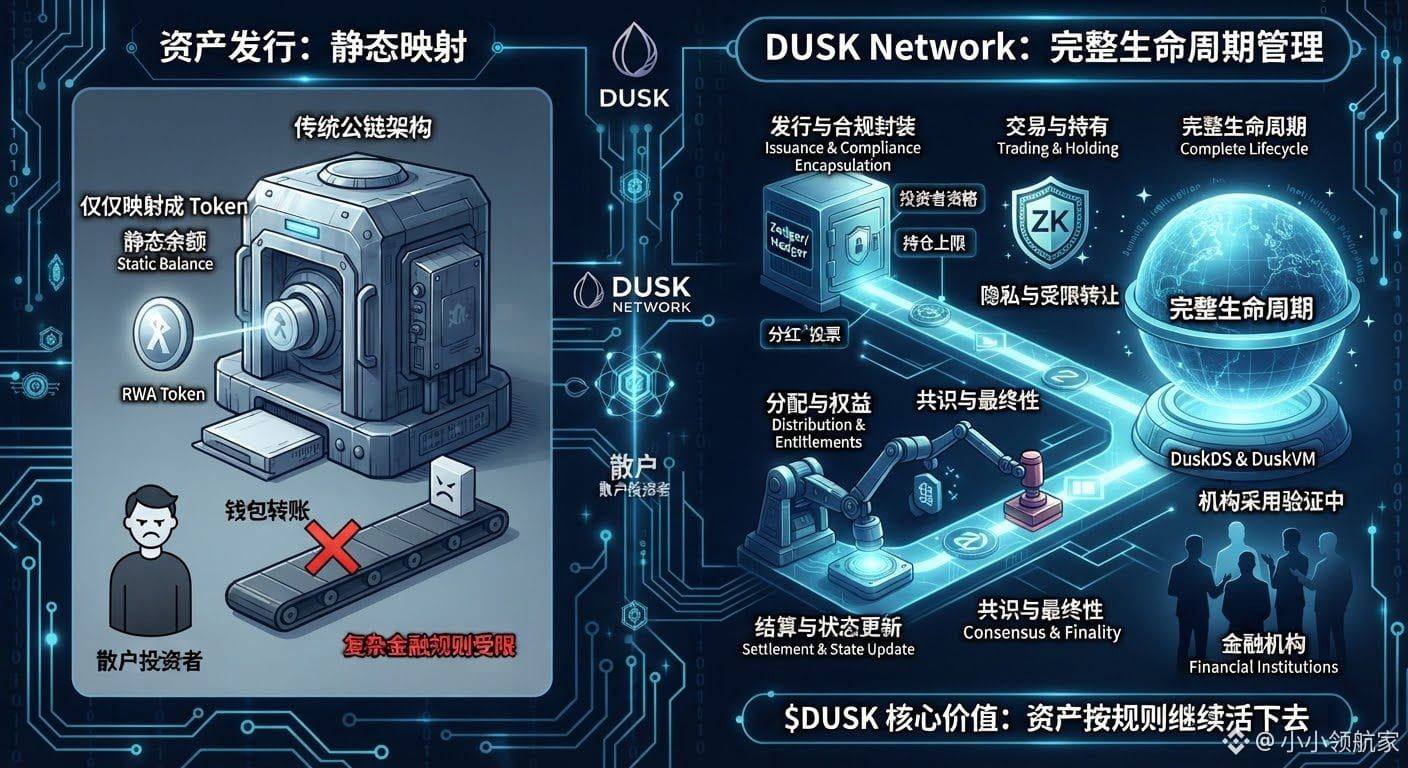
There’s one thing about Dusk I’m paying more attention to right now: after complex assets are tokenized and put on-chain, who manages their “lifecycle”?
When I re-read the materials for @Dusk , I noticed an angle that’s easy to overlook: once a financial asset truly enters the chain, the real challenge isn’t issuing a Token—it’s what happens after that Token exists.
Bonds mature, funds distribute dividends, securities may have position limits and transfer conditions, and investor eligibility can also change. In other words, a financial asset isn’t a static balance—it’s a constantly evolving set of states.
What I find particularly interesting about Dusk is that it doesn’t treat the problem as simply “asset issuance + wallet transfers.” In the official architecture, DuskDS is responsible for consensus, finality, data availability, and settlement; DuskVM runs Rust/WASM contracts directly on L1; and DuskEVM provides the EVM execution environment. That creates a fairly clear path between asset logic and final settlement. 
Going deeper, Zedger’s design explains this approach even better. From the early stage, it was built with securities-style scenarios in mind—account capabilities, privacy, dividends, voting, and restricted asset transfers. Now Dusk’s documentation also places Zedger/Hedger in the application layer for regulated asset issuance and management. 
That’s what led me to rethink what people mean by RWA.
If you only map real-world assets into Tokens, you’ve actually completed just the first step. What really matters is: after the asset changes, who can operate it, what rules they must follow, how the state gets updated, and how the final outcome is determined.
So when I look at $DUSK now, I’m less interested in how many features it adds, and more focused on whether it can manage the asset end-to-end—from “being issued” through the full lifecycle of “trading, holding, distributing, and settling.”
Of course, protocol design is only the starting point. Real-world adoption by institutions, developers’ usage, and long-term operational safety still need to be validated.
But at least from the architectural direction, what Dusk has helped me see isn’t just “putting financial assets on-chain.” It’s an attempt to answer a more difficult question: after an asset is on-chain, can it truly keep living according to the rules of the financial asset itself? #dusk
#dusk $DUSK @Dusk
When I re-read the materials for @Dusk , I noticed an angle that’s easy to overlook: once a financial asset truly enters the chain, the real challenge isn’t issuing a Token—it’s what happens after that Token exists.
Bonds mature, funds distribute dividends, securities may have position limits and transfer conditions, and investor eligibility can also change. In other words, a financial asset isn’t a static balance—it’s a constantly evolving set of states.
What I find particularly interesting about Dusk is that it doesn’t treat the problem as simply “asset issuance + wallet transfers.” In the official architecture, DuskDS is responsible for consensus, finality, data availability, and settlement; DuskVM runs Rust/WASM contracts directly on L1; and DuskEVM provides the EVM execution environment. That creates a fairly clear path between asset logic and final settlement. 
Going deeper, Zedger’s design explains this approach even better. From the early stage, it was built with securities-style scenarios in mind—account capabilities, privacy, dividends, voting, and restricted asset transfers. Now Dusk’s documentation also places Zedger/Hedger in the application layer for regulated asset issuance and management. 
That’s what led me to rethink what people mean by RWA.
If you only map real-world assets into Tokens, you’ve actually completed just the first step. What really matters is: after the asset changes, who can operate it, what rules they must follow, how the state gets updated, and how the final outcome is determined.
So when I look at $DUSK now, I’m less interested in how many features it adds, and more focused on whether it can manage the asset end-to-end—from “being issued” through the full lifecycle of “trading, holding, distributing, and settling.”
Of course, protocol design is only the starting point. Real-world adoption by institutions, developers’ usage, and long-term operational safety still need to be validated.
But at least from the architectural direction, what Dusk has helped me see isn’t just “putting financial assets on-chain.” It’s an attempt to answer a more difficult question: after an asset is on-chain, can it truly keep living according to the rules of the financial asset itself? #dusk
#dusk $DUSK @Dusk