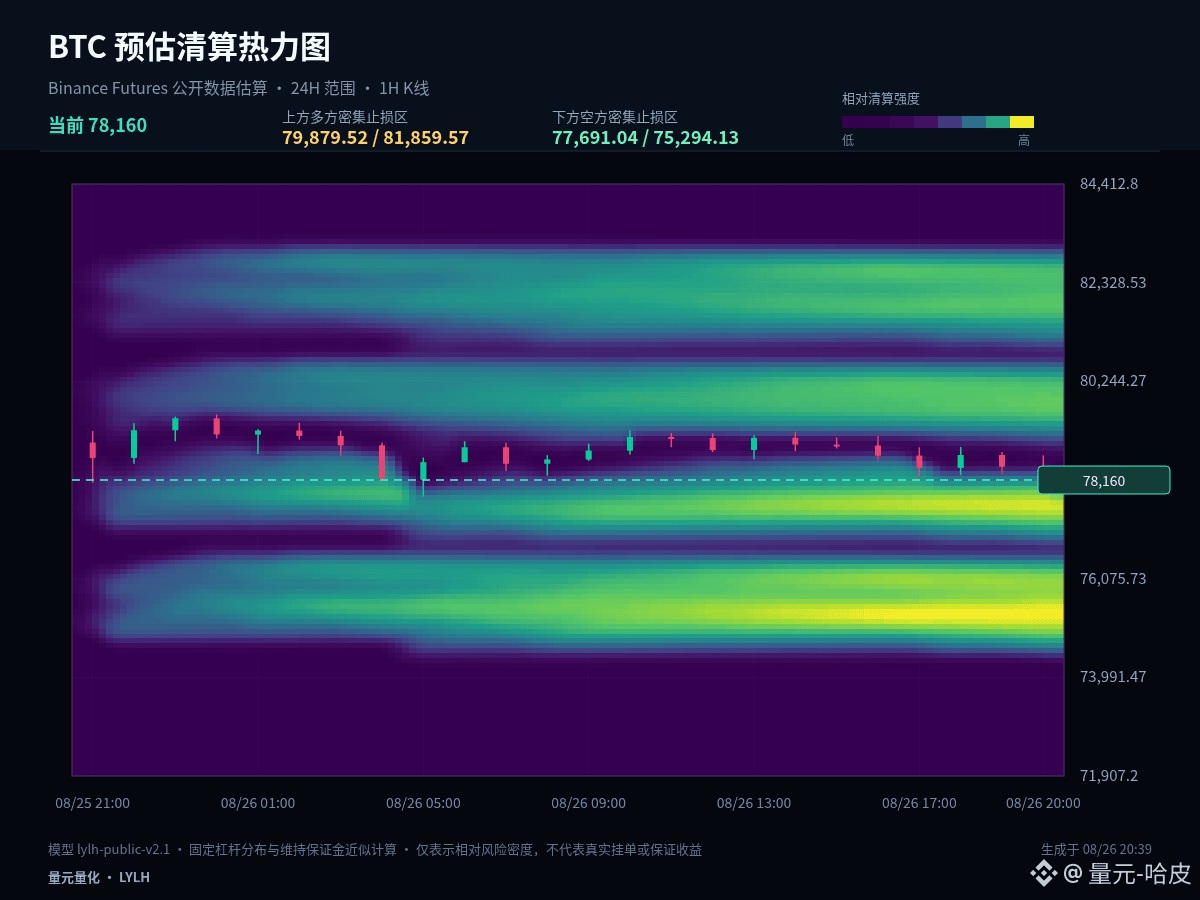
$BTC #BTC If this round can only keep one observation price, I would choose 78,707.36. Current price: 78,236.52. In the past 1 hour: -0.32%, in the past 24 hours: -0.74%. The centerline gain/loss can help filter out a lot of intra-day noise.
The price has not yet reclaimed 78,707.36. For now, treat the current rebound as a weak repair; truly turning strong relies on proving it with a stable closing. If it turns weak again, 77,851 is the next level to observe whether the sell pressure is fading.
Current 1-hour: -0.32%, 24-hour: -0.74%. These two periods have not formed enough clear, same-direction alignment. In a range market, the tolerance for chasing and killing is low. It’s better to use the upper boundary to confirm direction and the lower boundary to confirm pullback/holding. The centerline is only used as the strength/weakness boundary.
Set clear execution conditions: after breaking above 79,563.71, you need confirmation—not to chase just because of a momentary spike. After dipping to 77,851, you need to see whether it can quickly reclaim—not to catch every drop. If the mid-zone doesn’t offer enough reward-to-risk, waiting is also part of the strategy.
On position sizing, you need to distinguish between spot and contracts. If you already have spot holdings, manage them in segments around key levels, and don’t frequently flip direction due to a single 1-hour candlestick. Being in cash and waiting for confirmation, then entering in batches, is more comfortable. Contracts place more emphasis on the entry position and invalidation conditions. When volatility expands, proactively reduce position size to avoid turning short-term judgments into passive holding.
The real divergence in this market is whether it continues or returns to the range. Will you wait for a breakout confirmation, or wait for a support pullback test? Tell me the price you’re most focused on.
#OpenAIReportedlyCompletesBelModelPretraining
The price has not yet reclaimed 78,707.36. For now, treat the current rebound as a weak repair; truly turning strong relies on proving it with a stable closing. If it turns weak again, 77,851 is the next level to observe whether the sell pressure is fading.
Current 1-hour: -0.32%, 24-hour: -0.74%. These two periods have not formed enough clear, same-direction alignment. In a range market, the tolerance for chasing and killing is low. It’s better to use the upper boundary to confirm direction and the lower boundary to confirm pullback/holding. The centerline is only used as the strength/weakness boundary.
Set clear execution conditions: after breaking above 79,563.71, you need confirmation—not to chase just because of a momentary spike. After dipping to 77,851, you need to see whether it can quickly reclaim—not to catch every drop. If the mid-zone doesn’t offer enough reward-to-risk, waiting is also part of the strategy.
On position sizing, you need to distinguish between spot and contracts. If you already have spot holdings, manage them in segments around key levels, and don’t frequently flip direction due to a single 1-hour candlestick. Being in cash and waiting for confirmation, then entering in batches, is more comfortable. Contracts place more emphasis on the entry position and invalidation conditions. When volatility expands, proactively reduce position size to avoid turning short-term judgments into passive holding.
The real divergence in this market is whether it continues or returns to the range. Will you wait for a breakout confirmation, or wait for a support pullback test? Tell me the price you’re most focused on.
#OpenAIReportedlyCompletesBelModelPretraining