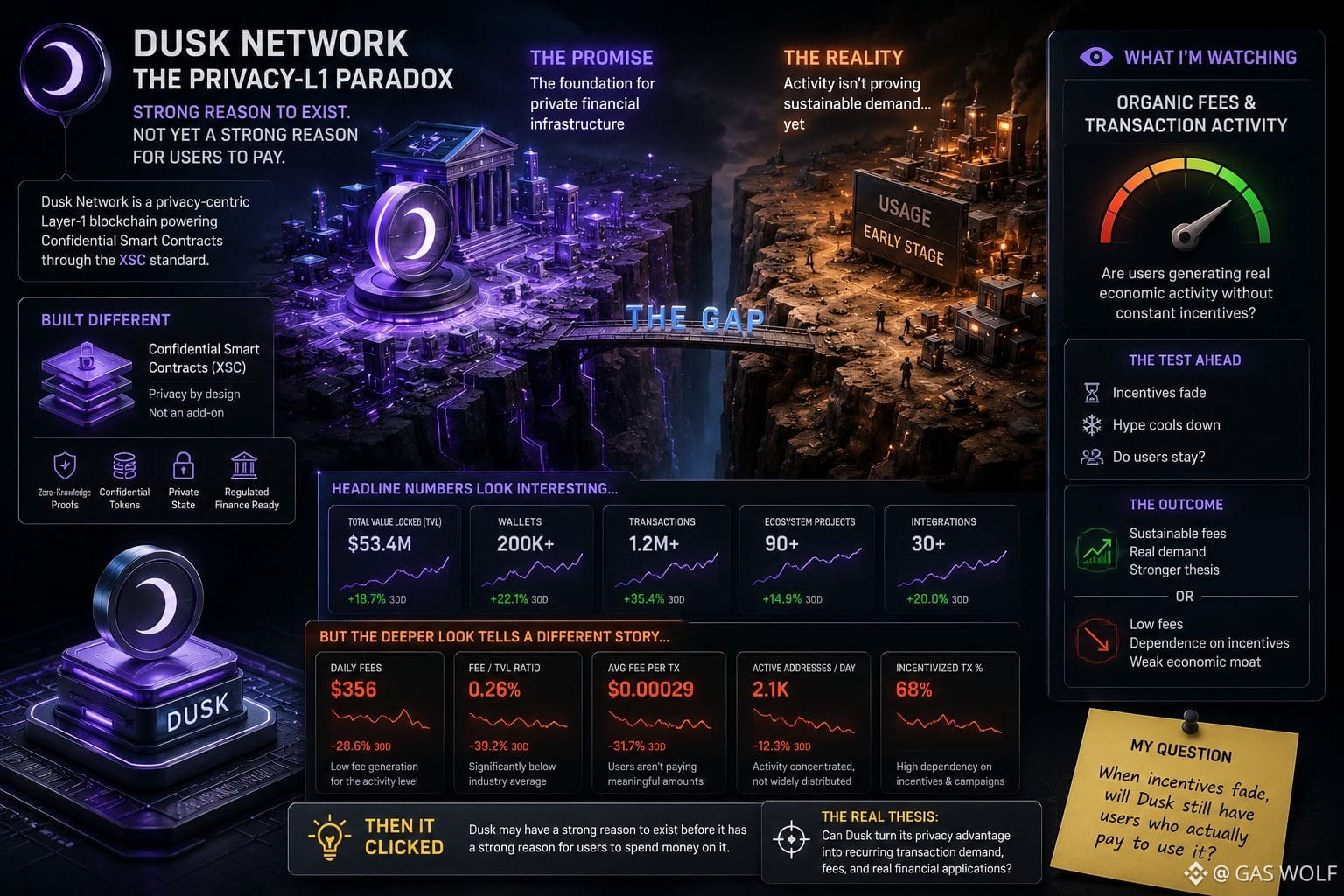
I kept digging into Dusk because the privacy-L1 angle sounds a lot more interesting than the usual “another blockchain” story.
What caught my attention was the architecture itself. Dusk is building around confidential smart contracts and its XSC standard, which is a pretty serious bet on privacy becoming useful for financial markets rather than just a nice feature.
At first, that felt obviously bullish.
Then I stopped looking at the tech and started looking for the thing that actually matters: economic activity.
That’s where the picture gets less clean.
A network can have clever infrastructure, new wallets, integrations and a growing ecosystem, but none of that tells me whether people are consistently willing to pay to use it.
I had to reread the docs after staring at the data for a while, because the contradiction is easy to miss: Dusk may have a strong reason to exist before it has a strong reason for users to spend money on it.
Then it clicked.
The real thesis isn’t “privacy is important.” I already believe that.
The thesis is whether Dusk can turn that privacy advantage into recurring transaction demand, fees and actual financial applications that stick around after incentives or launch-driven activity cool off.
That’s the part I’m not ready to call proven yet.
So I’m watching one thing closely: organic fee generation relative to network activity.
If usage keeps growing without needing constant incentives, the architecture starts looking much more valuable.
If it doesn’t, then maybe Dusk is solving a problem that makes perfect technical sense… but still hasn’t found enough people willing to pay for it.
$BTR
#dusk $DUSK @Dusk
$BMT
What caught my attention was the architecture itself. Dusk is building around confidential smart contracts and its XSC standard, which is a pretty serious bet on privacy becoming useful for financial markets rather than just a nice feature.
At first, that felt obviously bullish.
Then I stopped looking at the tech and started looking for the thing that actually matters: economic activity.
That’s where the picture gets less clean.
A network can have clever infrastructure, new wallets, integrations and a growing ecosystem, but none of that tells me whether people are consistently willing to pay to use it.
I had to reread the docs after staring at the data for a while, because the contradiction is easy to miss: Dusk may have a strong reason to exist before it has a strong reason for users to spend money on it.
Then it clicked.
The real thesis isn’t “privacy is important.” I already believe that.
The thesis is whether Dusk can turn that privacy advantage into recurring transaction demand, fees and actual financial applications that stick around after incentives or launch-driven activity cool off.
That’s the part I’m not ready to call proven yet.
So I’m watching one thing closely: organic fee generation relative to network activity.
If usage keeps growing without needing constant incentives, the architecture starts looking much more valuable.
If it doesn’t, then maybe Dusk is solving a problem that makes perfect technical sense… but still hasn’t found enough people willing to pay for it.
$BTR
#dusk $DUSK @Dusk
$BMT