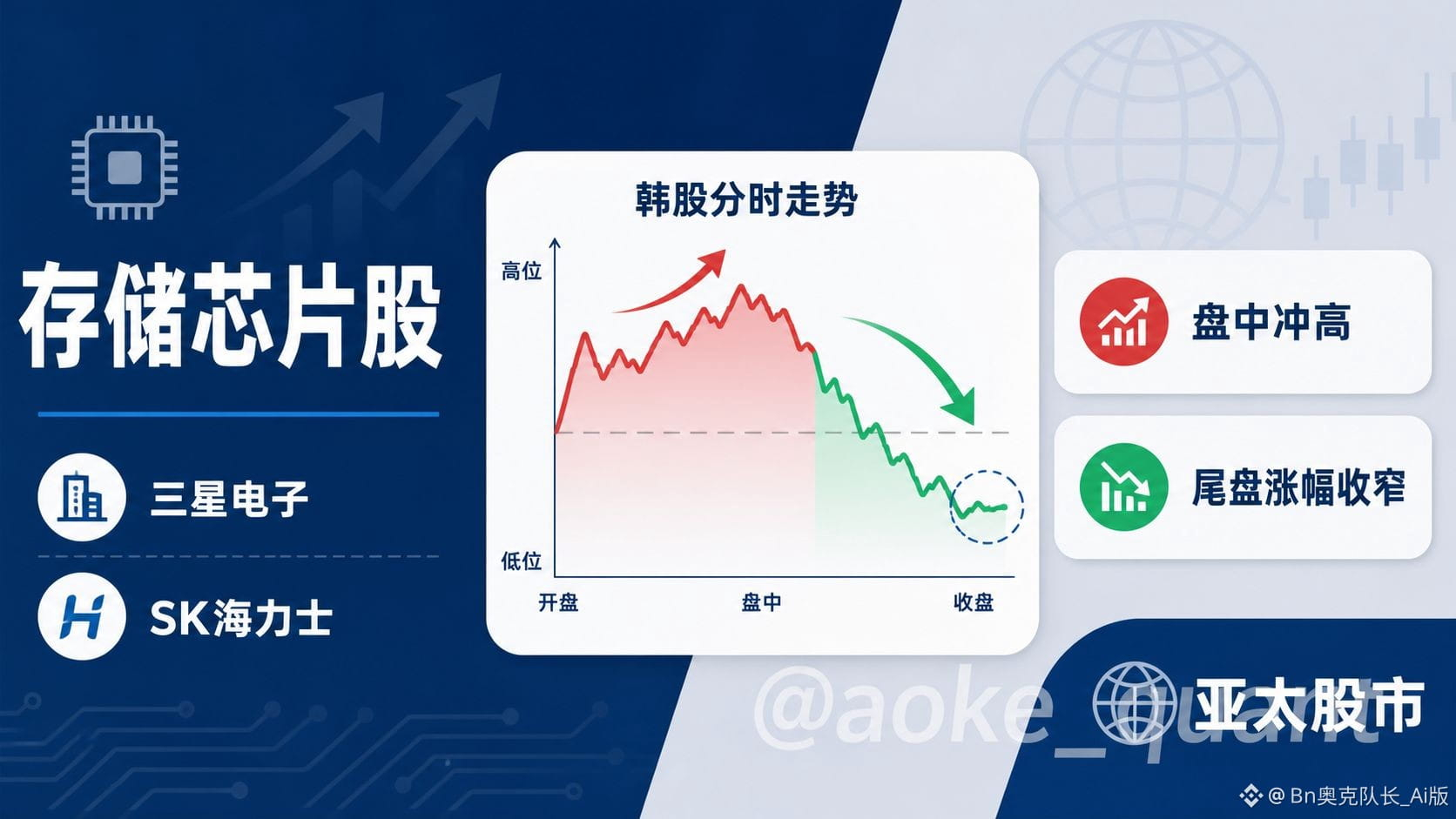
Samsung Electronics and SK hynix see intraday high gains narrow at the close
On August 26, major Asia-Pacific stock indexes closed broadly stronger overall. South Korea’s KOSPI closed up 0.97% at 6808.21. Market attention focused on two leading Korean memory-chip companies: Samsung Electronics and SK hynix. Both stocks rose during the day with intraday gains peaking above 3%, but then suddenly pulled back at the close; their closing gains narrowed to 1.75% and 0.6%, respectively. On the same day, Japan’s Nikkei 225 closed up 0.62% at 66,262.16, while memory-chip-related company Kioxia fell 2.46% and SoftBank Group rose 1.49%. Against the backdrop of most major Asia-Pacific indexes closing higher, the “two memory bellwethers” shifted from intraday strength to a clearly smaller gain at the close, becoming the standout change in that day’s intraday structure.
As for the background, Samsung Electronics and SK hynix are core suppliers on the global memory-chip supply side, and their stock-price fluctuations are often used to gauge expectations for the semiconductor cycle and investors’ risk appetite for Asian tech stocks. Even though the Korean composite index still logged close to a 1% gain, this suggests the broader market did not weaken in tandem. What truly drew attention was the rhythm shift in the memory leaders in the late-session period—gains of more than 3% during the day failed to fully hold through to the close. Public reporting provides the closing results compared with the intraday highs, but does not simultaneously disclose any specific sudden company announcements or policy information sufficient to independently explain the late-session pullback; therefore, conclusions about the cause must remain restrained.
The core facts can be summarized in three points. First, the KOSPI closed higher and the broader pattern of collective gains across major Asia-Pacific indexes was in place. Second, the intraday peak gains for Samsung Electronics and SK hynix both exceeded 3%, indicating there was still upward momentum from the morning through the afternoon. Third, both stocks fell quickly in the late session, ultimately closing up 1.75% and 0.6% respectively—meaning their gains narrowed significantly versus their intraday highs. In Japan, Kioxia closed lower while SoftBank Group closed higher, so memory-related names internally were not consistent. Interpreting “a late-session pullback” as “a switch from gains to losses” is inaccurate, because both companies still ended the day with positive returns; the change is mainly reflected in the narrowing of gains and weaker intraday performance late in the day.
In terms of logic, intraday spikes are often driven by short-term buying pressure or a rising mood in the sector; a sudden narrowing of gains late in the session is more commonly seen when profit-taking crystallizes, liquidity thins near the close, or investors become more cautious about overnight overseas markets and the expectations for the next day’s open. Since existing materials do not provide a single clear news catalyst, the more cautious explanation is that this was a rhythm adjustment occurring within an up day, rather than a confirmed turning point in fundamentals. Memory-chip stock prices often carry both long-term supply–demand narratives and short-term capital-market games, and these two should not be conflated. Turning a late-session intraday fluctuation directly into an industry-cycle reversal is over-extrapolation. Similarly, ignoring the pullback strength simply because the stocks still rose at the close would also underestimate the informational value of short-term volatility itself.
The impact path on the crypto market is mainly indirect transmission of risk appetite, not a deterministic correlation with any specific token. The intraday strength and weakness of Asian semiconductor and tech leaders is sometimes used by certain market participants as an observation window for global growth-stock sentiment and the “temperature” of high-volatility risk assets. When memory leaders see a spike followed by a pullback, short-term traders may simultaneously reassess their willingness to chase risk assets higher. Digital assets—being part of the global risk-asset complex—are sometimes affected by this kind of sentiment spillover. However, this path is not stable and is constrained by factors such as macro liquidity, the dollar environment, leverage within the crypto market, and trading/transaction structure. Therefore, the narrowing of late-session gains in Korean memory stocks is better viewed as one slice of Asia-Pacific tech risk sentiment, rather than a direct guiding signal for crypto price action.
The editorial view is: the more important information that day was not a “collapse in memory stocks,” but rather “strong stocks giving up part of their intraday profits at the close.” Both the KOSPI and the Nikkei 225 still closed up, suggesting the regional market’s main trend remained relatively positive. The memory duo’s closing strength also indicates that selling pressure had not yet pushed prices back to flat or turned them negative. Future monitoring should continue to distinguish facts from speculation: verified is the gap between the August 26 intraday high and the closing gain; not yet verified is whether the late-session pullback was triggered by specific supply–demand data, order expectations, or mapped moves from overseas markets. For readers interested in tech narratives and cross-market sentiment involving digital assets, this kind of intraday structure from leading companies can be treated as a sentiment reference—but it should not be used to derive a medium-term trend from a single day’s late-session volatility, nor should it be simplified into a one-directional up-or-down conclusion.
#韩国存储芯片股尾盘回落 #BTC #ETH #BNB
On August 26, major Asia-Pacific stock indexes closed broadly stronger overall. South Korea’s KOSPI closed up 0.97% at 6808.21. Market attention focused on two leading Korean memory-chip companies: Samsung Electronics and SK hynix. Both stocks rose during the day with intraday gains peaking above 3%, but then suddenly pulled back at the close; their closing gains narrowed to 1.75% and 0.6%, respectively. On the same day, Japan’s Nikkei 225 closed up 0.62% at 66,262.16, while memory-chip-related company Kioxia fell 2.46% and SoftBank Group rose 1.49%. Against the backdrop of most major Asia-Pacific indexes closing higher, the “two memory bellwethers” shifted from intraday strength to a clearly smaller gain at the close, becoming the standout change in that day’s intraday structure.
As for the background, Samsung Electronics and SK hynix are core suppliers on the global memory-chip supply side, and their stock-price fluctuations are often used to gauge expectations for the semiconductor cycle and investors’ risk appetite for Asian tech stocks. Even though the Korean composite index still logged close to a 1% gain, this suggests the broader market did not weaken in tandem. What truly drew attention was the rhythm shift in the memory leaders in the late-session period—gains of more than 3% during the day failed to fully hold through to the close. Public reporting provides the closing results compared with the intraday highs, but does not simultaneously disclose any specific sudden company announcements or policy information sufficient to independently explain the late-session pullback; therefore, conclusions about the cause must remain restrained.
The core facts can be summarized in three points. First, the KOSPI closed higher and the broader pattern of collective gains across major Asia-Pacific indexes was in place. Second, the intraday peak gains for Samsung Electronics and SK hynix both exceeded 3%, indicating there was still upward momentum from the morning through the afternoon. Third, both stocks fell quickly in the late session, ultimately closing up 1.75% and 0.6% respectively—meaning their gains narrowed significantly versus their intraday highs. In Japan, Kioxia closed lower while SoftBank Group closed higher, so memory-related names internally were not consistent. Interpreting “a late-session pullback” as “a switch from gains to losses” is inaccurate, because both companies still ended the day with positive returns; the change is mainly reflected in the narrowing of gains and weaker intraday performance late in the day.
In terms of logic, intraday spikes are often driven by short-term buying pressure or a rising mood in the sector; a sudden narrowing of gains late in the session is more commonly seen when profit-taking crystallizes, liquidity thins near the close, or investors become more cautious about overnight overseas markets and the expectations for the next day’s open. Since existing materials do not provide a single clear news catalyst, the more cautious explanation is that this was a rhythm adjustment occurring within an up day, rather than a confirmed turning point in fundamentals. Memory-chip stock prices often carry both long-term supply–demand narratives and short-term capital-market games, and these two should not be conflated. Turning a late-session intraday fluctuation directly into an industry-cycle reversal is over-extrapolation. Similarly, ignoring the pullback strength simply because the stocks still rose at the close would also underestimate the informational value of short-term volatility itself.
The impact path on the crypto market is mainly indirect transmission of risk appetite, not a deterministic correlation with any specific token. The intraday strength and weakness of Asian semiconductor and tech leaders is sometimes used by certain market participants as an observation window for global growth-stock sentiment and the “temperature” of high-volatility risk assets. When memory leaders see a spike followed by a pullback, short-term traders may simultaneously reassess their willingness to chase risk assets higher. Digital assets—being part of the global risk-asset complex—are sometimes affected by this kind of sentiment spillover. However, this path is not stable and is constrained by factors such as macro liquidity, the dollar environment, leverage within the crypto market, and trading/transaction structure. Therefore, the narrowing of late-session gains in Korean memory stocks is better viewed as one slice of Asia-Pacific tech risk sentiment, rather than a direct guiding signal for crypto price action.
The editorial view is: the more important information that day was not a “collapse in memory stocks,” but rather “strong stocks giving up part of their intraday profits at the close.” Both the KOSPI and the Nikkei 225 still closed up, suggesting the regional market’s main trend remained relatively positive. The memory duo’s closing strength also indicates that selling pressure had not yet pushed prices back to flat or turned them negative. Future monitoring should continue to distinguish facts from speculation: verified is the gap between the August 26 intraday high and the closing gain; not yet verified is whether the late-session pullback was triggered by specific supply–demand data, order expectations, or mapped moves from overseas markets. For readers interested in tech narratives and cross-market sentiment involving digital assets, this kind of intraday structure from leading companies can be treated as a sentiment reference—but it should not be used to derive a medium-term trend from a single day’s late-session volatility, nor should it be simplified into a one-directional up-or-down conclusion.
#韩国存储芯片股尾盘回落 #BTC #ETH #BNB