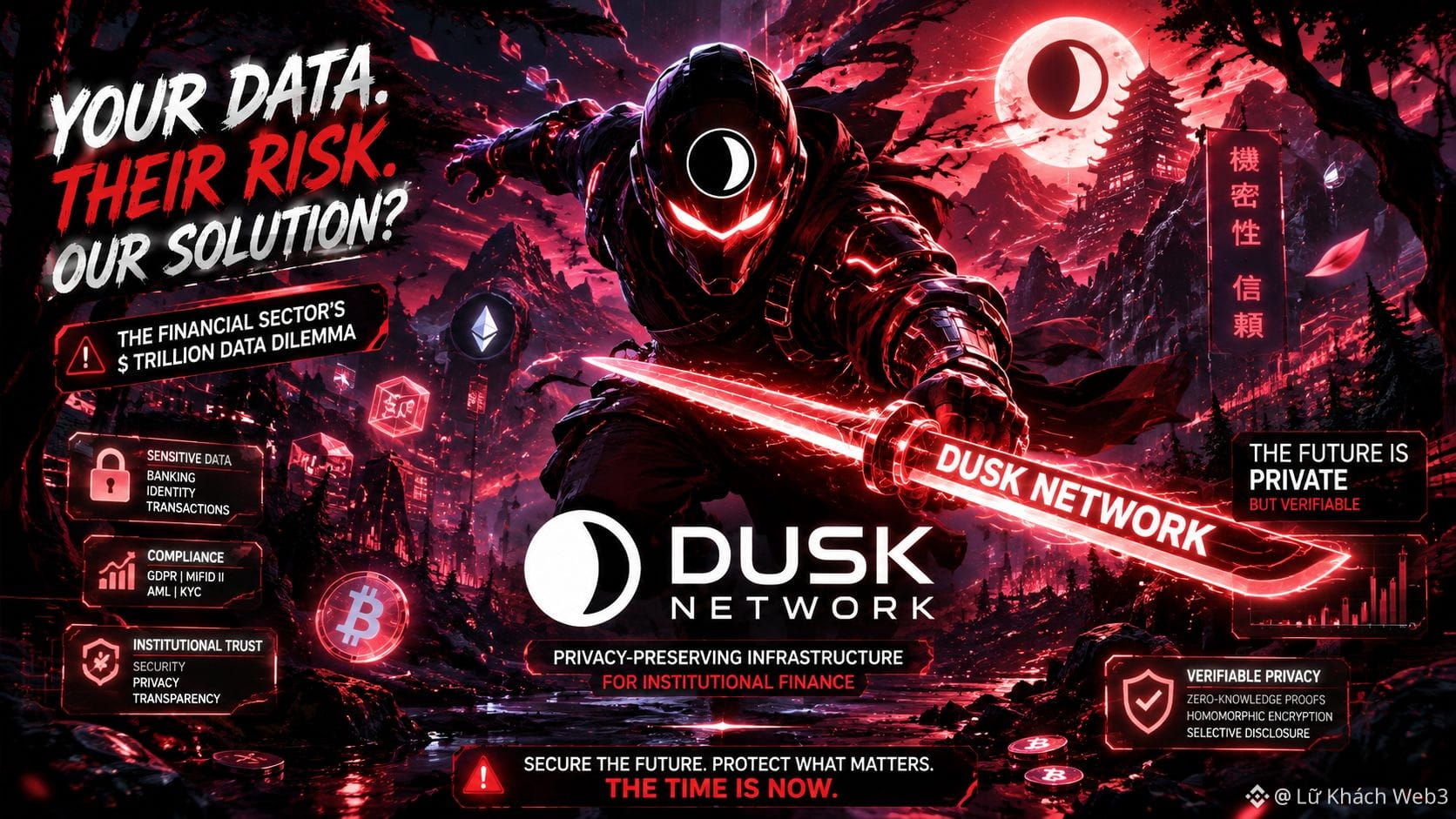
There was one thing that made me pause when reading about Dusk Network: if a blockchain is built around transparency, why would a network aiming at institutional finance need to place privacy in such an important position?
At first, I thought it might just be product positioning. But after reading Dusk’s documents more closely, the issue became clearer. Dusk describes financial applications that need to protect balance, position, counterparty, and business logic instead of putting the entire state on a public ledger.
I kept checking how they handle this problem. Dusk doesn’t simply say “hide data.” The current architecture combines confidential transfers, zero-knowledge proofs, and selective disclosure. Some information can be kept private on-chain, while the information that is necessary can still be proven or disclosed in a controlled way.
What I didn’t expect is that privacy here isn’t set in total opposition to compliance. Citadel, for example, uses selective disclosure to prove attributes such as residency, age bracket, or accreditation without necessarily disclosing all the underlying data.
Hold on—this still isn’t enough to say that Dusk has solved the problem of sensitive data in institutional finance. Privacy also depends on how the applications are implemented and what metadata might still be exposed.
But after reading more deeply, I started to view the question differently: in on-chain finance, isn’t the real issue not “privacy vs. transparency,” but rather who can see which data, and under what circumstances?
#dusk $DUSK @Dusk $BTC
At first, I thought it might just be product positioning. But after reading Dusk’s documents more closely, the issue became clearer. Dusk describes financial applications that need to protect balance, position, counterparty, and business logic instead of putting the entire state on a public ledger.
I kept checking how they handle this problem. Dusk doesn’t simply say “hide data.” The current architecture combines confidential transfers, zero-knowledge proofs, and selective disclosure. Some information can be kept private on-chain, while the information that is necessary can still be proven or disclosed in a controlled way.
What I didn’t expect is that privacy here isn’t set in total opposition to compliance. Citadel, for example, uses selective disclosure to prove attributes such as residency, age bracket, or accreditation without necessarily disclosing all the underlying data.
Hold on—this still isn’t enough to say that Dusk has solved the problem of sensitive data in institutional finance. Privacy also depends on how the applications are implemented and what metadata might still be exposed.
But after reading more deeply, I started to view the question differently: in on-chain finance, isn’t the real issue not “privacy vs. transparency,” but rather who can see which data, and under what circumstances?
#dusk $DUSK @Dusk $BTC