
Post

--

竹竹 YGØZ²
·
--
Many people assess the security of a blockchain by habitually asking, “What is the consensus mechanism? Is there protection against double-spending? Does the network layer resist Sybil attacks?” It seems that if any one layer provides a convincing proof, the entire chain is secure. This intuition may be wrong in Dusk’s design.
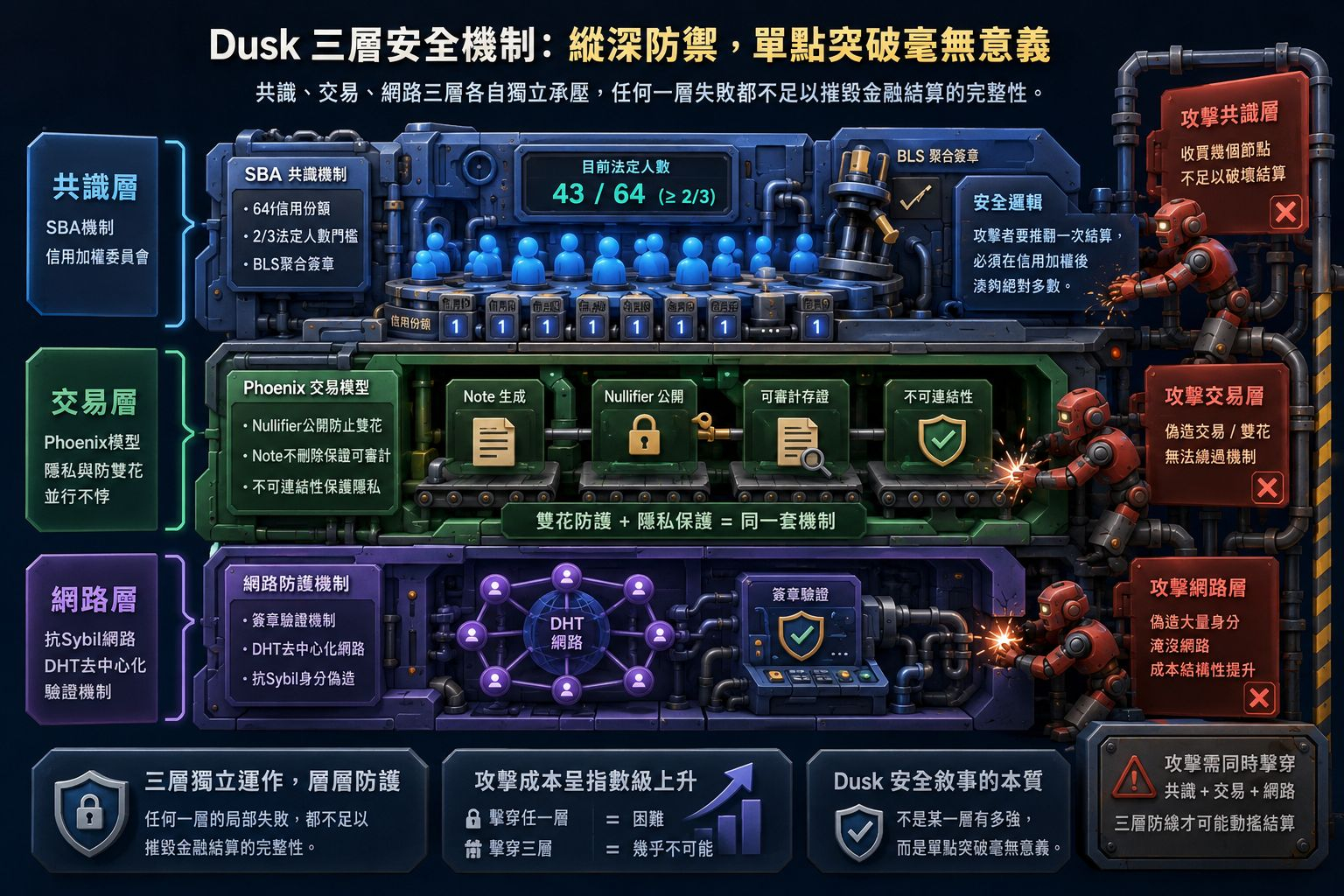
Dusk’s security logic doesn’t place all the bets on a single layer. Instead, it makes consensus, transactions, and the network each independently bear their own pressure. A localized failure in any one layer is not enough on its own to destroy the integrity of financial settlement.
Consensus layer: Under Dusk’s SBA mechanism, a committee size based on 64 credit shares combined with a 2/3 statutory quorum means an attacker must overturn a settlement. It’s not enough to bribe “a few nodes”; they must, after credit-weighting, assemble an absolute majority. BLS aggregated signatures reduce validation cost to an extremely low level, but they do not reduce the attacker’s cost as a consequence—efficiency optimization and attack threshold are two different things.
Transaction layer: Dusk’s Phoenix model uses a public nullifier to prevent double-spending. Notes are not deleted, ensuring auditability. At the same time, it uses a non-linkability design to sever address relationships between transactions. This means double-spending protection and privacy protection are not mutually exclusive—they are woven into the same mechanism.
Network layer: Dusk’s signature verification plus DHT, together with an anti-Sybil design, structurally increases the attack cost of flooding the network by forging large numbers of identities.
When the three layers are stacked together, Dusk’s real security story isn’t “how strong any one layer is,” but that the attacker must simultaneously break through the consensus, transaction, and network layers to undermine settlement guarantees. The essence of defense in depth is to make “single-point breakthroughs” meaningless.
#dusk $DUSK @Dusk
Dusk’s security logic doesn’t place all the bets on a single layer. Instead, it makes consensus, transactions, and the network each independently bear their own pressure. A localized failure in any one layer is not enough on its own to destroy the integrity of financial settlement.
Consensus layer: Under Dusk’s SBA mechanism, a committee size based on 64 credit shares combined with a 2/3 statutory quorum means an attacker must overturn a settlement. It’s not enough to bribe “a few nodes”; they must, after credit-weighting, assemble an absolute majority. BLS aggregated signatures reduce validation cost to an extremely low level, but they do not reduce the attacker’s cost as a consequence—efficiency optimization and attack threshold are two different things.
Transaction layer: Dusk’s Phoenix model uses a public nullifier to prevent double-spending. Notes are not deleted, ensuring auditability. At the same time, it uses a non-linkability design to sever address relationships between transactions. This means double-spending protection and privacy protection are not mutually exclusive—they are woven into the same mechanism.
Network layer: Dusk’s signature verification plus DHT, together with an anti-Sybil design, structurally increases the attack cost of flooding the network by forging large numbers of identities.
When the three layers are stacked together, Dusk’s real security story isn’t “how strong any one layer is,” but that the attacker must simultaneously break through the consensus, transaction, and network layers to undermine settlement guarantees. The essence of defense in depth is to make “single-point breakthroughs” meaningless.
#dusk $DUSK @Dusk
Disclaimer: Includes third-party opinions. No advice. Binance AI may be used without guarantee. See T&Cs.