I kept coming back to one question while looking at Dusk and NPEX:
Can a regulated market be auditable without turning every investor’s financial activity into public data?
NPEX makes this more than a theoretical question. Dusk’s work with the regulated Dutch exchange gives that question a real-world context: regulated securities, investors and market infrastructure have to operate within rules that require both oversight and confidentiality.
That creates a specific problem.
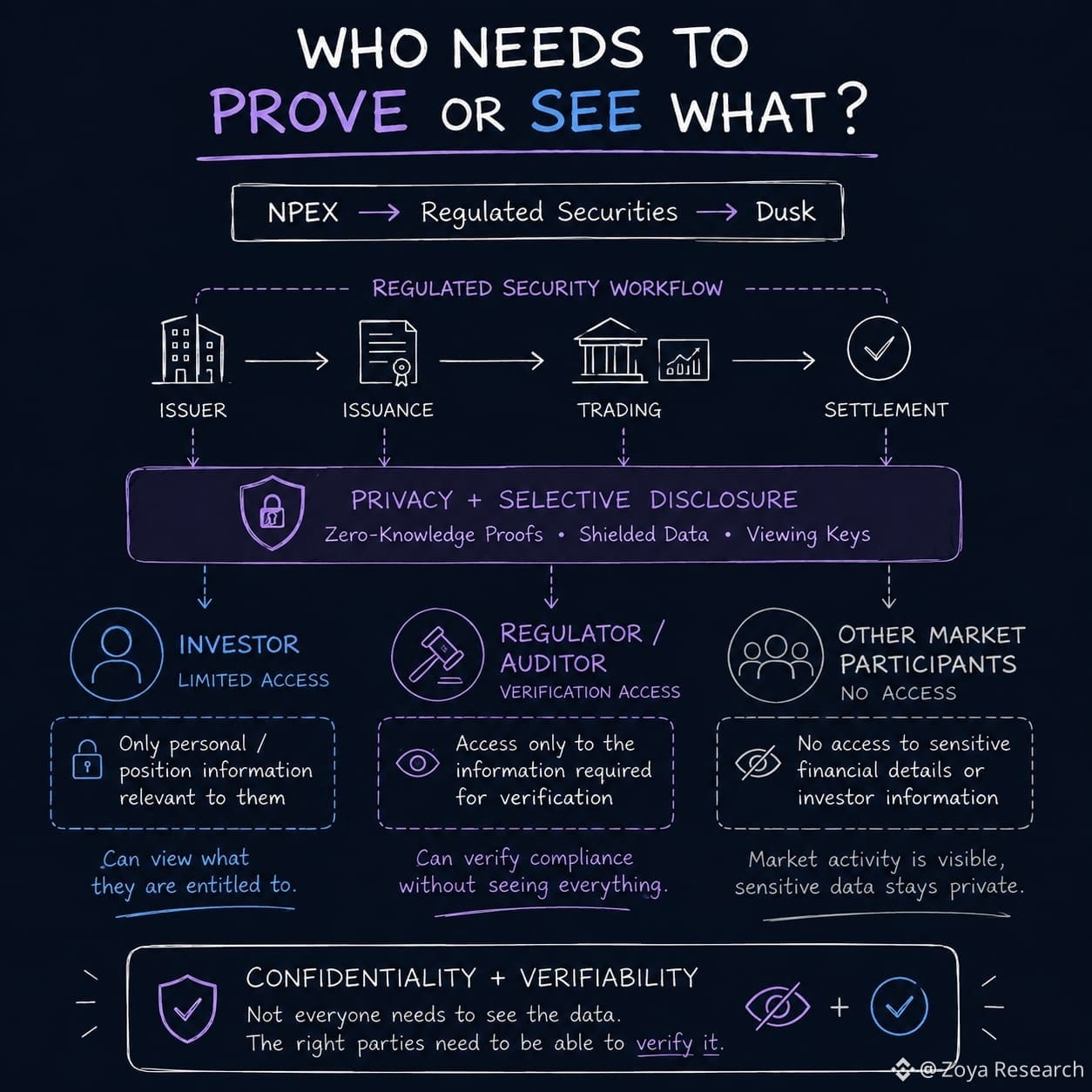
A regulator may need to verify that an investor is eligible or that a transaction follows the required conditions. But that does not automatically mean every other market participant should see the underlying financial information.
This is where Dusk’s architecture gets interesting.
Its Phoenix transaction model keeps balances and transfers shielded, while zero-knowledge proofs can establish transaction validity without exposing the underlying details. When additional evidence is required, viewing keys can provide selective access.
So privacy here isn’t simply about hiding data.
It changes the question from “Is the information public?” to “Who needs to prove or see what?”
But the real test is what happens when an actual regulated security moves through this workflow: who can see what, who can prove what, and how much manual coordination is still required behind the scenes?
That’s the part I don’t think should be assumed.
If those permissions can actually be enforced onchain across investors, issuers, venues and supervisors, does privacy become more than a compliance feature — does it become part of the market infrastructure itself?
@Dusk $DUSK #dusk
Can a regulated market be auditable without turning every investor’s financial activity into public data?
NPEX makes this more than a theoretical question. Dusk’s work with the regulated Dutch exchange gives that question a real-world context: regulated securities, investors and market infrastructure have to operate within rules that require both oversight and confidentiality.
That creates a specific problem.
A regulator may need to verify that an investor is eligible or that a transaction follows the required conditions. But that does not automatically mean every other market participant should see the underlying financial information.
This is where Dusk’s architecture gets interesting.
Its Phoenix transaction model keeps balances and transfers shielded, while zero-knowledge proofs can establish transaction validity without exposing the underlying details. When additional evidence is required, viewing keys can provide selective access.
So privacy here isn’t simply about hiding data.
It changes the question from “Is the information public?” to “Who needs to prove or see what?”
But the real test is what happens when an actual regulated security moves through this workflow: who can see what, who can prove what, and how much manual coordination is still required behind the scenes?
That’s the part I don’t think should be assumed.
If those permissions can actually be enforced onchain across investors, issuers, venues and supervisors, does privacy become more than a compliance feature — does it become part of the market infrastructure itself?
@Dusk $DUSK #dusk