I kept thinking that when @Dusk đ had already obscured my transaction from the crowd, then surely that would be enough. Because the idea is simple.
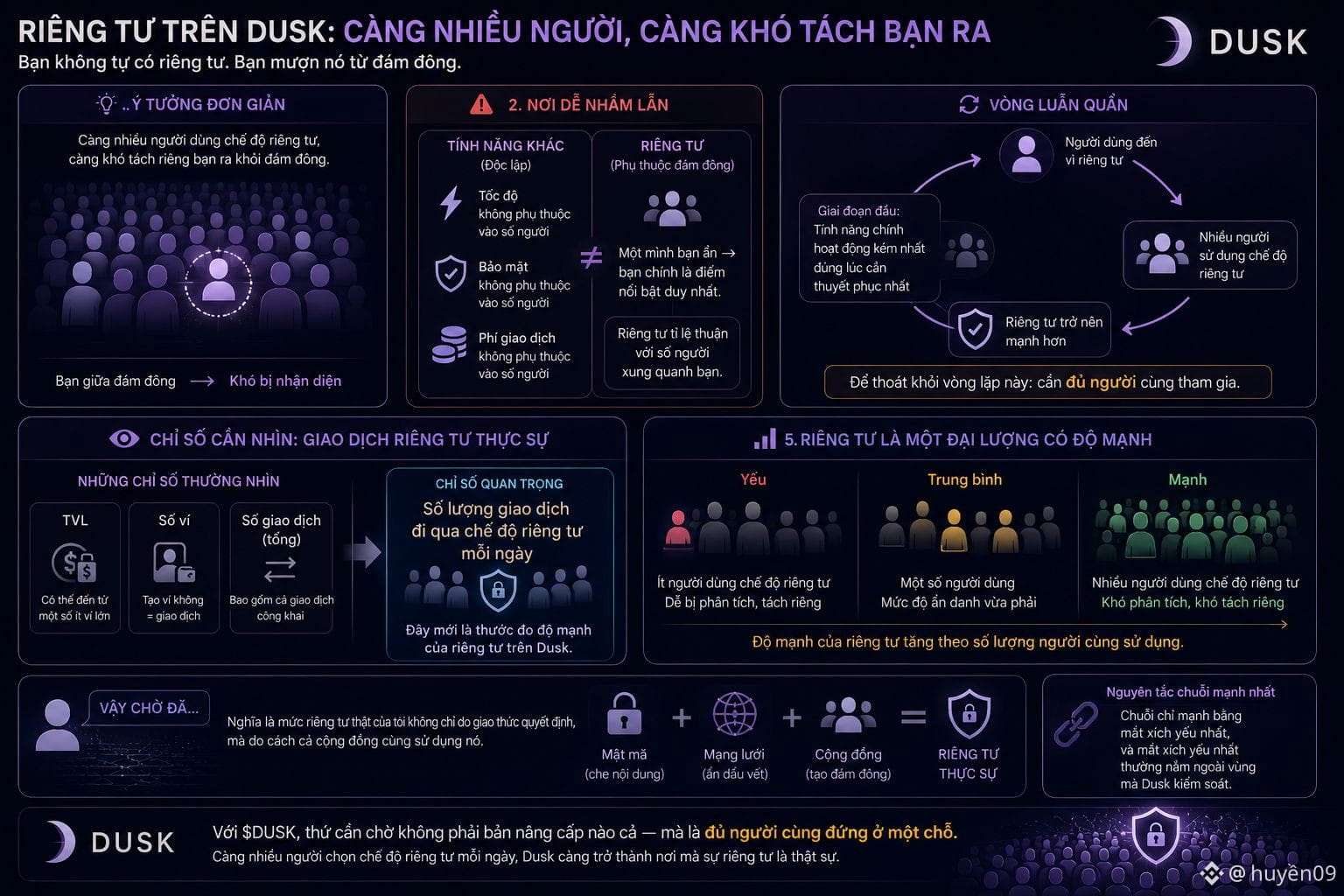
The more users share the same privacy setting, the harder it is to single any one person out. So why would the number of users matter that much to a technical feature?
It must be because privacy isn’t something you own. It’s something you borrow from others. And yes—that’s where I keep mixing two different things together. Every other feature in a chain works independently. Speed doesn’t depend on how many people are using it at the same time—if anything, it goes the other way. But privacy is proportional to the number of people around you. Alone, and hidden, you become the only standout. That’s where things get very real. It creates a vicious cycle.
Users come for privacy, but privacy is only good enough once many people have come. The early phase is always the stage where the main feature performs the worst—right when you need to persuade people the most.
So wait… which means the metric you should look at isn’t TVL or the number of wallets, but how many real transactions actually pass through the shielded side every day.
Turns out I’d been treating privacy as a feature that’s either on or off.
Actually, it’s a quantity with a certain strength—and that strength is decided by the community, not by the development team.
With $DUSK , there’s no upgrade you need to wait for—what you need is enough people standing in the same place.
#dusk $BTC $ETH