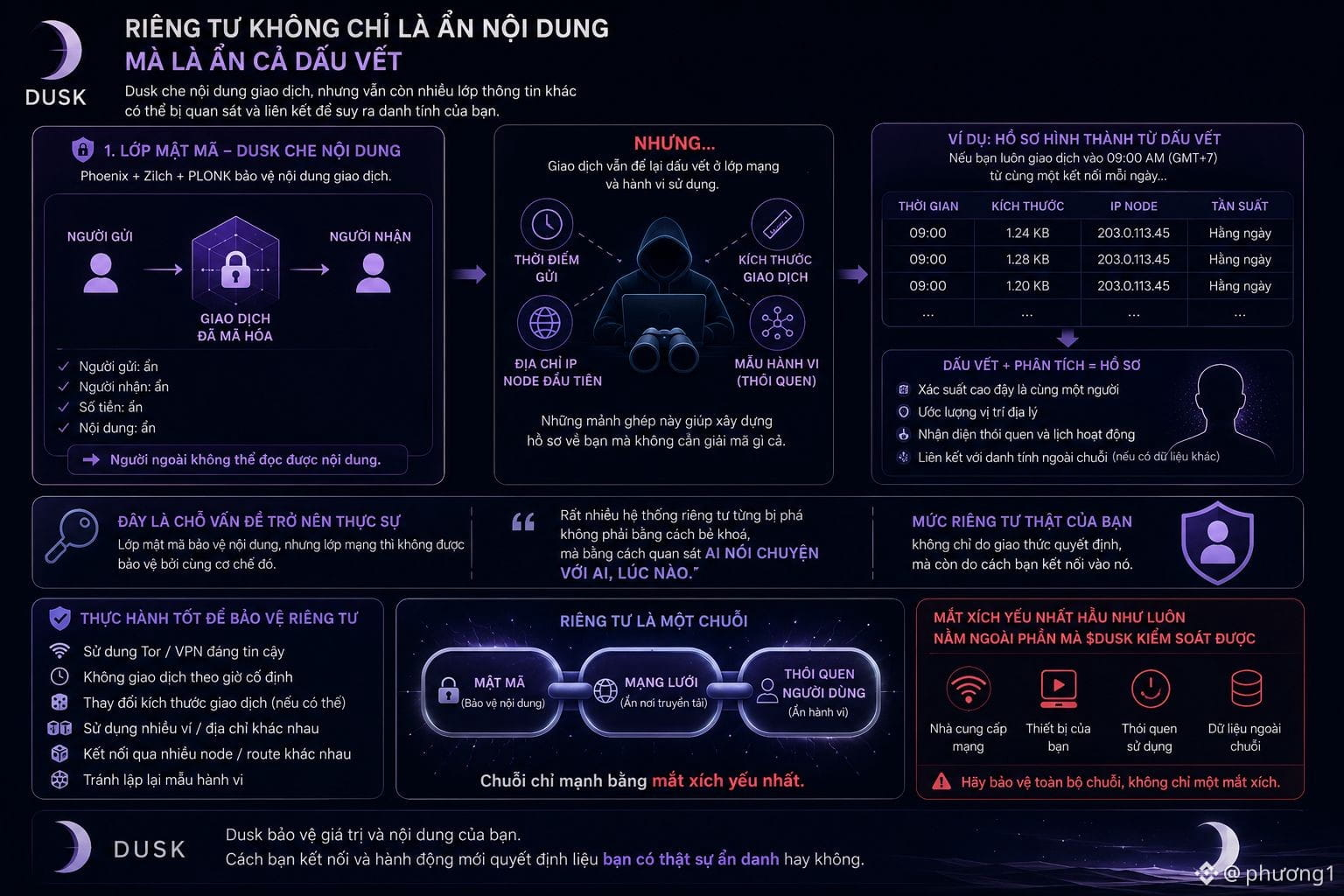
I kept wondering whether once @Dusk had hidden the transaction content, that would be enough for no one to infer anything about me.
because the most important thing had been covered.
the sender, the recipient, the amount — there was nothing to read.
so why didn’t I feel completely at ease?
maybe it was because the content isn’t the only thing a transaction leaves behind.
and sure enough, that’s where I kept mixing up two different things. There’s still the time it was sent. There’s still its size. There’s still the IP address of the first node that received it. And if I always transact at 9:00 AM Vietnam time, always from the same connection, then a profile about me is forming without anyone having to decode anything.
that’s where the problem becomes real. The encryption layer protects the content, but the network layer isn’t protected by the same mechanism. This is the place where many private systems have been broken before — not by cracking codes, but by watching who talks to whom, and when.
so hold on… it means my real level of privacy isn’t just determined by the protocol, but also by how I connect to it.
it turns out I’d kept thinking of privacy as a property of the chain. In fact, it’s the result of the whole chain: cryptography, the network, and the user’s own habits.
that chain is only as strong as its weakest link, and the weakest link is almost always outside the part that $DUSK can control.
#dusk $BTC $ETH