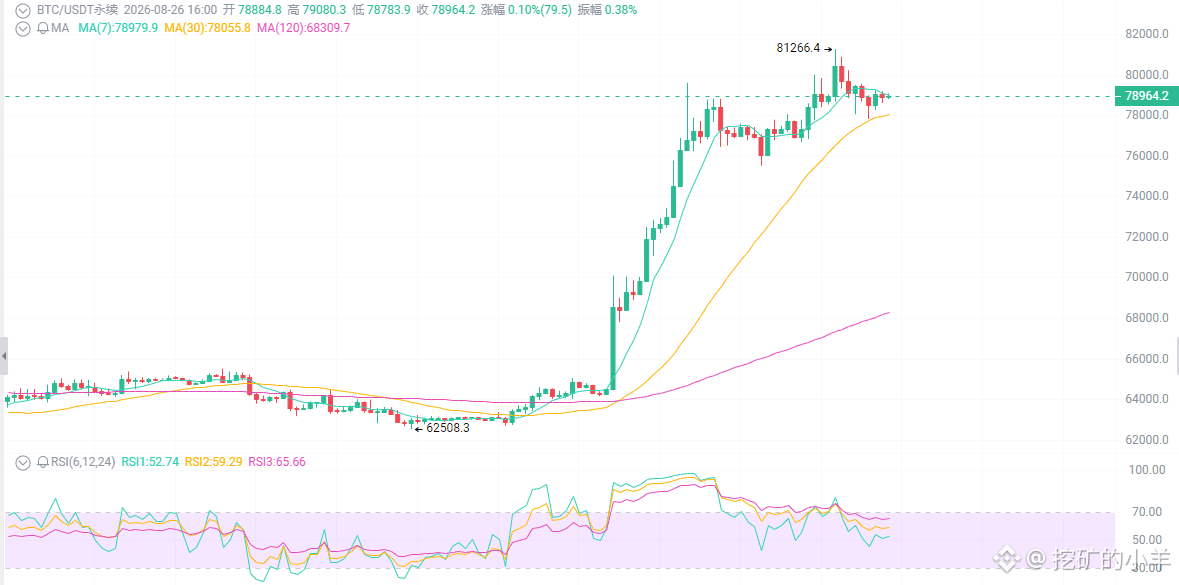
$79,000 BTC—are you going to chase it?
First, look at the surface: good news bombardment, and shorts getting wiped out.
Over the past 10 days, BTC surged from 64k to 81k in a straight run, up 23% week-over-week. The amount of short liquidations hit a record.
In August alone, ETFs have seen net inflows of $2.7–3.0 billion. The Ministry of Finance’s bond buybacks have pressured the dollar by suppressing yields, and Trump is pushing the CLARITY Act.
On the weekly chart, BTC has just moved above the 50-week moving average. RSI is 80–88 (overbought). The direction is right—but the location is ridiculously expensive.
First thing: ETFs are buying, but the buying momentum is starting to slow.
On Aug 24, net inflows were $338 million; on Aug 25, they dropped sharply to $75 million.
After 6–7 straight days of aggressive buying, it has turned into “slowing down and waiting.”
Same playbook: In March 2024, after continuous ETF inflows, momentum slowed and BTC fell from 73k to 56k. In January 2025, with the same rhythm, BTC dropped from 108k to 89k.
Second thing: the macro window is here—today through Friday is a “high-pressure chamber.”
Today (Aug 26), US Eastern time 8:30: July PCE + Q2 GDP revision.
PCE forecast core YoY is 3.3% (unchanged), while the GDP second revision forecast is 1.5%.
If data is soft: the dollar falls, and BTC pushes again to 81,200.
If data matches expectations: expect high-range consolidation—wait until Friday.
If data is hot: the core logic behind this rally—“fiscal easing + a depreciation trade”—will get slapped. The first drop targets 76,500–77,000.
Third thing: the technicals show two contradictory signals
Signal A: the trend has indeed strengthened.
BTC just moved above the 50-week moving average on the weekly chart—first time since Nov 2025.
Signal B: but the price is too expensive.
Daily RSI is 80–88, extremely overbought. Price is nearly 20% above the 50-day moving average (around 66k). After the Aug 25 surge to 81,200, it closed with a long upper-wick bearish candle—a typical “first stall K after an acceleration phase.”
Trading strategy
Short-term players:
For existing long positions, reduce to within 30% when above 79,000. After the PCE data is released, wait 15-minute candles to stabilize before acting again. If the data comes in hot and breaks below 78,300, consider a small-sized short trial. Targets: 77,000 / 75,000. Stop loss: 79,800. Quick in, quick out.
Swing traders:
Place buy orders at 77,200 and 74,800—don’t place them at something like 78,800, which “looks cheap” but is actually still halfway up the mountain. On a pullback to 76,700–77,300, take the first 20–30% of the planned position, stop loss 75,800. Between 73,900–75,000, add the second 50–60%, stop loss 72,800.
Breakout chasing longs:
If the 4H candle closes above 81,300, and on the retest 80,000–80,500 holds without breaking, open a long again. Target 82,800–84,000. Stop loss: below 80,000.
Invalidation line:
If the daily closes below 75,000, and the August rebound downgrades into an oversold rebound, the strategy changes from “buy the dips” to “sell the rebounds.”
First, look at the surface: good news bombardment, and shorts getting wiped out.
Over the past 10 days, BTC surged from 64k to 81k in a straight run, up 23% week-over-week. The amount of short liquidations hit a record.
In August alone, ETFs have seen net inflows of $2.7–3.0 billion. The Ministry of Finance’s bond buybacks have pressured the dollar by suppressing yields, and Trump is pushing the CLARITY Act.
On the weekly chart, BTC has just moved above the 50-week moving average. RSI is 80–88 (overbought). The direction is right—but the location is ridiculously expensive.
First thing: ETFs are buying, but the buying momentum is starting to slow.
On Aug 24, net inflows were $338 million; on Aug 25, they dropped sharply to $75 million.
After 6–7 straight days of aggressive buying, it has turned into “slowing down and waiting.”
Same playbook: In March 2024, after continuous ETF inflows, momentum slowed and BTC fell from 73k to 56k. In January 2025, with the same rhythm, BTC dropped from 108k to 89k.
Second thing: the macro window is here—today through Friday is a “high-pressure chamber.”
Today (Aug 26), US Eastern time 8:30: July PCE + Q2 GDP revision.
PCE forecast core YoY is 3.3% (unchanged), while the GDP second revision forecast is 1.5%.
If data is soft: the dollar falls, and BTC pushes again to 81,200.
If data matches expectations: expect high-range consolidation—wait until Friday.
If data is hot: the core logic behind this rally—“fiscal easing + a depreciation trade”—will get slapped. The first drop targets 76,500–77,000.
Third thing: the technicals show two contradictory signals
Signal A: the trend has indeed strengthened.
BTC just moved above the 50-week moving average on the weekly chart—first time since Nov 2025.
Signal B: but the price is too expensive.
Daily RSI is 80–88, extremely overbought. Price is nearly 20% above the 50-day moving average (around 66k). After the Aug 25 surge to 81,200, it closed with a long upper-wick bearish candle—a typical “first stall K after an acceleration phase.”
Trading strategy
Short-term players:
For existing long positions, reduce to within 30% when above 79,000. After the PCE data is released, wait 15-minute candles to stabilize before acting again. If the data comes in hot and breaks below 78,300, consider a small-sized short trial. Targets: 77,000 / 75,000. Stop loss: 79,800. Quick in, quick out.
Swing traders:
Place buy orders at 77,200 and 74,800—don’t place them at something like 78,800, which “looks cheap” but is actually still halfway up the mountain. On a pullback to 76,700–77,300, take the first 20–30% of the planned position, stop loss 75,800. Between 73,900–75,000, add the second 50–60%, stop loss 72,800.
Breakout chasing longs:
If the 4H candle closes above 81,300, and on the retest 80,000–80,500 holds without breaking, open a long again. Target 82,800–84,000. Stop loss: below 80,000.
Invalidation line:
If the daily closes below 75,000, and the August rebound downgrades into an oversold rebound, the strategy changes from “buy the dips” to “sell the rebounds.”