
I remember watching a few RWA narratives trade well before I could see much evidence that capital formation itself had become easier. At first I treated issuance as the important milestone. Lately I’m less convinced. Getting an SME security onchain means little if investors still pass through several disconnected systems before they can actually own and trade it.
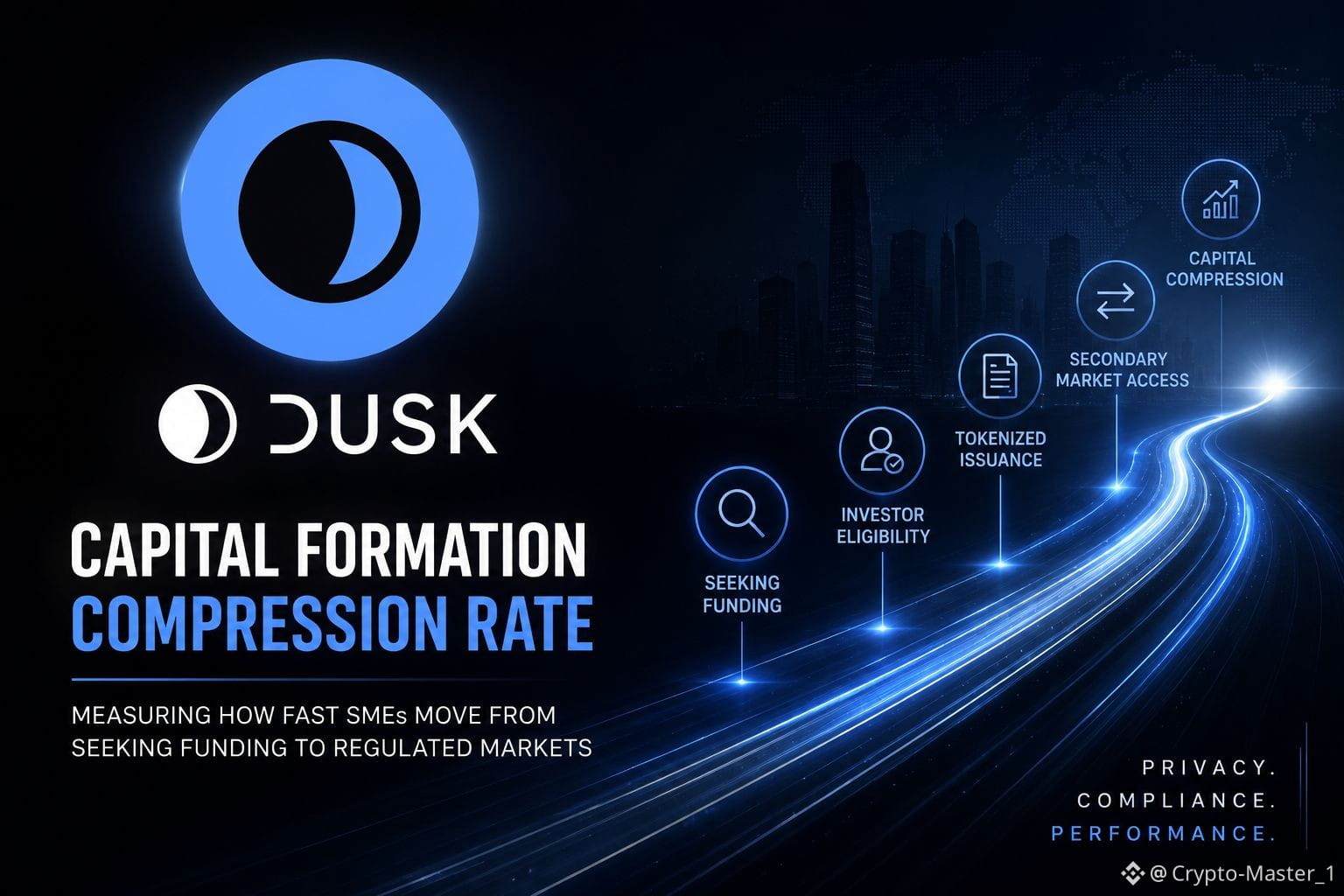
That’s why I keep thinking about a Capital Formation Compression Rate for $DUSK: the time between an SME seeking funding and reaching verified investors, issuance, settlement, then a regulated secondary market.
The interesting part is repetition. If Dusk can keep eligibility, ownership and settlement inside a reusable workflow, the second raise should theoretically be easier than the first. That creates a retention loop rather than one-off tokenization.
But I’d be careful with the token story. Faster workflows don’t automatically create recurring $DUSK demand. I’d want to see real transactions producing fees, sustained validator/staking participation, and network usage absorbing circulating supply rather than price simply reacting to DuskEVM or RWA narratives. Unlocks and dilution still matter.
The failure case is also fairly simple: issuance grows, but investors don’t return, secondary liquidity stays thin, or activity exists mainly to manufacture impressive metrics.
As a trader, I’d watch whether funding cycles actually compress over repeated issuances. If the time falls while organic fees and liquidity rise, I become more interested.
If only the narrative gets faster, I don’t.
#dusk $DUSK @Dusk
That’s why I keep thinking about a Capital Formation Compression Rate for $DUSK: the time between an SME seeking funding and reaching verified investors, issuance, settlement, then a regulated secondary market.
The interesting part is repetition. If Dusk can keep eligibility, ownership and settlement inside a reusable workflow, the second raise should theoretically be easier than the first. That creates a retention loop rather than one-off tokenization.
But I’d be careful with the token story. Faster workflows don’t automatically create recurring $DUSK demand. I’d want to see real transactions producing fees, sustained validator/staking participation, and network usage absorbing circulating supply rather than price simply reacting to DuskEVM or RWA narratives. Unlocks and dilution still matter.
The failure case is also fairly simple: issuance grows, but investors don’t return, secondary liquidity stays thin, or activity exists mainly to manufacture impressive metrics.
As a trader, I’d watch whether funding cycles actually compress over repeated issuances. If the time falls while organic fees and liquidity rise, I become more interested.
If only the narrative gets faster, I don’t.
#dusk $DUSK @Dusk