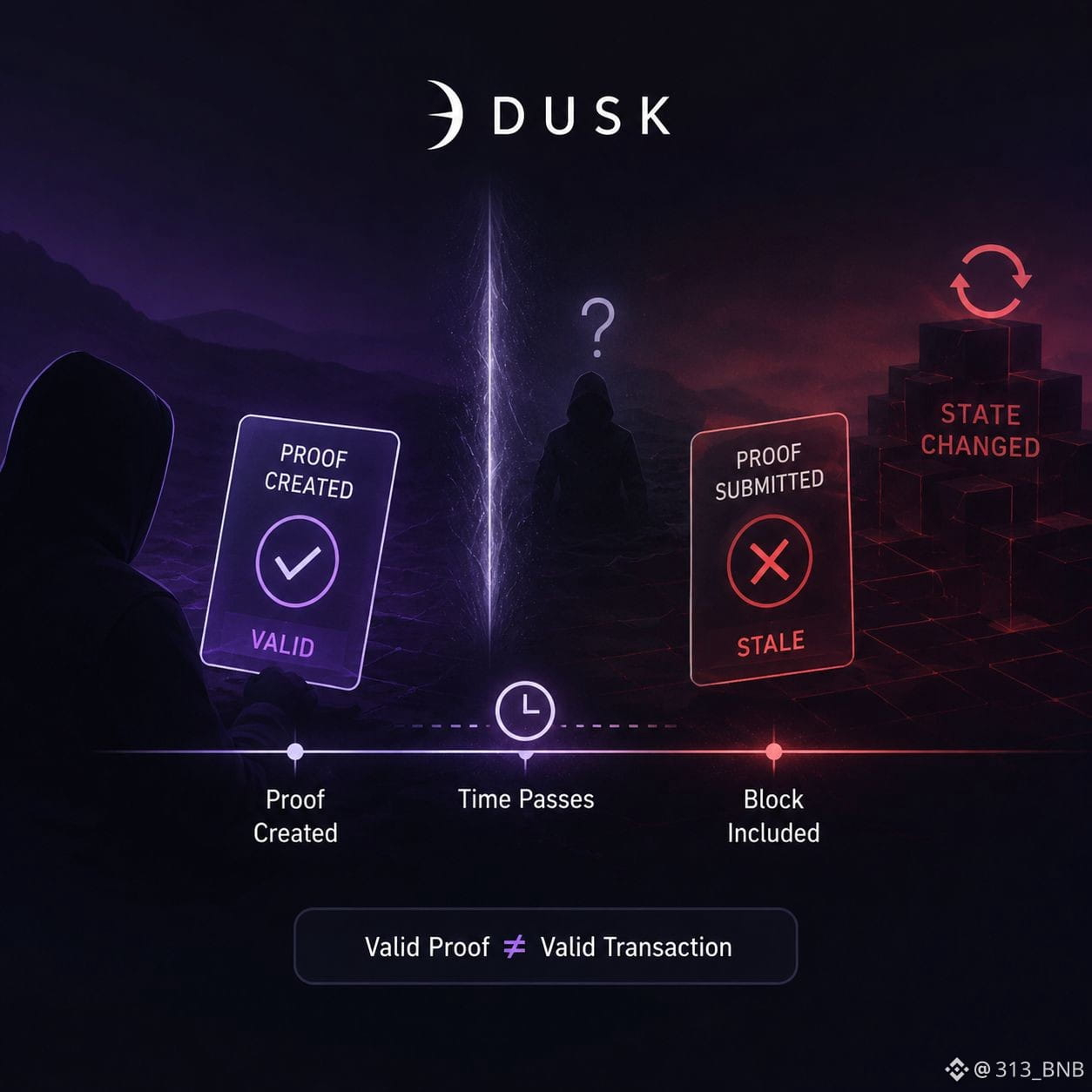
I used to think a valid proof was the finish line.
Then I started looking at what happens between proof creation and block inclusion, and @Dusk made the distinction much clearer.
A proof can be mathematically correct and still fail if the state it describes has already changed.
That sounds small, but privacy makes it more interesting. On a public chain, you can observe pending activity and react to possible conflicts. In a shielded environment, you lose that visibility by design.
So the real question isn't only, “Is the proof correct?”
It may also be, “Is the proof still valid for the state that exists when it gets processed?”
If $DUSK activity scales, I’m curious how much this timing problem matters in practice—and whether users will understand failures caused not by bad proofs, but by proofs arriving too late.
#dusk $BTC $ETH
Then I started looking at what happens between proof creation and block inclusion, and @Dusk made the distinction much clearer.
A proof can be mathematically correct and still fail if the state it describes has already changed.
That sounds small, but privacy makes it more interesting. On a public chain, you can observe pending activity and react to possible conflicts. In a shielded environment, you lose that visibility by design.
So the real question isn't only, “Is the proof correct?”
It may also be, “Is the proof still valid for the state that exists when it gets processed?”
If $DUSK activity scales, I’m curious how much this timing problem matters in practice—and whether users will understand failures caused not by bad proofs, but by proofs arriving too late.
#dusk $BTC $ETH