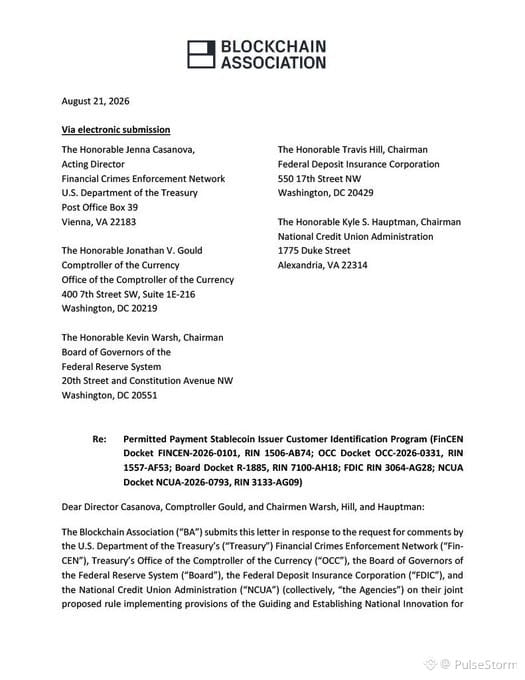
BREAKING: Blockchain Association just dropped a 15-page bomb on stablecoin ID rules — five federal agencies in the crosshairs (FinCEN, OCC, Fed, FDIC, NCUA) and the industry is NOT backing down.
Here's the setup:
They're cool with KYC at the primary level — issuance, redemption, custody. Makes sense. You deal directly with the issuer, you show ID.
But extending that same heavy lift to secondary peer-to-peer transfers? That's where they draw the line.
Why? Because issuers literally can't see those transactions. Smart contracts execute autonomously. No visibility. No control. Calling it "technically infeasible" and outside the actual statute.
They're also pushing for sharper definitions — what even counts as an "account," a "customer," or a "digital asset service provider"? Vague regs = compliance chaos.
And they're not just complaining — they're offering alternatives: zero-knowledge proofs, third-party data validation. Real solutions.
Comments close August 21. Final rules drop before the GENIUS Act kicks in January 18, 2027.
This isn't anti-regulation. This is the industry saying: "Regulate us, but make it match how stablecoins actually move on-chain."
The trade angle? If these rules land too heavy, expect friction in $USDT $USDC secondary flows. If they land smart, stablecoins get regulatory clarity without breaking DeFi rails — bullish for adoption, bullish for on-chain volume.
Watch how agencies respond. This could set the template for every tokenized asset going forward. Not just stablecoins — the whole damn market.
Here's the setup:
They're cool with KYC at the primary level — issuance, redemption, custody. Makes sense. You deal directly with the issuer, you show ID.
But extending that same heavy lift to secondary peer-to-peer transfers? That's where they draw the line.
Why? Because issuers literally can't see those transactions. Smart contracts execute autonomously. No visibility. No control. Calling it "technically infeasible" and outside the actual statute.
They're also pushing for sharper definitions — what even counts as an "account," a "customer," or a "digital asset service provider"? Vague regs = compliance chaos.
And they're not just complaining — they're offering alternatives: zero-knowledge proofs, third-party data validation. Real solutions.
Comments close August 21. Final rules drop before the GENIUS Act kicks in January 18, 2027.
This isn't anti-regulation. This is the industry saying: "Regulate us, but make it match how stablecoins actually move on-chain."
The trade angle? If these rules land too heavy, expect friction in $USDT $USDC secondary flows. If they land smart, stablecoins get regulatory clarity without breaking DeFi rails — bullish for adoption, bullish for on-chain volume.
Watch how agencies respond. This could set the template for every tokenized asset going forward. Not just stablecoins — the whole damn market.