Don’t rush to trade RWA. What Dusk Network is doing with its native issuance isn’t changing the “skin,” it’s replacing the whole ledger logic.
In most RWA projects on the market, you’ll find that, nine times out of ten, they’re basically packaging assets for sale. Off-chain, they find a trust to wrap up things like real estate, stocks, or fund interests; on-chain, they issue a Token as the receipt. They tell you the assets are “on-chain,” but what they really hold is still a digitized pickup order. If something goes wrong, the off-chain trust layer will wobble first, and the on-chain tokens will still get stuck.
@Dusk isn’t squeezing itself into this crowded lane. It’s pushing native issuance. The assets are on-chain from the moment they come into being. The issuance rules, transfer restrictions, and settlement paths are all hard-coded into XSC’s confidential security contracts.
These contracts run on the Rusk virtual machine. Their state is stored by default as ciphertext—completely different from the fully transparent ledgers of Ethereum. When a bond is issued, the value date, coupon frequency, and investor whitelist are written directly into the contract. PLONK proofs validate, in the encrypted state, whether each transfer is compliant. Interest payments trigger automatically when due, and settlement completes atomically within a block—so T+2 effectively disappears from the process checklist.
Technically, the real challenge is making privacy and verification not fight each other. Hedger uses additive homomorphic encryption based on ElGamal to process the amount fields. On-chain nodes can directly perform add/subtract validation on the ciphertext, confirming that balances are conserved before and after the transfer—without seeing the specific numbers. Zero-knowledge proofs add another layer: they prove the transaction didn’t trigger a blacklist or exceed limits, without exposing the trigger conditions themselves. Proof generation happens in the browser within 2 seconds—fast enough to matter for market makers.
Audit keys aren’t a magic master key. They’re distributed by regulatory level: the exchange can see compliance results, and only higher-tier regulators—like central-bank level oversight—can unlock full transaction details.
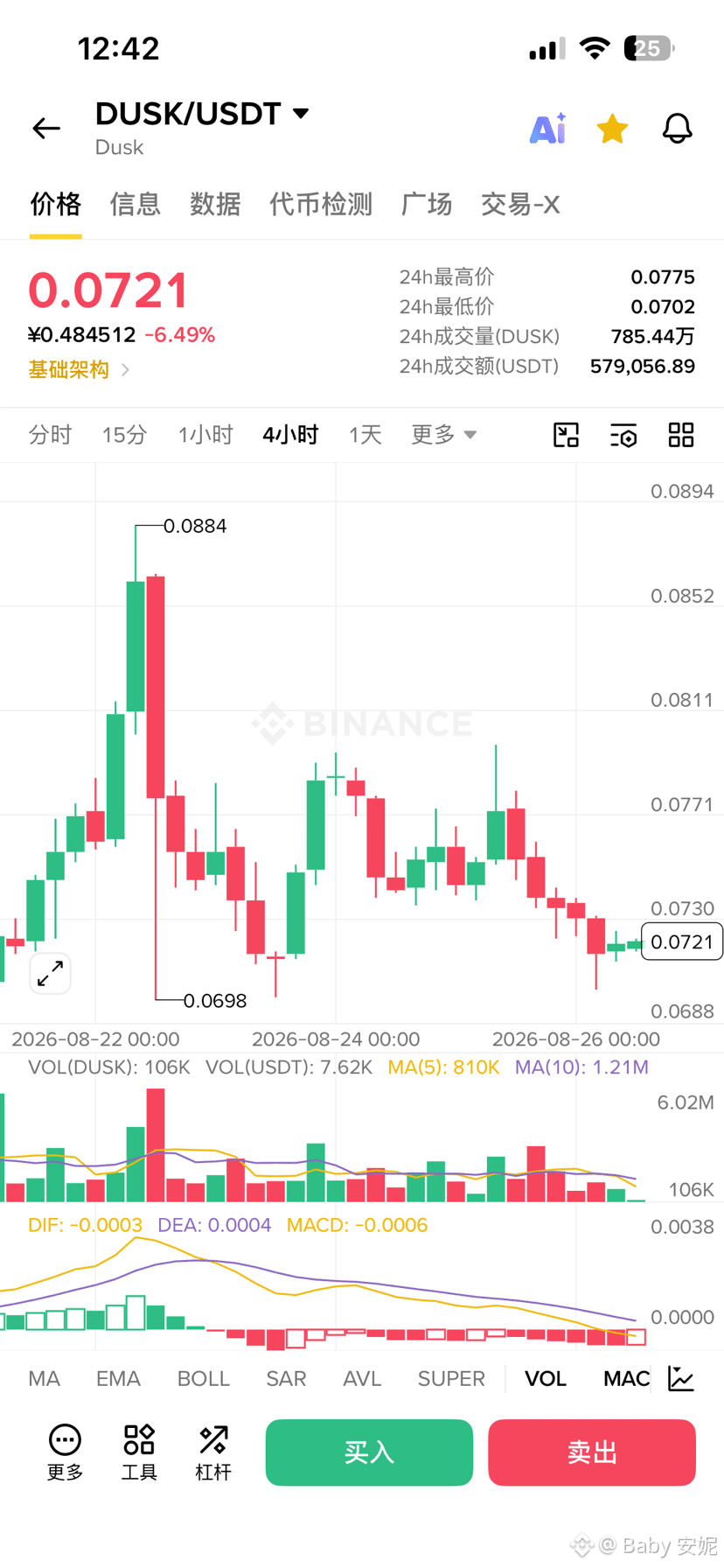
DUSK’s market cap is only around 35 million, but this native issuance logic has seized the window of the EU DLT pilot program. Packaged assets are patches for an old order; native issuance is swapping out the operating system. The bottlenecks aren’t just “technology.” They’re whether the performance overhead of homomorphic encryption can hold up in high-frequency scenarios, and whether the top-level key partitioning, once something goes wrong, still has a contingency mechanism—because right now the safety net is blank.
Whether institutions dare to hand over their lifeline to this new ledger depends on whether the first batch of bonds runs smoothly.
#dusk $DUSK