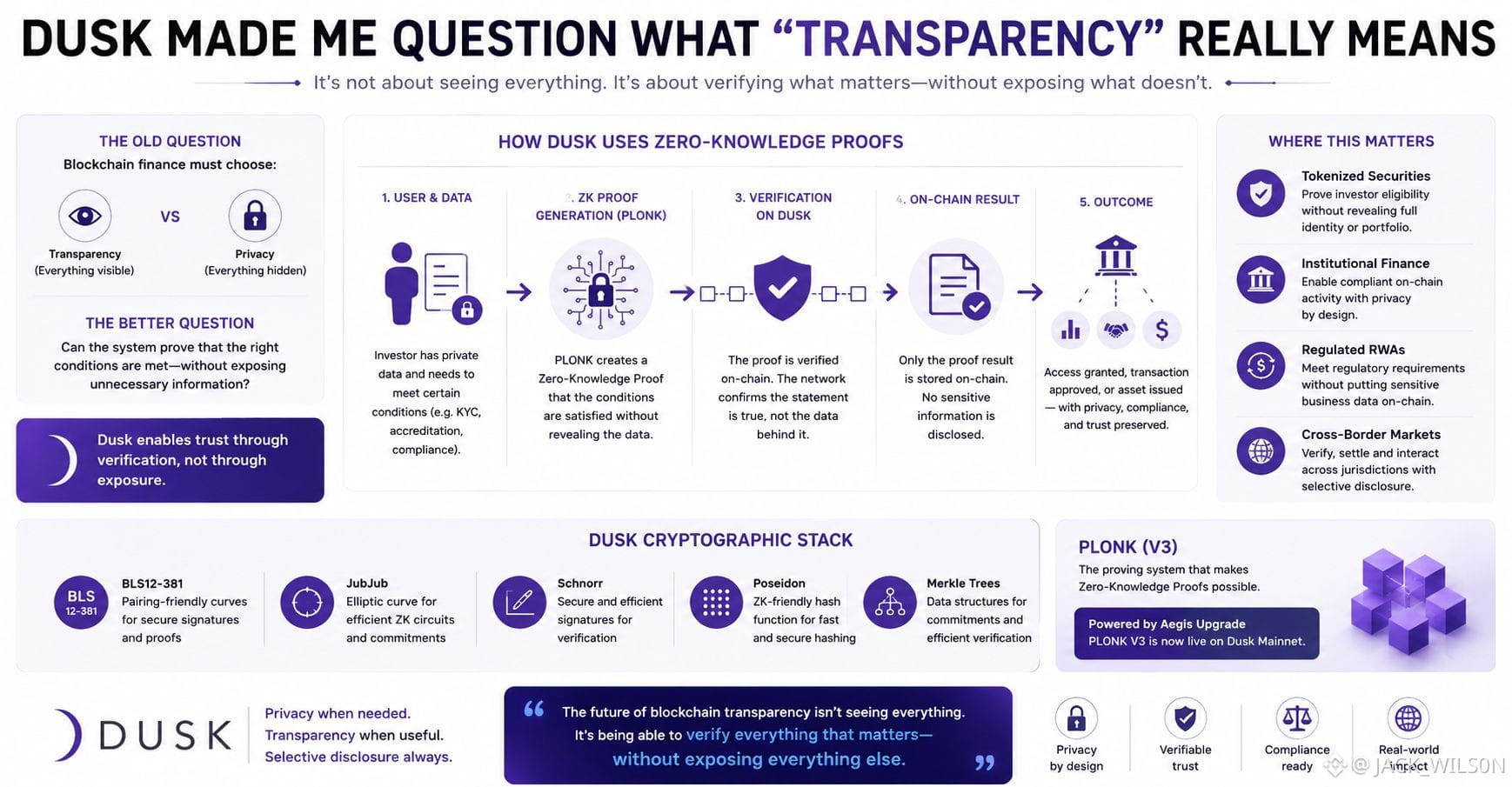

DUSK Made Me Question What “Transparency” Really Means
I used to think blockchain finance had to choose between privacy and transparency.
The more I explored Dusk, the more I realized that might be the wrong question.
Real financial markets don’t need everyone to see everything. They need the right people to verify the right information.
That’s where Dusk’s approach gets interesting.
With Zero-Knowledge Proofs, the goal isn’t simply to hide data. It’s to prove that something is true without exposing everything behind that proof.
Think about an investor passing a compliance check.
The important question isn’t necessarily, “Can everyone see this investor’s personal information?”
It’s:
“Can the system prove that this investor meets the required conditions?”
That distinction could be huge for tokenized securities, institutional finance and regulated RWAs.
What caught my attention is that Dusk isn’t treating this as one isolated feature. Its cryptographic stack brings together tools such as BLS12-381, JubJub, Schnorr, Poseidon and Merkle trees, while PLONK provides the foundation for generating and verifying ZK proofs.
And with PLONK V3 activated on Dusk mainnet through Aegis, this feels less like a theoretical idea and more like infrastructure being built.
Maybe the future of blockchain transparency isn’t seeing everything.
Maybe it’s being able to verify everything that matters—without exposing everything else.
@Dusk #Dusk $DUSK #dusk