
大仁Jaron
121 Posts

大仁Jaron
Wb3项目投研|AI研究生|推特X: @Jaron2277|web3与AI未来无限可能

SOL Holder
Frequent Trader
3.6 Years
577 Following
30.0K+ Followers
29.5K+ Liked
Posts
All
Quotes
PINNED
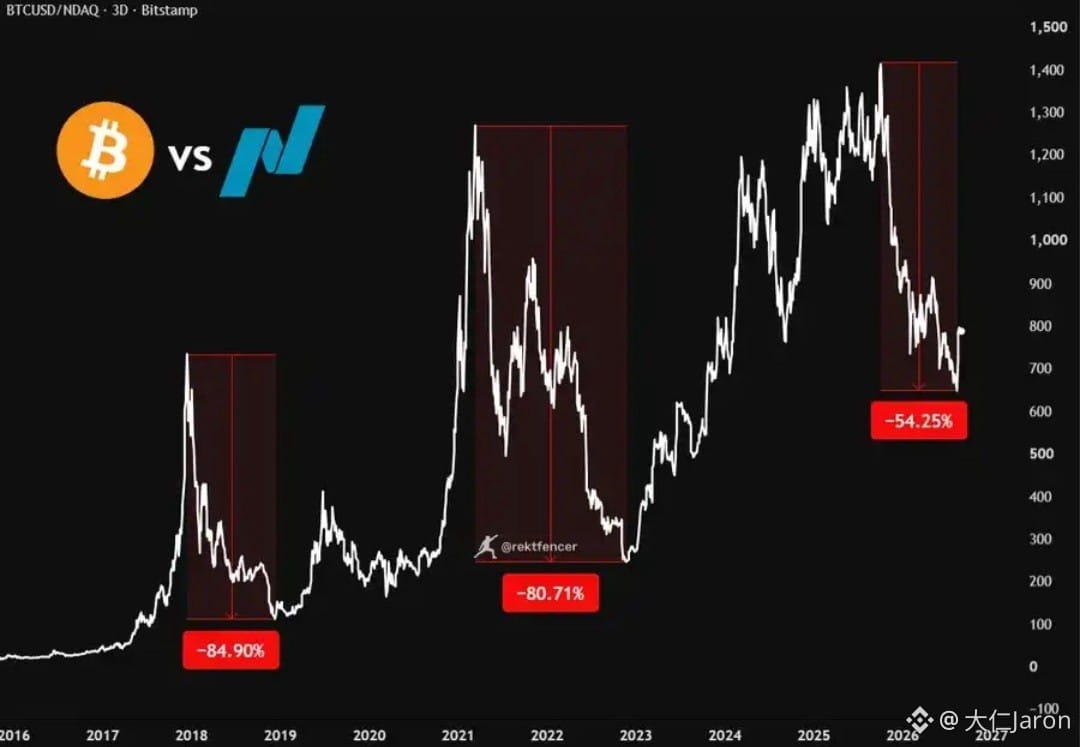
On August 30, analyst Rekt Fencer published a BTC vs. Nasdaq 3-day chart ratio, marking three notable drawdowns: approximately -84.9% in 2018, about -80.7% in 2022, and currently around -54.3% in 2026. Rekt Fencer said that after the first two times Bitcoin fell behind the Nasdaq by such a large margin, it was followed by a very strong independent uptrend, and the price was then sharply driven upward in a straight surge. Now the ratio has dropped significantly again; history may repeat for the third time. The bottom is already near, and next BTC will strengthen again.
🧧🧧🧧Reply 666 to get $SOL 🧧🧧🧧
🎁🎁🎁👇👇👇🎁🎁🎁
🧧🧧🧧Reply 666 to get $SOL 🧧🧧🧧
🎁🎁🎁👇👇👇🎁🎁🎁
PINNED


币圈淘金小旋风
·
--
$BTC $ETH $BNB sideways consolidation is grinding people, 🐮🐮🐮🐮🐮🐮🐮 is the market still there? Do BTC and ETH have hopes of breaking to new highs?
Truth be told, the crypto space has been really exhausting lately. BTC and ETH have been stuck in a range for a long time, grinding back and forth. They can’t rise much, and they don’t fall deeply either. A lot of people have run out of patience—asking every day: when will it finally choose a direction? Has the bull market already quietly ended?🔥
To be honest, this is a classic sideways washout phase right now. Neither the longs nor the shorts have the upper hand. Trading volume has also been shrinking. Short-term funds are shuffling around; chasing the price gets you trapped, while trying to bottom-fish leaves you worried it’ll keep grinding. Many retail traders who can’t hold their positions get shaken out by this kind of repeated volatility.
Whether the bull move is over can’t be judged solely by short-term sideways action. As long as the big trend hasn’t been thoroughly broken down, don’t hastily conclude that the bull market is finished. If you want new highs, you need a breakout with increased volume over key resistance. Without volume to back it up, even if price spikes, it could be a false breakout and easily get hammered back down.
ETH has more volatility—basically it follows “Big Pie” (BTC). As long as BTC doesn’t move, ETH is hard to establish an independent upswing.
Now,千万别乱操作—don’t mess around with random trades. Don’t rush to bet on a one-way surge or crash. Break above and hold the resistance before considering a long. If key support breaks down, be careful about the next round of pullback. During a sideways phase, the worst thing is frequent back-and-forth trading—it’s easy to get beaten repeatedly. #黄金本周下跌3.24% #特朗普达成委内瑞拉17油田开发协议 #日元贬值日本已投入970亿美元护盘
Truth be told, the crypto space has been really exhausting lately. BTC and ETH have been stuck in a range for a long time, grinding back and forth. They can’t rise much, and they don’t fall deeply either. A lot of people have run out of patience—asking every day: when will it finally choose a direction? Has the bull market already quietly ended?🔥
To be honest, this is a classic sideways washout phase right now. Neither the longs nor the shorts have the upper hand. Trading volume has also been shrinking. Short-term funds are shuffling around; chasing the price gets you trapped, while trying to bottom-fish leaves you worried it’ll keep grinding. Many retail traders who can’t hold their positions get shaken out by this kind of repeated volatility.
Whether the bull move is over can’t be judged solely by short-term sideways action. As long as the big trend hasn’t been thoroughly broken down, don’t hastily conclude that the bull market is finished. If you want new highs, you need a breakout with increased volume over key resistance. Without volume to back it up, even if price spikes, it could be a false breakout and easily get hammered back down.
ETH has more volatility—basically it follows “Big Pie” (BTC). As long as BTC doesn’t move, ETH is hard to establish an independent upswing.
Now,千万别乱操作—don’t mess around with random trades. Don’t rush to bet on a one-way surge or crash. Break above and hold the resistance before considering a long. If key support breaks down, be careful about the next round of pullback. During a sideways phase, the worst thing is frequent back-and-forth trading—it’s easy to get beaten repeatedly. #黄金本周下跌3.24% #特朗普达成委内瑞拉17油田开发协议 #日元贬值日本已投入970亿美元护盘


@必按666 势不可挡 unstoppable
必按666 势不可挡
·
--
Use Binance’s prediction new platform to predict the direction of this historic oil agreement based on the past—let’s see if you can predict it correctly!
🔥 Historic oil agreement
Reports say that the United States and Venezuela have reached an agreement on a 100-year oil cooperation, covering 17 oil fields, with an estimated 65 billion barrels of proven potential reserves.
Up to $100 billion can be invested in Venezuela’s oil industry.
Venezuelan crude oil may also help replenish the United States’ strategic petroleum reserves.
#石油 #委内瑞拉 #美国 #越南试点加密资产市场
🔥 Historic oil agreement
Reports say that the United States and Venezuela have reached an agreement on a 100-year oil cooperation, covering 17 oil fields, with an estimated 65 billion barrels of proven potential reserves.
Up to $100 billion can be invested in Venezuela’s oil industry.
Venezuelan crude oil may also help replenish the United States’ strategic petroleum reserves.
#石油 #委内瑞拉 #美国 #越南试点加密资产市场

On August 27, according to encrypted KOL Kunlun Xing, Binance founder CZ attended an in-person book lovers meetup for 《Binance Life》 in Hong Kong. He set up a booth to sell books on site, actively chatted with customers who bought books, and said he accepts payments in Hong Kong dollars or RMB. Throughout the event, he stayed down-to-earth, interacted with readers at the venue, and responded with “Thank you for your patronage.”
In addition, today CZ will attend the Bitcoin Asia 2026 conference, scheduled to hold an interview from 15:00 to 15:30 on the theme of 《The Bitcoin Century》.
In addition, today CZ will attend the Bitcoin Asia 2026 conference, scheduled to hold an interview from 15:00 to 15:30 on the theme of 《The Bitcoin Century》.

Log in to explore more content