
橙子Joyce
206 Posts

橙子Joyce
 Square Verified+
价值投资者:以十年为单位投资美股及BTC.ETH.BNB.SOL.推特X:@Joyce88ai

BNB Holder
Frequent Trader
8.7 Years
727 Following
32.1K+ Followers
39.3K+ Liked
Posts
All
Quotes
Videos
Live
PINNED
NVIDIA and SpaceX form a “match made in heaven”! Rubin computing power reaches space orbit, and Musk anchors SpaceX’s valuation to a Type II Kardashev civilization
In some parallel universe, NVIDIA CEO Jensen Huang and “Mr. All-Powerful” and world’s richest man Elon Musk might be a pair of cosmic super heroes.
Right after “AI chip superpower” $NVIDIA (NVDA.US)$ just released a strong earnings report further lifting global AI capex expectations and launching a new bull run across the AI compute supply chain, Musk is trying to push the expansion boundaries of AI infrastructure from ground level to space orbit—$SpaceX (SPCX.US)$, which he founded and leads, plans to launch its first batch of AI data-center satellites using NVIDIA’s next-generation compute cluster—an AI-dominant cluster led by the Vera Rubin architecture—into space in Q4 2027, and to achieve “significant scale” by 2028. This doesn’t mean ground data centers will be rapidly replaced; instead, it bets that compute in space orbit can bypass major bottlenecks such as terrestrial power grids, land, and water supply, becoming a new layer of AI compute supply.
For NVIDIA, this means expanding the potential market for Vera Rubin from “ground-based AI factories” to “orbital AI factories”; for SpaceX, it’s integrating Starship launches, orbital power, satellite networks, and AI cloud computing into a vertically integrated platform. However, Wall Street financial institutions like Evercore expect that meaningful revenue data won’t be available until as early as fiscal year 2029; thermal management, radiation, collisions, and regulation remain key constraints that will determine whether the concept can be commercialized.$NVDA.US
I invest in BNB and SPCX every day.
I suggest everyone invest according to their own allocation and, for those using contracts, trade with small positions!
$SPCX
In some parallel universe, NVIDIA CEO Jensen Huang and “Mr. All-Powerful” and world’s richest man Elon Musk might be a pair of cosmic super heroes.
Right after “AI chip superpower” $NVIDIA (NVDA.US)$ just released a strong earnings report further lifting global AI capex expectations and launching a new bull run across the AI compute supply chain, Musk is trying to push the expansion boundaries of AI infrastructure from ground level to space orbit—$SpaceX (SPCX.US)$, which he founded and leads, plans to launch its first batch of AI data-center satellites using NVIDIA’s next-generation compute cluster—an AI-dominant cluster led by the Vera Rubin architecture—into space in Q4 2027, and to achieve “significant scale” by 2028. This doesn’t mean ground data centers will be rapidly replaced; instead, it bets that compute in space orbit can bypass major bottlenecks such as terrestrial power grids, land, and water supply, becoming a new layer of AI compute supply.
For NVIDIA, this means expanding the potential market for Vera Rubin from “ground-based AI factories” to “orbital AI factories”; for SpaceX, it’s integrating Starship launches, orbital power, satellite networks, and AI cloud computing into a vertically integrated platform. However, Wall Street financial institutions like Evercore expect that meaningful revenue data won’t be available until as early as fiscal year 2029; thermal management, radiation, collisions, and regulation remain key constraints that will determine whether the concept can be commercialized.$NVDA.US
I invest in BNB and SPCX every day.
I suggest everyone invest according to their own allocation and, for those using contracts, trade with small positions!
$SPCX


大仁Jaron
·
--
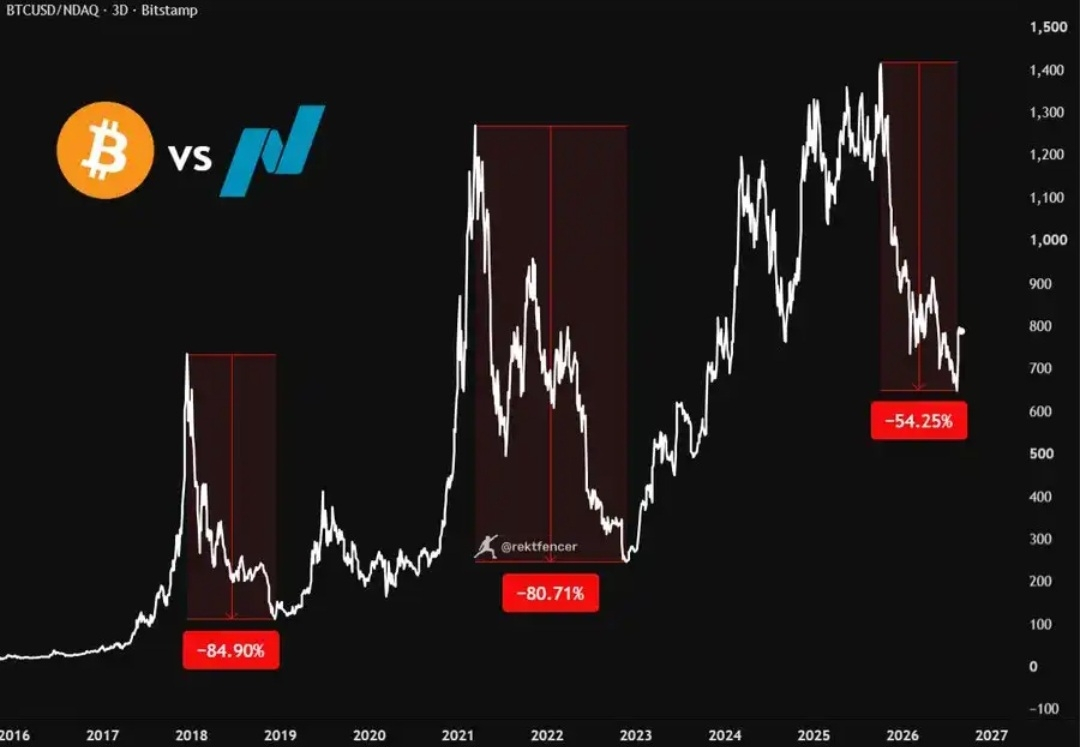
On August 30, analyst Rekt Fencer published a BTC vs. Nasdaq 3-day chart ratio, marking three notable drawdowns: approximately -84.9% in 2018, about -80.7% in 2022, and currently around -54.3% in 2026. Rekt Fencer said that after the first two times Bitcoin fell behind the Nasdaq by such a large margin, it was followed by a very strong independent uptrend, and the price was then sharply driven upward in a straight surge. Now the ratio has dropped significantly again; history may repeat for the third time. The bottom is already near, and next BTC will strengthen again.
🧧🧧🧧Reply 666 to get $SOL 🧧🧧🧧
🎁🎁🎁👇👇👇🎁🎁🎁
🧧🧧🧧Reply 666 to get $SOL 🧧🧧🧧
🎁🎁🎁👇👇👇🎁🎁🎁

大丽7613
·
--
[Replay] 🎙️ Let's talk about your gains in the crypto world—BNB
02 h 20 m 37 s · 14.6k listens

生蚝哥Oyster
·
--
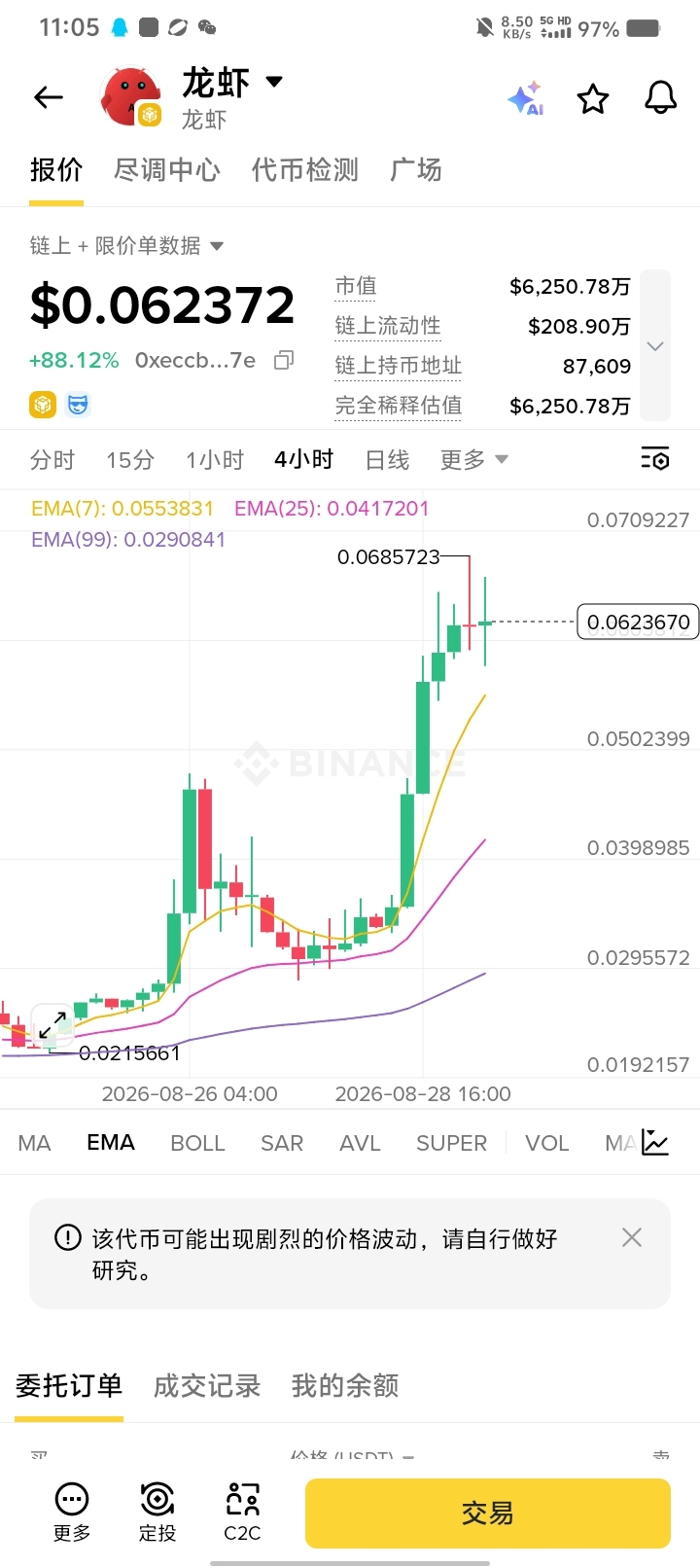
Bullish🌿A new week begins; market ups and downs are simply the norm.
Don’t let short-term fluctuations throw off your mindset. Keep your patience and sense of measure—stick to your own rhythm.
Wishing everyone stable positioning, with opportunities arriving as scheduled, and all things going well✨
Don’t let short-term fluctuations throw off your mindset. Keep your patience and sense of measure—stick to your own rhythm.
Wishing everyone stable positioning, with opportunities arriving as scheduled, and all things going well✨


加倉妹
·
--
The plane cuts through the clouds and only then do you see the sunlight above them.
Life is the same—if you don’t give up and bravely push through the difficulties in front of you, there will surely be a more beautiful view ahead! Keep going—your dreams are just around the corner! 😊
Life is the same—if you don’t give up and bravely push through the difficulties in front of you, there will surely be a more beautiful view ahead! Keep going—your dreams are just around the corner! 😊


奋斗1688BNB
·
--
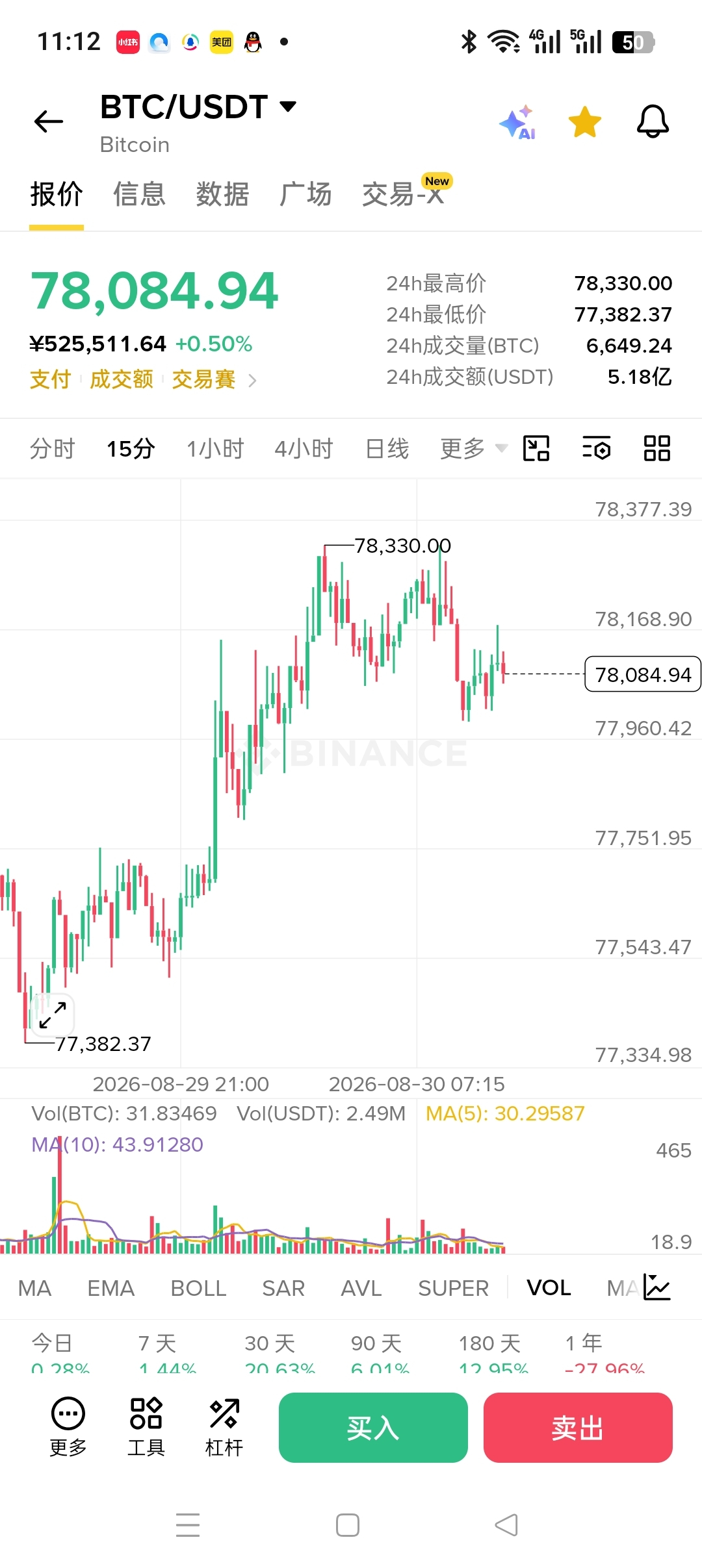
$BTC Honestly, deep down, I actually expect more than anyone else that BTC will pull back to around 40,000.
If we really get to this level, my take can be discussed and held for years.
But reality is right in front of us: that big bullish candle for BTC has pierced through three moving averages in one move, and the overall market structure has completely changed.
I can’t stick to old habits and stubbornly insist that BTC will definitely return to 40,000.
Some people will question: I was looking at 50,000 the other day—so why did my view change so quickly?
To be honest, I’m also afraid—afraid of missing out on this bull market cycle.
Thinking must evolve with the market.
Right now is the early stage of a transition from bear to bull, just like what people in my hometown say: when a young person is just beginning to show their talent, the market is only just starting to wake up.
There’s still a chance to get in, but for BTC in the 50-thousand handle, we probably won’t be waiting for that again.
Opportunities for positioning still exist around 65,000 and 68,000; in the worst case, around 70,000. The probability of this opportunity is at least 50%.
A single misstep can become a lifelong regret—by the time you turn around, the bull market has already gone far.
Every time a bull market starts, the path is never a simple copy of the previous one. Trying to “cut a boat by the sword,” blindly replicating past patterns, will only mislead yourself—and mislead the people around you.
Humble yourself to the trend—there’s nothing shameful about it.
Of course, chasing long positions right now isn’t rational either. If this round can’t break through 8.3W, the market will likely come into a pullback, and most likely trade sideways in the 65,000–72,000 range for 3–5 months.
Then, once one day sees a breakout with strong volume, the bull market’s main surge toward 100,000 will officially begin—this is the scenario I think is most likely to play out next.
Why does the bodhisattva sit upside down? It’s a sigh for all sentient beings who refuse to turn back.
ETH will move in sync with BTC, oscillating as it pulls back to the 1,800–2,000 range—good for staged spot entries.
SOL dropping to 80–90 can be accumulated in batches.
PAXG pulling back to around 4,200–4,300 is worth watching; with multiple central banks continuously increasing large holdings, it’s something to pay attention to.
There are quite a few U.S. stock benchmarks. I’ll break them down one by one later. SPX won’t keep making lower lows; the rebound trend should continue. Previously, I planned long-term positions around 110, and that approach still holds.
Let me be candid here: I’m sorry—I was previously leaning too bearish. The market has already transitioned from bear to bull, and the bull market has only just started to show its head.
I hope the broader market will later offer a pullback. For family members who haven’t set up spot positions yet, you can use the pullback to enter in batches.
That’s all the thinking I can share. I hope everyone can抓紧 the cycle and time it well.
If we really get to this level, my take can be discussed and held for years.
But reality is right in front of us: that big bullish candle for BTC has pierced through three moving averages in one move, and the overall market structure has completely changed.
I can’t stick to old habits and stubbornly insist that BTC will definitely return to 40,000.
Some people will question: I was looking at 50,000 the other day—so why did my view change so quickly?
To be honest, I’m also afraid—afraid of missing out on this bull market cycle.
Thinking must evolve with the market.
Right now is the early stage of a transition from bear to bull, just like what people in my hometown say: when a young person is just beginning to show their talent, the market is only just starting to wake up.
There’s still a chance to get in, but for BTC in the 50-thousand handle, we probably won’t be waiting for that again.
Opportunities for positioning still exist around 65,000 and 68,000; in the worst case, around 70,000. The probability of this opportunity is at least 50%.
A single misstep can become a lifelong regret—by the time you turn around, the bull market has already gone far.
Every time a bull market starts, the path is never a simple copy of the previous one. Trying to “cut a boat by the sword,” blindly replicating past patterns, will only mislead yourself—and mislead the people around you.
Humble yourself to the trend—there’s nothing shameful about it.
Of course, chasing long positions right now isn’t rational either. If this round can’t break through 8.3W, the market will likely come into a pullback, and most likely trade sideways in the 65,000–72,000 range for 3–5 months.
Then, once one day sees a breakout with strong volume, the bull market’s main surge toward 100,000 will officially begin—this is the scenario I think is most likely to play out next.
Why does the bodhisattva sit upside down? It’s a sigh for all sentient beings who refuse to turn back.
ETH will move in sync with BTC, oscillating as it pulls back to the 1,800–2,000 range—good for staged spot entries.
SOL dropping to 80–90 can be accumulated in batches.
PAXG pulling back to around 4,200–4,300 is worth watching; with multiple central banks continuously increasing large holdings, it’s something to pay attention to.
There are quite a few U.S. stock benchmarks. I’ll break them down one by one later. SPX won’t keep making lower lows; the rebound trend should continue. Previously, I planned long-term positions around 110, and that approach still holds.
Let me be candid here: I’m sorry—I was previously leaning too bearish. The market has already transitioned from bear to bull, and the bull market has only just started to show its head.
I hope the broader market will later offer a pullback. For family members who haven’t set up spot positions yet, you can use the pullback to enter in batches.
That’s all the thinking I can share. I hope everyone can抓紧 the cycle and time it well.

路人1688-luren
·
--
The Meaning of Studying
Recently, several young streamers with large fan bases visited a university campus to chat with college students. Their educational backgrounds are not particularly outstanding, yet they earn substantial incomes through livestreaming. On stage, they talked about their experiences and perseverance, with some relaxed and teasing expressions mixed in as well. Such exchanges allow college students to see different paths to growth beyond the classroom—an inherently positive thing. However, once related videos went viral, some netizens began to lament: “What’s the use of going to college? After graduation, my monthly salary is only a few thousand yuan.” “It’s better to start streaming earlier.” … “The idea that studying is useless” seems to have taken on a new tone, sparking discussion as a result.


静心1688
·
--
💥Words that are true are not always pleasing; pleasing words are often not trustworthy.
💥The truth is often not easy to hear; words that sound beautiful are often not real.
#首笔抗量子比特币交易主网完成
#越南试点加密资产市场
💥The truth is often not easy to hear; words that sound beautiful are often not real.
#首笔抗量子比特币交易主网完成
#越南试点加密资产市场


oO小蝦米對抗大鯨魚Oo
·
--
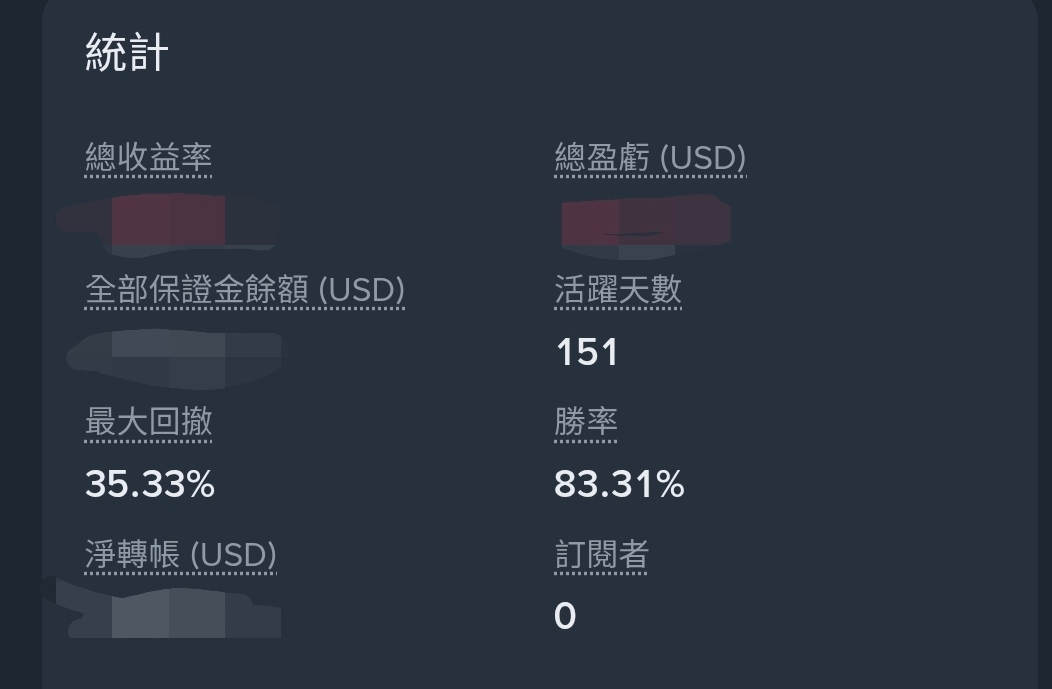
Little chives🥦’s loafnote📔 $BNB
I thought everyone was pretty much the same...
Turns out,
My investment portfolio really is🐮
I only found out now
Honestly, I just feel like I’m lucky😂
If, when it comes to trading, this kind of backtest
isn’t it pretty bad🤔
I thought everyone was pretty much the same...
Turns out,
My investment portfolio really is🐮
I only found out now
Honestly, I just feel like I’m lucky😂
If, when it comes to trading, this kind of backtest
isn’t it pretty bad🤔

Verified
G20 finance and technology meeting sets the tone for global monetary policy and new AI regulation rules
Next week, the United States will simultaneously host two key G20 ministerial-level meetings to warm up for the year-end G20 leaders’ summit. The two meetings will run in parallel, covering macro-finance and the technology industry, respectively—setting the tone for the direction of global economic policy and AI regulation.
August 31—September 1: The G20 meeting of finance ministers and central bank governors will focus on global inflation, macro policy coordination, exchange-rate volatility, debt risks, and financial stability. The wording in its communique will directly affect the U.S. dollar, U.S. Treasuries, and the outlook for major global asset classes.
September 1—September 2: The G20 technology ministers’ meeting will be held on top of that, bringing together technology officials worldwide and major tech leaders such as Musk, Jensen Huang, and Sam Altman. It will focus on implementing the U.S. AI “Carroll/AIO” principles, and discuss global AI governance, technological innovation, and the rules of the digital economy.
Tesla officially announces: Cybercab launch event on September 3
Stick to dollar-cost averaging into $BTC, $BNB, and mega-cap technology companies
$TSLAB
$NVDAB
$AAPL.US
Next week, the United States will simultaneously host two key G20 ministerial-level meetings to warm up for the year-end G20 leaders’ summit. The two meetings will run in parallel, covering macro-finance and the technology industry, respectively—setting the tone for the direction of global economic policy and AI regulation.
August 31—September 1: The G20 meeting of finance ministers and central bank governors will focus on global inflation, macro policy coordination, exchange-rate volatility, debt risks, and financial stability. The wording in its communique will directly affect the U.S. dollar, U.S. Treasuries, and the outlook for major global asset classes.
September 1—September 2: The G20 technology ministers’ meeting will be held on top of that, bringing together technology officials worldwide and major tech leaders such as Musk, Jensen Huang, and Sam Altman. It will focus on implementing the U.S. AI “Carroll/AIO” principles, and discuss global AI governance, technological innovation, and the rules of the digital economy.
Tesla officially announces: Cybercab launch event on September 3
Stick to dollar-cost averaging into $BTC, $BNB, and mega-cap technology companies
$TSLAB
$NVDAB
$AAPL.US
Verified
Wach提出九问
Wach raised nine questions in one go, and each of them hit the mark. But he did not give answers on the spot; instead, he said the Federal Reserve’s special working group would study these issues in subsequent reports.
For the Federal Reserve, the most core challenge is how artificial intelligence will affect the employment objective within its dual mandate. Two of the questions are centered on jobs. Historically, general-purpose new technologies like AI have always eliminated some jobs, but the number of new jobs ultimately created has often exceeded the number of jobs lost. Some people’s situation may worsen, but most people can benefit from it.
AI may be different.
AI can see, hear, speak, and perform logical reasoning. In the future, it will also smoothly carry out various physical labor. Therefore, its impact will not be confined to a single industry. Although some new jobs may be created, if supporting policies are lacking, the number of newly added positions will likely be far less than the number of existing jobs today.
AI may have already begun to disrupt employment in the U.S. information sector. This sector includes publishing, broadcasting, media, website operations, and software development, among other areas. Employment in this segment peaked in November 2022, the same month ChatGPT was first released. Since then, industry employment has declined by 11%. However, employment changes are influenced by multiple factors, making it difficult to isolate the impact attributable solely to AI.
The other two questions focus on labor productivity. Productivity is closely tied to employment and is also one of the core drivers of economic growth. Looking back at history, after new technologies are introduced, it often takes years or even decades for productivity benefits to become visible. Past experience suggests that in the early stages—before supporting employee training programs and business processes are fully formed—new technologies tend to put downward pressure on productivity.
Artificial intelligence will significantly shorten this time frame.
Continue with regular investment: #BTC , BNB, and below—large technology companies
$NVDA.US
$AMZNB
$METAB
Wach raised nine questions in one go, and each of them hit the mark. But he did not give answers on the spot; instead, he said the Federal Reserve’s special working group would study these issues in subsequent reports.
For the Federal Reserve, the most core challenge is how artificial intelligence will affect the employment objective within its dual mandate. Two of the questions are centered on jobs. Historically, general-purpose new technologies like AI have always eliminated some jobs, but the number of new jobs ultimately created has often exceeded the number of jobs lost. Some people’s situation may worsen, but most people can benefit from it.
AI may be different.
AI can see, hear, speak, and perform logical reasoning. In the future, it will also smoothly carry out various physical labor. Therefore, its impact will not be confined to a single industry. Although some new jobs may be created, if supporting policies are lacking, the number of newly added positions will likely be far less than the number of existing jobs today.
AI may have already begun to disrupt employment in the U.S. information sector. This sector includes publishing, broadcasting, media, website operations, and software development, among other areas. Employment in this segment peaked in November 2022, the same month ChatGPT was first released. Since then, industry employment has declined by 11%. However, employment changes are influenced by multiple factors, making it difficult to isolate the impact attributable solely to AI.
The other two questions focus on labor productivity. Productivity is closely tied to employment and is also one of the core drivers of economic growth. Looking back at history, after new technologies are introduced, it often takes years or even decades for productivity benefits to become visible. Past experience suggests that in the early stages—before supporting employee training programs and business processes are fully formed—new technologies tend to put downward pressure on productivity.
Artificial intelligence will significantly shorten this time frame.
Continue with regular investment: #BTC , BNB, and below—large technology companies
$NVDA.US
$AMZNB
$METAB

The peak of Bitcoin’s current bull cycle is likely driven by institutional capital and ETF demand outside the United States.
Improved stablecoin liquidity and continued development of tokenized asset infrastructure will expand global market participation.
For example, in South Korea, the country currently lacks spot Bitcoin ETFs, retail investors cannot buy overseas-listed spot Bitcoin ETFs, and most companies cannot open trading accounts to buy Bitcoin. South Korea has begun phasing in access for businesses. The Financial Services Commission (FSC) roadmap covers roughly 3,500 listed companies and eligible professional investors, but financial institutions and other firms are still excluded.
Strategy’s Bitcoin banking industry adopts an index-based assessment of 25 major institutions across areas such as trading, custody, digital asset products, financing, and corporate participation, with an overall adoption rate of 32%. Data shows that the value of globally tokenized distributed assets is $38.63 billion, up 2.65% from 30 days ago. The Bank for International Settlements (BIS) notes that stablecoins have the potential to enable faster, programmable payments, but their current design may introduce risks related to financial integrity, liquidity, and monetary aspects.
In the two years before listing, U.S. spot Bitcoin ETFs accumulated net inflows of about $57 billion.
The next phase will be global institutionalization, when more institutions view Bitcoin as a strategic asset and countries lacking ETFs will further develop their investment channels.
$BTC
$BNB
Improved stablecoin liquidity and continued development of tokenized asset infrastructure will expand global market participation.
For example, in South Korea, the country currently lacks spot Bitcoin ETFs, retail investors cannot buy overseas-listed spot Bitcoin ETFs, and most companies cannot open trading accounts to buy Bitcoin. South Korea has begun phasing in access for businesses. The Financial Services Commission (FSC) roadmap covers roughly 3,500 listed companies and eligible professional investors, but financial institutions and other firms are still excluded.
Strategy’s Bitcoin banking industry adopts an index-based assessment of 25 major institutions across areas such as trading, custody, digital asset products, financing, and corporate participation, with an overall adoption rate of 32%. Data shows that the value of globally tokenized distributed assets is $38.63 billion, up 2.65% from 30 days ago. The Bank for International Settlements (BIS) notes that stablecoins have the potential to enable faster, programmable payments, but their current design may introduce risks related to financial integrity, liquidity, and monetary aspects.
In the two years before listing, U.S. spot Bitcoin ETFs accumulated net inflows of about $57 billion.
The next phase will be global institutionalization, when more institutions view Bitcoin as a strategic asset and countries lacking ETFs will further develop their investment channels.
$BTC
$BNB

Verified
According to Forbes, Arthur Hayes, co-founder of BitMEX and head of the Maelstrom Fund, said that the bond-market support recently pledged by U.S. Treasury Secretary Scott Bessent will push the Federal Reserve to “keep printing money,” and that the price of Bitcoin could reach $250,000. “Get ready, start buying,” Hayes told podcast host Anthony Pompliano. He expects Bitcoin to “perform very well” in the coming years, adding, “We won’t experience a 2008-style large-scale credit crisis, but we will just keep printing money, and eventually you’ll see Bitcoin hit $250,000.” Hayes noted that if the market does not run according to Bessent’s wishes and keeps testing him, he would have to continue printing money, potentially taking actions similar to those of former Treasury Secretary Yellen—draining the Fed’s reverse repo tools and injecting $2.4 trillion in liquidity. This week, reports said Bessent has indicated the Treasury may use nearly $1 trillion from the Treasury General Account (TGA) to fund bond purchases.
Gold, silver, copper, BTC, ETH, BNB, SOL—are all well worth investing in!
$XAUT
$BTC
$BNB
Gold, silver, copper, BTC, ETH, BNB, SOL—are all well worth investing in!
$XAUT
$BTC
$BNB


Verified
Woush Jackson Hole debut sends hawkish signal: inflation still above 2%, and the Fed “still has work to do”
Summary of key points from Fed Chair Woush Jackson Hole speech:
1. On Friday, Fed Chair Kevin Woush reiterated that the central bank’s inflation target is benchmarked to the personal consumption expenditures (PCE) price index in a prepared statement for an economic symposium hosted by the Kansas City Fed. “There should be no misunderstanding: the Fed’s 2% price stability target, measured by the personal consumption expenditures (PCE) price index, is a steadfast and unshakable objective,” he said.
2. Woush confirmed that “short-term interest rates are the main tool for achieving the dual mandate. Unconventional policies intended to stimulate economic activity may be applicable in truly crisis moments, but in other circumstances they should be used with caution—indeed, they may not be used at all.”
3. Woush said that if core inflation is unable to keep falling, officials will have to take action. “We have to be confident that core inflation is moving toward our target—clearly and fast enough. Otherwise, we still have work to do.”
4. Woush said that policymakers should focus on prices for now, adding that recent inflation data that has been better than expected does not mean that “the underlying trend has seen a meaningful improvement. Inflation is still above our 2% target. Therefore, the Fed’s top priority should be prices at present,” he said.
5. Woush also defended its approach of lacking forward guidance. “A quieter Fed, with more targeted communication, will better achieve its goals. And whether we can deliver on the mission—that is the only truly meaningful standard for testing our credibility.”
$GOOGL.US
Google’s stock price is very attractive; its cash flow ratio ranks among the global top ten. The price is really compelling—people are advised to buy.
Summary of key points from Fed Chair Woush Jackson Hole speech:
1. On Friday, Fed Chair Kevin Woush reiterated that the central bank’s inflation target is benchmarked to the personal consumption expenditures (PCE) price index in a prepared statement for an economic symposium hosted by the Kansas City Fed. “There should be no misunderstanding: the Fed’s 2% price stability target, measured by the personal consumption expenditures (PCE) price index, is a steadfast and unshakable objective,” he said.
2. Woush confirmed that “short-term interest rates are the main tool for achieving the dual mandate. Unconventional policies intended to stimulate economic activity may be applicable in truly crisis moments, but in other circumstances they should be used with caution—indeed, they may not be used at all.”
3. Woush said that if core inflation is unable to keep falling, officials will have to take action. “We have to be confident that core inflation is moving toward our target—clearly and fast enough. Otherwise, we still have work to do.”
4. Woush said that policymakers should focus on prices for now, adding that recent inflation data that has been better than expected does not mean that “the underlying trend has seen a meaningful improvement. Inflation is still above our 2% target. Therefore, the Fed’s top priority should be prices at present,” he said.
5. Woush also defended its approach of lacking forward guidance. “A quieter Fed, with more targeted communication, will better achieve its goals. And whether we can deliver on the mission—that is the only truly meaningful standard for testing our credibility.”
$GOOGL.US
Google’s stock price is very attractive; its cash flow ratio ranks among the global top ten. The price is really compelling—people are advised to buy.

GOOGLUS-0.36%
Verified
NVIDIA’s impressive earnings report caused its market value to surge by $442 billion in a single day; after the close, its market cap reached $5.49 trillion, marking the company’s second-largest single-day gain in history and completely breaking the “stock price must fall on earnings day” curse. The strong results dispelled the gloom over AI trading, catching short-sellers off guard, and also boosted the entire technology sector.
Although earnings expectations far exceeded forecasts, they may still be somewhat on the conservative side. The company has clearly described the current situation as “supply constrained.” If supply were not constrained, actual demand growth would be significantly higher.
NVIDIA’s outstanding growth is deeply embedded in Wall Street’s collective perception. Investors generally expect its performance to come in above expectations, which has led to its stock falling on six of the past eight earnings release days. This week, many options traders are still betting on the stock price to drop after the earnings announcement.
“Accelerated growth driven by architecture evolution (1:1 delivery ratio between LPU and NVL rack implementations, as well as the launch of the Vera intelligent CPU rack).”
“Capital returns remain strong. In fiscal 2027’s second quarter, the return amount hit a record $26 billion, including $20 billion in share repurchases and a quarterly dividend of $0.25 per share, totaling $6 billion.”
“Capacity ramp-up for Rubin and LPU is faster than expected. Vera Rubin has started mass production and shipments this month. All hyperscale data center, AI cloud platform, and system OEM vendors have placed orders, making it NVIDIA’s fastest-growing chip to date.
Groq 3 LPX is also now fully in production and will begin mass production and shipping later this quarter, with Neocloud NEBIUS becoming the first adopter. Revenue from the Vera Rubin chips is expected to account for about 20% of data center revenue in fiscal 2027’s third quarter.”
NVIDIA’s latest earnings report lifted Wall Street’s optimism, with a number of major banks—including Morgan Stanley, Citigroup, and Mizuho Bank—raising their target prices. Twenty-six investment banks increased their target price for NVIDIA by $250–$550!
I began investing in NVIDIA stock in the summer of 2020, and my understanding of the company has been very thorough and comprehensive. I have continued to invest in NVIDIA shares. I highly recommend that you allocate and buy NVIDIA stock as part of your investment portfolio.
$NVDA.US
Although earnings expectations far exceeded forecasts, they may still be somewhat on the conservative side. The company has clearly described the current situation as “supply constrained.” If supply were not constrained, actual demand growth would be significantly higher.
NVIDIA’s outstanding growth is deeply embedded in Wall Street’s collective perception. Investors generally expect its performance to come in above expectations, which has led to its stock falling on six of the past eight earnings release days. This week, many options traders are still betting on the stock price to drop after the earnings announcement.
“Accelerated growth driven by architecture evolution (1:1 delivery ratio between LPU and NVL rack implementations, as well as the launch of the Vera intelligent CPU rack).”
“Capital returns remain strong. In fiscal 2027’s second quarter, the return amount hit a record $26 billion, including $20 billion in share repurchases and a quarterly dividend of $0.25 per share, totaling $6 billion.”
“Capacity ramp-up for Rubin and LPU is faster than expected. Vera Rubin has started mass production and shipments this month. All hyperscale data center, AI cloud platform, and system OEM vendors have placed orders, making it NVIDIA’s fastest-growing chip to date.
Groq 3 LPX is also now fully in production and will begin mass production and shipping later this quarter, with Neocloud NEBIUS becoming the first adopter. Revenue from the Vera Rubin chips is expected to account for about 20% of data center revenue in fiscal 2027’s third quarter.”
NVIDIA’s latest earnings report lifted Wall Street’s optimism, with a number of major banks—including Morgan Stanley, Citigroup, and Mizuho Bank—raising their target prices. Twenty-six investment banks increased their target price for NVIDIA by $250–$550!
I began investing in NVIDIA stock in the summer of 2020, and my understanding of the company has been very thorough and comprehensive. I have continued to invest in NVIDIA shares. I highly recommend that you allocate and buy NVIDIA stock as part of your investment portfolio.
$NVDA.US
NVDAUS+0.69%
Verified
Walsh Jackson Hall’s first public speech is about to arrive! The market hopes he will talk more about economic issues, and views on interest-rate prospects are divided.
① Federal Reserve Chair Kevin Walsh will deliver his first keynote address at Jackson Hole on Friday at 10:00 PM Beijing time;
② According to a media survey, the market expects to receive more information from the Fed chair;
③ Among 31 respondents, 80% believe the Fed chair should provide more insights into the state of the economy.
I think the likelihood of not raising rates is relatively high, and it’s a very good idea to allocate capital to stocks of Nvidia, Microsoft, Amazon, and SpaceX.
The valuations of these companies are relatively reasonable right now, making them well-suited for a buy allocation.
$NVDA.US
$SPCX
$AAPL.US
① Federal Reserve Chair Kevin Walsh will deliver his first keynote address at Jackson Hole on Friday at 10:00 PM Beijing time;
② According to a media survey, the market expects to receive more information from the Fed chair;
③ Among 31 respondents, 80% believe the Fed chair should provide more insights into the state of the economy.
I think the likelihood of not raising rates is relatively high, and it’s a very good idea to allocate capital to stocks of Nvidia, Microsoft, Amazon, and SpaceX.
The valuations of these companies are relatively reasonable right now, making them well-suited for a buy allocation.
$NVDA.US
$SPCX
$AAPL.US

Log in to explore more content