

Stock investing—just look at the Golden Qilin analyst reports. Authoritative, professional, timely, and comprehensive—helping you uncover potential theme opportunities!
(Source: 21st Century Business Herald)
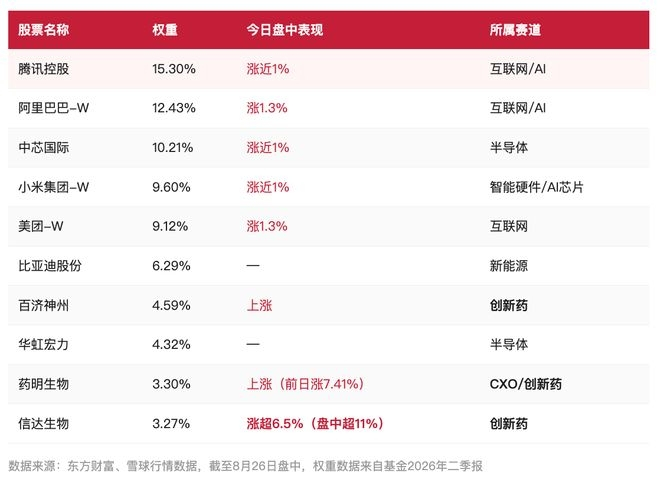
On August 26, all three major Hang Seng Indexes opened higher collectively. Innovative drug and internet stocks rose together! The Hong Kong Stock Connect Technology ETF Founder (159125) rose 1.26%; constituent stock Innovent Biologics surged more than 11%. BeiGene, Alibaba, and Meituan rose more than 2%, while Semiconductor Manufacturing International Corporation and Xiaomi Group rose more than 1%. Tencent Holdings and Wuxi Biologics also followed up with gains.
Industry analysis indicates that the core drivers behind today's rebound in Hong Kong stocks are two main lines: “AI monetization from the internet sector being realized + performance and catalysts for innovative drug companies resonating together.” On the internet side, after Alibaba's HK$80 billion AI placement was subscribed nearly three times over, the increased holdings by Jack Ma and management signaled strong confidence; on the innovative drug side, the half-year report profit of Innovent Biologics exceeded the total for all of 2025, while CanSino Biologics partnered with DpH to develop an mRNA tumor vaccine, together with earlier Phase III breakthroughs for mRNA cancer vaccines by Moderna/Merck & Co., leading to a concentrated release of market sentiment across the sector.
Catalyst one: AI-driven capital expenditure commitment from internet industry leaders + management making substantial purchases with real money
According to Alibaba’s August 23 announcement, its HKD 80 billion AI placement was subscribed at nearly 3 times the amount, with the proceeds investing 100% in full-stack AI capabilities and infrastructure construction. It attracted active subscriptions from long-term investors such as global sovereign wealth funds, setting a record for the largest block placement in Hong Kong stock history. Founder Jack Ma increased his holdings for several consecutive days by more than HKD 600 million; Chairman Joe Tsai increased his holdings by HKD 160 million over two days; CEO Eddie Wu Yun-ming increased his holdings by about HKD 40 million. Management moved urgently with real cash to convey confidence in AI.
For Xiaomi, it has released three self-developed chips: the AI flagship SoC Xuanjie O3, the high-bandwidth AI acceleration chip Xuanjie O100, and the intelligent driving high-computing AI chip Xuanjie D100. They will be applied across an entire ecosystem including smartphones, cars, and robots, strengthening the technology narrative.
Catalyst two: explosive performance from innovative drug companies + clinical catalysts + industry trend resonance
Cinda Bio’s interim report shows that its profit exceeded the full-year 2025 level. According to the announcement, in 2026H1 total revenue was RMB 8.618 billion (+44.8%), and IFRS net profit was RMB 1.253 billion (+50.2%), already surpassing full-year 2025 revenue of RMB 814 million. Cumulative BD transactions totaled USD 34.0 billion, accounting for more than 30% of the total outbound licensing transaction value for Chinese pharmaceutical companies in the same period. It also clearly sets a 2030 revenue target of RMB 35–40 billion.
In addition, CanSino Biologics teamed up with Depsell to develop an mRNA cancer vaccine: it signed a strategic cooperation framework agreement for the joint development of mRNA personalized therapeutic cancer vaccines, focusing on gastrointestinal solid tumors and rare tumors. CanSino’s intraday stock price surged by more than 18%.
For CXO, in 2026H1, Pharmaron/Medicines? (Wiming Lian?) comprehensive revenue was RMB 3.701 billion (+41.5%), adjusted net profit increased by 37.4%, and the net profit margin was 27.8%.
In September, WCLC (World Conference on Lung Cancer) will be held, and in October, ESMO (European Society for Medical Oncology) annual meeting will take place on October 23–27. The industry is entering a new round of intensive data catalyst period.
[Institution: take a dip to buy Hong Kong tech assets]
Dongwu Securities stated that the pricing focus for Hong Kong stocks has shifted from a dual model of “financial reports + macro” to a stage dominated by “macro factors.” The price-to-earnings ratio (PE-TTM) of the Hang Seng Tech Index is only 25 times, positioned at the 36th percentile over the past decade. It is far lower than the Nasdaq 100 and the ChiNext index. Since the AI full-stack advantages have not been fully reflected, the firm suggests buying on dips.
Essence Securities noted that “innovation + internationalization” remains the core main line for the pharmaceutical sector in 2026. China’s companies’ global competitiveness continues to strengthen; high-visibility and favorable conditions for outbound BD are expected to persist. The increasing number of Co-Co models reflects the enhancement of the industry’s discourse power. The sector is shifting from a “valuation-driven” mode to an “earnings + global execution-driven” mode. Major industry conferences’ clinical data, landmark BD deals, and breakthroughs in new technologies are important catalysts.
According to available information, the Hang Seng Tech ETF via Hong Kong Stock Connect (159125) tracks the Guo Zheng Hang Seng Tech Index (987008). The top ten holdings together account for about 75% of the total weight. The top ten weighted stocks include Tencent Holdings, Alibaba, Xiaomi Group, Meituan, BYD Company, Semiconductor Manufacturing International Corporation (SMIC), BeiGene, WuXi Biologics, Cinda Biologics, and Kuaishou. Among them, internet and innovative drugs are the two major pillars.
(The views expressed in this article are from licensed securities institutions and do not constitute any investment advice, nor do they represent the platform’s viewpoint. Investors should make independent judgments and decisions.)