
橙子Joyce
213 Posts

橙子Joyce
 Square Verified+
价值投资者:以十年为单位投资美股及BTC.ETH.BNB.SOL.推特X:@Joyce88ai

BNB Holder
Frequent Trader
8.7 Years
694 Following
30.9K+ Followers
36.8K+ Liked
Posts
All
Quotes
Videos
Live
PINNED
Verified
USDC issues nearly $2 billion more in one week—what supports Circle’s next growth cycle?
1.USDC ends nearly six months of sideways, weak performance, adding about $1.7 billion to $2.0 billion in supply within a week, becoming a direct signal that Circle’s fundamentals are recovering.
2.Awarded Circle a “beat the broader market” rating with a $140 target price, the long-term thesis hinges on whether Arc can convert institutional partnerships into assets, settlement, and revenue.
3.USDC’s total supply still lags behind USDT, but in transaction volumes after excluding bots and high-frequency activity, USDC’s share has already risen to 60% or more in 2026.
4.Real-world stablecoin payments are growing at about 30% year over year, but they currently account for only around 3% of adjusted transaction volume—so they have not yet become a major source of demand.
5.AI agent payments see nearly 19 million monthly transactions, but the value is only about $1 million; at this stage, it mainly reflects infrastructure adoption.
USDC re-expands, and the top-tier competitive landscape has not changed for now
Even with supply below USDT, USDC captures more effective trading volume
Payments grow steadily, while AI agents remain stuck in “small-ticket, high-frequency”
Arc will be the real test of Circle’s platformization
At this stage, Circle’s most certain growth still comes from the rebound in USDC supply and an increase in trading share. Payment rails, tokenized asset economics, and AI agent activity also offer further room to expand valuation potential, but these businesses still need to go through the transformation from partnership announcements to infrastructure adoption, and ultimately to asset realization and revenue capture.
Next, the market needs to watch four variables:
1.Can USDC supply continue to grow?
2.Can the adjusted transaction share hold steady?
3.Can the share of real-world payments increase?
4.After Arc goes live, can it attract real assets and pull transactions in?
$BTC
$BNB
1.USDC ends nearly six months of sideways, weak performance, adding about $1.7 billion to $2.0 billion in supply within a week, becoming a direct signal that Circle’s fundamentals are recovering.
2.Awarded Circle a “beat the broader market” rating with a $140 target price, the long-term thesis hinges on whether Arc can convert institutional partnerships into assets, settlement, and revenue.
3.USDC’s total supply still lags behind USDT, but in transaction volumes after excluding bots and high-frequency activity, USDC’s share has already risen to 60% or more in 2026.
4.Real-world stablecoin payments are growing at about 30% year over year, but they currently account for only around 3% of adjusted transaction volume—so they have not yet become a major source of demand.
5.AI agent payments see nearly 19 million monthly transactions, but the value is only about $1 million; at this stage, it mainly reflects infrastructure adoption.
USDC re-expands, and the top-tier competitive landscape has not changed for now
Even with supply below USDT, USDC captures more effective trading volume
Payments grow steadily, while AI agents remain stuck in “small-ticket, high-frequency”
Arc will be the real test of Circle’s platformization
At this stage, Circle’s most certain growth still comes from the rebound in USDC supply and an increase in trading share. Payment rails, tokenized asset economics, and AI agent activity also offer further room to expand valuation potential, but these businesses still need to go through the transformation from partnership announcements to infrastructure adoption, and ultimately to asset realization and revenue capture.
Next, the market needs to watch four variables:
1.Can USDC supply continue to grow?
2.Can the adjusted transaction share hold steady?
3.Can the share of real-world payments increase?
4.After Arc goes live, can it attract real assets and pull transactions in?
$BTC
$BNB
PINNED
Verified
SpaceX plans to build a $100 billion Starship launch base on the southern coast of Louisiana, adding a third Starship launch site. The facility will be located on Pea Island, covering about 125,000 acres. It is planned to construct five launch complexes, 10 launch pads, as well as propellant production, power generation, spacecraft processing, and employee housing facilities. The base will help SpaceX increase the frequency of Starship launches and support plans to build up to 1 million data center satellites in the future. Starship will also be used to launch upgraded Starlink satellites, with the earliest orbit data center mission planned for 2027, and NASA astronauts for a Moon landing as early as 2028.
Acquiring Cursor is an important step for SpaceX to expand its enterprise-grade artificial intelligence capabilities, because Cursor’s technology and data can help improve the performance of Grok.
After integrating Cursor’s data into Grok’s supplemental training, Grok’s performance has already improved significantly. Grok 4.6 combines powerful AI capabilities with costs that are substantially lower than comparable products, making it more appealing to users and supporting broader applications.
As enterprise customers’ profitability potential for Grok becomes increasingly important over time, artificial intelligence may become a larger contributor to SpaceX’s revenue. More widespread applications and continuously improving profitability will provide new momentum for growth beyond SpaceX’s existing business.
Now SpaceX’s stock price is very attractive, and positioning ahead of time to buy is the best investment strategy. In the next 3–5 years, you could see multiple times the returns!
For reference only!
$SPCXB
Acquiring Cursor is an important step for SpaceX to expand its enterprise-grade artificial intelligence capabilities, because Cursor’s technology and data can help improve the performance of Grok.
After integrating Cursor’s data into Grok’s supplemental training, Grok’s performance has already improved significantly. Grok 4.6 combines powerful AI capabilities with costs that are substantially lower than comparable products, making it more appealing to users and supporting broader applications.
As enterprise customers’ profitability potential for Grok becomes increasingly important over time, artificial intelligence may become a larger contributor to SpaceX’s revenue. More widespread applications and continuously improving profitability will provide new momentum for growth beyond SpaceX’s existing business.
Now SpaceX’s stock price is very attractive, and positioning ahead of time to buy is the best investment strategy. In the next 3–5 years, you could see multiple times the returns!
For reference only!
$SPCXB

小银-路飞社区
·
--
Either build a team, or join a team.
The way forward and making your move,
I definitely choose the latter.
Choosing matters more than working hard.
If you don’t have the gift, you’ll have to learn to catch on!
The way forward and making your move,
I definitely choose the latter.
Choosing matters more than working hard.
If you don’t have the gift, you’ll have to learn to catch on!



ABL阿布辣2020
·
--
Support to Bitcoin? The U.S. repurchases long-term bonds, even possibly tapping trillions in TGA—yet yields stay high
The U.S. Treasury expands its repurchase of long-term Treasuries (raising the per-operation cap from roughly $2 billion to at least $4 billion, and potentially increasing it further), while reports say it may use nearly $950 billion in TGA funds (Treasury General Account) to support bond purchases. The moment the news broke, it immediately drove a surge in Bitcoin and gold (Bitcoin bounced quickly from its lows, with a sizable gain in a short time, accompanied by extensive liquidation of short positions). However, U.S. bond yields—especially at the long end—after a brief dip, rebounded strongly, returning to elevated levels. Analysts generally believe that with the current scale of repurchase operations alone, it’s difficult to truly relieve the pressure of high yields. Behind this are structural issues such as a large supply of Treasuries, persistent fiscal deficits, and insufficient long-end buying demand in the market.
In short: the Treasury wants to push down long-term bond yields through repurchases, but yields didn’t come down—Bitcoin surged first instead. The market still has doubts about the durability of high yields. $BTC #财政部拟动用TGA #长债回购能否治本
The U.S. Treasury expands its repurchase of long-term Treasuries (raising the per-operation cap from roughly $2 billion to at least $4 billion, and potentially increasing it further), while reports say it may use nearly $950 billion in TGA funds (Treasury General Account) to support bond purchases. The moment the news broke, it immediately drove a surge in Bitcoin and gold (Bitcoin bounced quickly from its lows, with a sizable gain in a short time, accompanied by extensive liquidation of short positions). However, U.S. bond yields—especially at the long end—after a brief dip, rebounded strongly, returning to elevated levels. Analysts generally believe that with the current scale of repurchase operations alone, it’s difficult to truly relieve the pressure of high yields. Behind this are structural issues such as a large supply of Treasuries, persistent fiscal deficits, and insufficient long-end buying demand in the market.
In short: the Treasury wants to push down long-term bond yields through repurchases, but yields didn’t come down—Bitcoin surged first instead. The market still has doubts about the durability of high yields. $BTC #财政部拟动用TGA #长债回购能否治本

楠楠nannan势不可挡
·
--
Bullish🧧🧧🧧🧧🧧🧧
Red date tea steeped in the morning doesn’t taste right until the afternoon. Turns out you don’t have to rush through your days—slow down and you’ll taste the sweetness
Red date tea steeped in the morning doesn’t taste right until the afternoon. Turns out you don’t have to rush through your days—slow down and you’ll taste the sweetness





·
--
🎙️ Superman 100U fixed investment in BTC on day 12, DUSK long or short

End
02 h 23 m 12 s
7.5k
15
·
--
🎙️ When the moment gets urgent, stay calm and look back on the usual road. bnb

End
02 h 24 m 20 s
8k
20

叮噹-Doraemon
·
--
Can AI run directly into the heart of financial core systems? IBM mainframe chips achieve a major breakthrough: a single chip natively supports both IBM and Arm architectures
AI News Flash: At Hot Chips, IBM unveiled a new-generation dual-architecture host processor. For the first time, a single chip can natively run both IBM host instruction sets and Arm instruction sets, enabling nanoscale-speed switching between the two architectures without simulation or conversion.
Key highlights of the core:
① Dual-architecture on one die: each processor core can natively execute both IBM Z and Arm instructions, enabling nanoscale switching. No separate heterogeneous cores or traditional simulation methods are used.
② Top-tier process and performance: built using an advanced 2-nanometer manufacturing process, with a clock speed exceeding 5.7GHz. Includes an AI inference accelerator and a large on-chip cache.
Key highlights of the core:
① Dual-architecture on one die: each processor core can natively execute both IBM Z and Arm instructions, enabling nanoscale switching. No separate heterogeneous cores or traditional simulation methods are used.
② Top-tier process and performance: built using an advanced 2-nanometer manufacturing process, with a clock speed exceeding 5.7GHz. Includes an AI inference accelerator and a large on-chip cache.

生蚝哥Oyster
·
--
Bullish🧧No need to rush—don’t be swayed by short-term gains or losses. Don’t be anxious about what you have or haven’t gained in the moment. Make friends with time.
Let patience sink in and simply wait for things to bloom. All your perseverance and waiting will eventually be answered by the passage of years.
May we all be able to steady our mindset, slowly cultivate, and reap the long-term benefits that belong to us ✨
#bnb
Let patience sink in and simply wait for things to bloom. All your perseverance and waiting will eventually be answered by the passage of years.
May we all be able to steady our mindset, slowly cultivate, and reap the long-term benefits that belong to us ✨
#bnb




蒋雅琪1368
·
--
$BNB, the great Binance. This time, they’re going straight into Bhutan and teaming up with local DK Bank. Now, just with the Binance app, you can scan and spend crypto at more than 3,700 stores!
What’s most explosive is that all fees are waived before the end of 2026!
Binance’s global expansion this round is too aggressive—more and more use cases are coming up, and the BNB ecosystem is about to take off.
$BNB $GIGGLE $Binance Life
What’s most explosive is that all fees are waived before the end of 2026!
Binance’s global expansion this round is too aggressive—more and more use cases are coming up, and the BNB ecosystem is about to take off.
$BNB $GIGGLE $Binance Life

乘风Sunshine
·
--
The court ruled that Sun Yuchen’s personal claim would continue to be heard in open court, while the portion of the lawsuit against WLFI is pending further negotiation
WLFI co-founder Zach Witkoff said that Sun Yuchen’s statements about the trial outcome contain multiple falsehoods, claiming that he packaged his message that “personal demands are temporarily left with the court” as a victory.
First Digital CEO Vincent Chok responded that Sun Yuchen’s remarks about FDUSD are seriously inaccurate, and that Sun has yet to present any evidence in court to support the allegations.
First Digital filed a defamation lawsuit against Sun Yuchen in Hong Kong in April 2025.
#孙宇晨 #WLFI .
WLFI co-founder Zach Witkoff said that Sun Yuchen’s statements about the trial outcome contain multiple falsehoods, claiming that he packaged his message that “personal demands are temporarily left with the court” as a victory.
First Digital CEO Vincent Chok responded that Sun Yuchen’s remarks about FDUSD are seriously inaccurate, and that Sun has yet to present any evidence in court to support the allegations.
First Digital filed a defamation lawsuit against Sun Yuchen in Hong Kong in April 2025.
#孙宇晨 #WLFI .

go
Bilverse
·
--
🧧 EXCLUSIVE ETH GIVEAWAY IS LIVE! 🧧
I’m giving back to the community! Want a piece of the pie? Here is your chance to claim your share of Ethereum.
How to Enter:
1. 💬 Comment "ETH" below
2. 🔄 Share this post to spread the word.
3. 🔔 Follow @Bilverse for future drops and giveaways.
⚡ Limited slots available—first come, first served!
Click here to DOUBLE your Rewards! 🧧🚀
Drop your comments now! 👇
#ETH #RedPacketMission #Bilverse #CryptoCommunity
I’m giving back to the community! Want a piece of the pie? Here is your chance to claim your share of Ethereum.
How to Enter:
1. 💬 Comment "ETH" below
2. 🔄 Share this post to spread the word.
3. 🔔 Follow @Bilverse for future drops and giveaways.
⚡ Limited slots available—first come, first served!
Click here to DOUBLE your Rewards! 🧧🚀
Drop your comments now! 👇
#ETH #RedPacketMission #Bilverse #CryptoCommunity


大仁Jaron
·
--
U.S. Bets on Stablecoins [ Takeover ] as It Sells Off $29 Billion in Short-Term Treasuries
In June, foreign investors had a total net inflow of $133.5 billion into U.S. financial markets, but during the same period they sold $29.0 billion worth of Treasury bills.
Two sets of data show two distinctly different directions of capital flows within the same month: most incoming funds flowed toward the U.S. stock market, but demand for U.S. government debt weakened significantly. Foreign buyers purchased $181.4 billion worth of U.S. stocks, but only $6.8 billion in long-term Treasury bonds; in the short-term bond segment, they sold off Treasury bills that are often used as a cash reservoir.
This divergence in capital flows also helps explain why stablecoins were included in the U.S. government debt-response strategy. Stablecoin issuers such as Tether and Circle typically allocate most of the reserve assets supporting the value of their tokens to Treasury bills and similar assets. If overseas buyers continue to reduce their holdings of Treasury bills, the rapidly growing stablecoin sector—potentially on a scale comparable to, and with demand power that could rival, overseas capital—may become another significant force. The June data shows that this industry already has a sufficient size, but the recent token-issuance scale is small and cannot by itself account for the $29.0 billion in selling pressure.
Two sets of data show two distinctly different directions of capital flows within the same month: most incoming funds flowed toward the U.S. stock market, but demand for U.S. government debt weakened significantly. Foreign buyers purchased $181.4 billion worth of U.S. stocks, but only $6.8 billion in long-term Treasury bonds; in the short-term bond segment, they sold off Treasury bills that are often used as a cash reservoir.
This divergence in capital flows also helps explain why stablecoins were included in the U.S. government debt-response strategy. Stablecoin issuers such as Tether and Circle typically allocate most of the reserve assets supporting the value of their tokens to Treasury bills and similar assets. If overseas buyers continue to reduce their holdings of Treasury bills, the rapidly growing stablecoin sector—potentially on a scale comparable to, and with demand power that could rival, overseas capital—may become another significant force. The June data shows that this industry already has a sufficient size, but the recent token-issuance scale is small and cannot by itself account for the $29.0 billion in selling pressure.
go

长得帅不如跑的快1688
·
--
🔥 BTC is still challenging $80K — but ETH may be the more interesting story today.
Crypto has staged a powerful recovery over the past week.
$BTC is still holding around the $78K area and remains within reach of the psychological $80K level.
But something new is happening:
ETH is starting to outperform BTC.
Ethereum has gained roughly 29% over the past week, compared with around 21% for Bitcoin. At the same time, U.S. spot ETH ETFs recorded approximately $697M in weekly net inflows.
That may be signaling an important shift:
Capital could be moving from a BTC-led rally toward broader rotation across major crypto assets.
BTC opened the door.
ETH is starting to attract the next wave of attention.
Now the question is whether that rotation continues.
📊 Three things I’m watching:
🔹 Can BTC remain stable around the $80K zone?
🔹 Can ETH continue outperforming BTC?
🔹 Will BNB and other majors attract the next wave of capital?
If BTC consolidates at higher levels while ETH continues to outperform, the market conversation could gradually shift from:
“How high can BTC go?”
to:
“Where does the money go NEXT?”
At this stage, watching Bitcoin alone may not be enough.
Capital rotation is becoming the story.
👇 Who are you watching for the next phase?
BTC / ETH / BNB
#BTC #ETH #BNB
Crypto has staged a powerful recovery over the past week.
$BTC is still holding around the $78K area and remains within reach of the psychological $80K level.
But something new is happening:
ETH is starting to outperform BTC.
Ethereum has gained roughly 29% over the past week, compared with around 21% for Bitcoin. At the same time, U.S. spot ETH ETFs recorded approximately $697M in weekly net inflows.
That may be signaling an important shift:
Capital could be moving from a BTC-led rally toward broader rotation across major crypto assets.
BTC opened the door.
ETH is starting to attract the next wave of attention.
Now the question is whether that rotation continues.
📊 Three things I’m watching:
🔹 Can BTC remain stable around the $80K zone?
🔹 Can ETH continue outperforming BTC?
🔹 Will BNB and other majors attract the next wave of capital?
If BTC consolidates at higher levels while ETH continues to outperform, the market conversation could gradually shift from:
“How high can BTC go?”
to:
“Where does the money go NEXT?”
At this stage, watching Bitcoin alone may not be enough.
Capital rotation is becoming the story.
👇 Who are you watching for the next phase?
BTC / ETH / BNB
#BTC #ETH #BNB

go

Techno BNB
·
--
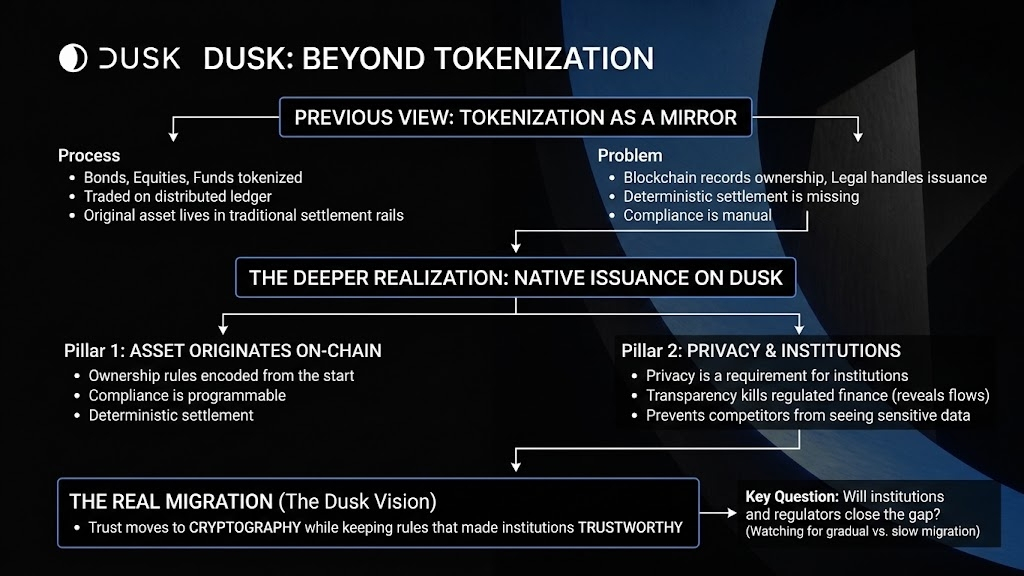
#dusk $DUSK @Dusk Previously, I used to think the migration to blockchain was about bringing existing assets on-chain.
Bonds. Equities. Funds. Tokenize them, trade them on a distributed ledger, and the hardest part was done.
But the more I looked into Dusk, the more I realized that view was incomplete.
Tokenization is a mirror. It reflects an existing asset onto a new system while the original instrument still lives in traditional settlement rails. The blockchain records ownership. The legal system still handles issuance and enforcement. The token is a representation, not a replacement.
Dusk is building for something different.
Native issuance means the asset itself originates on-chain. The ownership rules are encoded from the start. The settlement is deterministic, not probabilistic. The privacy is selective, not optional. The compliance is programmable, not manual.
Most chains treat privacy as a feature for users who want discretion. Dusk treats it as a requirement for institutions that cannot expose sensitive data to competitors. Most chains celebrate transparency as a virtue. Dusk recognizes that transparency kills regulated finance because a public ledger reveals positions and flows that institutions are legally bound to protect.
I find this approach far more practical than the standard crypto narrative.
The real migration is not assets moving to blockchain. It is trust moving to cryptography while keeping the rules that made institutions trustworthy. Dusk does not ask finance to abandon compliance. It asks finance to enforce compliance through code.
That is a harder path. It requires regulators to accept on-chain records as legal records. It requires institutions to trust confidential smart contracts with custody and settlement.
I am still watching whether that migration happens gradually or whether the gap between what Dusk can do and what institutions are ready to adopt remains wider than the technology alone can bridge.
That is the gap I want to keep observing.
@Dusk
$DUSK
#dusk
Bonds. Equities. Funds. Tokenize them, trade them on a distributed ledger, and the hardest part was done.
But the more I looked into Dusk, the more I realized that view was incomplete.
Tokenization is a mirror. It reflects an existing asset onto a new system while the original instrument still lives in traditional settlement rails. The blockchain records ownership. The legal system still handles issuance and enforcement. The token is a representation, not a replacement.
Dusk is building for something different.
Native issuance means the asset itself originates on-chain. The ownership rules are encoded from the start. The settlement is deterministic, not probabilistic. The privacy is selective, not optional. The compliance is programmable, not manual.
Most chains treat privacy as a feature for users who want discretion. Dusk treats it as a requirement for institutions that cannot expose sensitive data to competitors. Most chains celebrate transparency as a virtue. Dusk recognizes that transparency kills regulated finance because a public ledger reveals positions and flows that institutions are legally bound to protect.
I find this approach far more practical than the standard crypto narrative.
The real migration is not assets moving to blockchain. It is trust moving to cryptography while keeping the rules that made institutions trustworthy. Dusk does not ask finance to abandon compliance. It asks finance to enforce compliance through code.
That is a harder path. It requires regulators to accept on-chain records as legal records. It requires institutions to trust confidential smart contracts with custody and settlement.
I am still watching whether that migration happens gradually or whether the gap between what Dusk can do and what institutions are ready to adopt remains wider than the technology alone can bridge.
That is the gap I want to keep observing.
@Dusk
$DUSK
#dusk
Log in to explore more content