



If you buy an asset worth 100,000 on-chain, others can see it—maybe that’s not a big deal.
But what if it’s an institution that buys tens of millions—or even hundreds of millions—in bonds in a single transaction?
How much you bought, when you bought, how your positions change, where you route funds next—even what you might want to do next—could all be inferred by market analysis.
This is also an issue that becomes increasingly hard to avoid when RWA truly moves into institutional use:
Blockchains need transparency, but institutions need privacy.
In the past few years, what RWA has solved more often is “how to move real-world assets onto the chain.”
And now, the problem has started to become:
Once assets are on-chain, how can you preserve the verifiability of the blockchain without leaving all commercial information exposed?
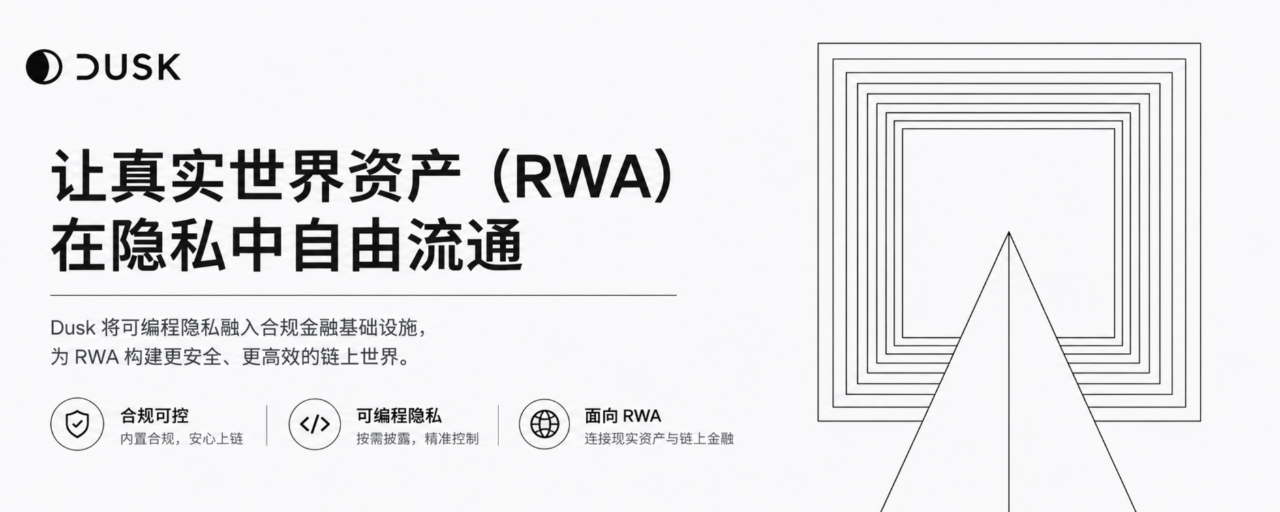
This is exactly the problem that Dusk aims to solve.
1️⃣ DuskEVM: Lower the barrier to app onboarding
DuskEVM is the EVM-compatible execution layer within the Dusk ecosystem. It supports Solidity, common EVM wallets, and mainstream development tools.
Teams familiar with the Ethereum development stack can leverage existing development experience to build financial applications on Dusk.
For RWA, this matters a great deal. The more mature the developer experience is, the better it is for real financial applications to be onboarded faster.
2️⃣ Programmable privacy
This is also the part of Dusk that deserves the most attention.
Once institutions put information on-chain, quotation strategies, position sizes, fund flows, and even trading intentions could all become sensitive information.
Dusk has designed Hedger for DuskEVM, using homomorphic encryption and zero-knowledge proofs to protect sensitive data while preserving the ability to validate transactions, conduct compliance reviews, and perform audits.
In simple terms:
Ordinary people can’t see sensitive information, while authorized parties can view it when the rules are satisfied.
Privacy scopes can be set according to rules—this is also the core of “programmable privacy.”
3️⃣ Move from tokenization to native issuance
Today, many RWA solutions still map existing assets onto the chain, and key processes like custody, registration, and clearing still heavily rely on off-chain systems.
An even further direction is to have the asset run more on-chain from the very beginning of issuance.
Issuance, transfer rules, settlement, and subsequent management can all be executed in a unified way via smart contracts—reducing duplicate reconciliations and intermediaries, and improving asset programmability and settlement efficiency.
But native on-chain issuance only solves the question of “how to issue.” To make assets truly circulate, you still need a complete set of supporting capabilities—trading, payments, data, compliance, and more.
4️⃣ In the end, RWA is about a complete infrastructure stack.
So, when it comes to actually bringing RWA to life, it’s hard to do it with just a single asset contract.
After asset issuance, there also needs to be someone to trade them, payment and settlement channels, and trustworthy market data, user onboarding/permissioning, cross-chain capabilities, and compliance mechanisms.
Dusk’s collaboration with NPEX involves the issuance, trading, and settlement of regulated financial instruments; the partnership with Chainlink covers trusted data and cross-chain capabilities; Dusk Trade is also integrating the asset discovery, whitelisting/permissioning, trading, and settlement flows.
Seen together, what Dusk wants to cover is the full end-to-end on-chain workflow for regulated assets—from issuance to circulation.
In the future, competition in RWA will increasingly focus on privacy, compliance, and settlement efficiency.
How far Dusk’s path can go ultimately depends on real business adoption and institutional uptake.
But “programmable privacy” is definitely worth continuing to watch.
