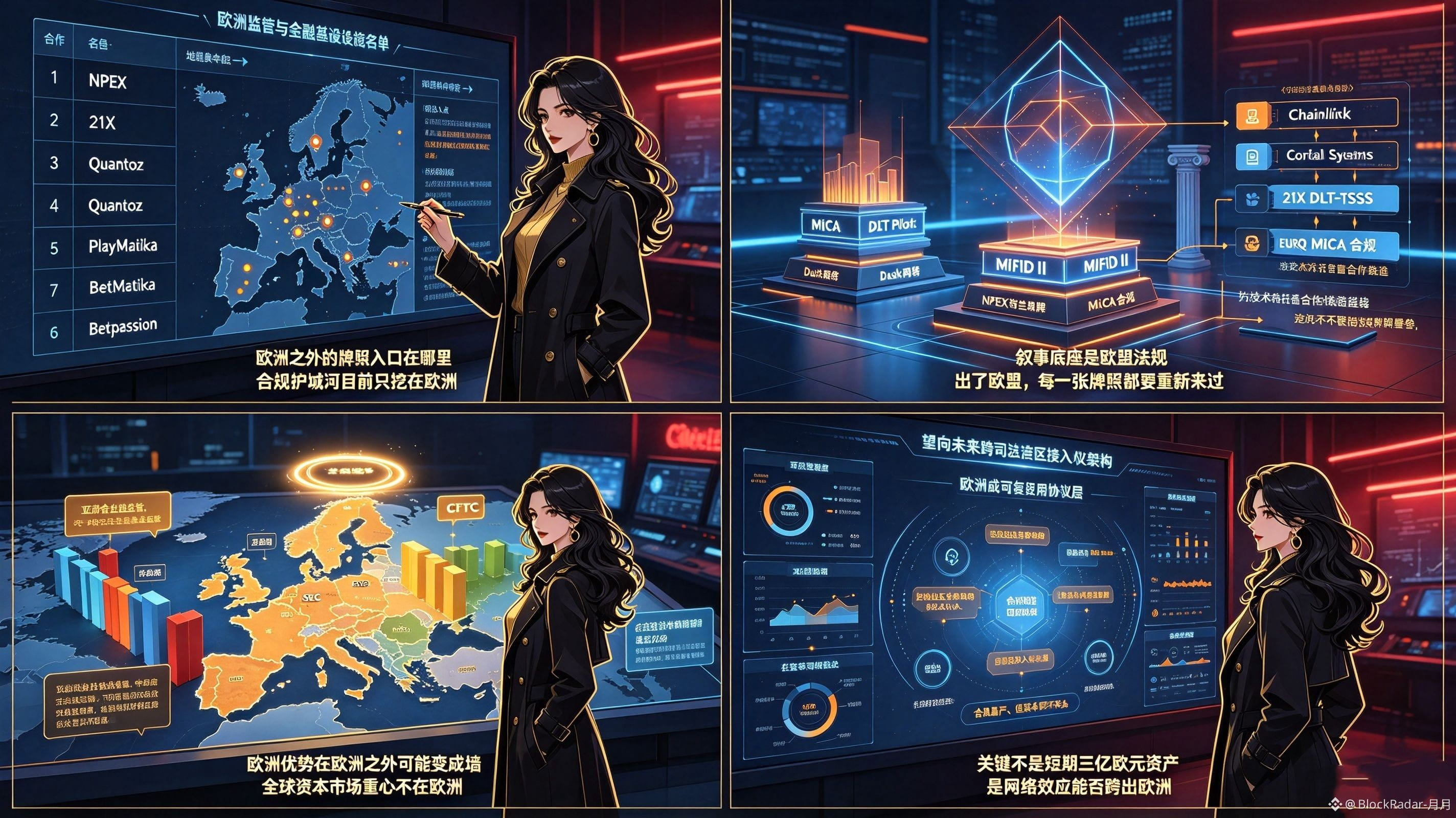
Last night I整理 @Dusk ’s partner roster and wanted to find licensed institutions outside Europe. I found that, in addition to NPEX, 21X, and Quantoz, Italy’s PlayMatika and Betpassion have also integrated with DuskPay—but they still fall within the EU. This geographical concentration made me pause for a long time before even getting to the table. I originally just wanted to map commercial progress, but I was pulled into a more fundamental issue: a chain that claims to be “global financial infrastructure” has, for now, only dug its compliance moat in Europe.
On the surface, Dusk is a privacy-compliant public chain. But the more I looked, the more it felt like its true core is a “digital mirror” of European financial regulation. Terms like MiCA, DLT Pilot, and MiFID II form the entire narrative foundation of Dusk. NPEX’s Dutch license, 21X’s DLT-TSS, and EURQ’s MiCA compliance—each one precisely corresponds to an EU regulation. Chainlink and Cordial Systems bring globalized technology and custody partnerships, but they are not licensed financial institutions, so they can’t replace the real barrier of licensing. The design is airtight in Brussels, but once you leave the EU, every license has to be recreated from scratch. #dusk
What makes me cautious is this: Europe’s compliance advantage is a moat within Europe, but outside Europe it could turn into a wall. The U.S. has the SEC and CFTC, and Asia has its own regulatory frameworks. If Dusk wants to enter those markets, it can’t simply reuse the EU compliance playbook—it has to rebuild the legal framework from the ground up and renegotiate licenses. And the center of gravity of global capital markets clearly isn’t in Europe—U.S. stocks, Asian bonds, Middle Eastern sovereign funds, all far beyond the scope Dusk can currently reach. Even more subtly, the privacy design depth of $DUSK is tightly bound to Europe’s data protection traditions; in other jurisdictions that may not be a positive, and sometimes it even requires additional explanation.
What I’m watching now is whether Dusk can abstract Europe’s compliance experience into a reusable technical architecture—so that licensed institutions elsewhere can integrate as quickly as plugging into a protocol, rather than having to go through an entirely new round of legal customization every time they enter a new jurisdiction. What I truly care about isn’t NPEX’s short-term €300M assets, but in the long run whether DUSK’s network effects can break out of Europe, or whether it will ultimately be trapped in a fortress of “the strictest compliance, but insufficient capital depth.”
On the surface, Dusk is a privacy-compliant public chain. But the more I looked, the more it felt like its true core is a “digital mirror” of European financial regulation. Terms like MiCA, DLT Pilot, and MiFID II form the entire narrative foundation of Dusk. NPEX’s Dutch license, 21X’s DLT-TSS, and EURQ’s MiCA compliance—each one precisely corresponds to an EU regulation. Chainlink and Cordial Systems bring globalized technology and custody partnerships, but they are not licensed financial institutions, so they can’t replace the real barrier of licensing. The design is airtight in Brussels, but once you leave the EU, every license has to be recreated from scratch. #dusk
What makes me cautious is this: Europe’s compliance advantage is a moat within Europe, but outside Europe it could turn into a wall. The U.S. has the SEC and CFTC, and Asia has its own regulatory frameworks. If Dusk wants to enter those markets, it can’t simply reuse the EU compliance playbook—it has to rebuild the legal framework from the ground up and renegotiate licenses. And the center of gravity of global capital markets clearly isn’t in Europe—U.S. stocks, Asian bonds, Middle Eastern sovereign funds, all far beyond the scope Dusk can currently reach. Even more subtly, the privacy design depth of $DUSK is tightly bound to Europe’s data protection traditions; in other jurisdictions that may not be a positive, and sometimes it even requires additional explanation.
What I’m watching now is whether Dusk can abstract Europe’s compliance experience into a reusable technical architecture—so that licensed institutions elsewhere can integrate as quickly as plugging into a protocol, rather than having to go through an entirely new round of legal customization every time they enter a new jurisdiction. What I truly care about isn’t NPEX’s short-term €300M assets, but in the long run whether DUSK’s network effects can break out of Europe, or whether it will ultimately be trapped in a fortress of “the strictest compliance, but insufficient capital depth.”