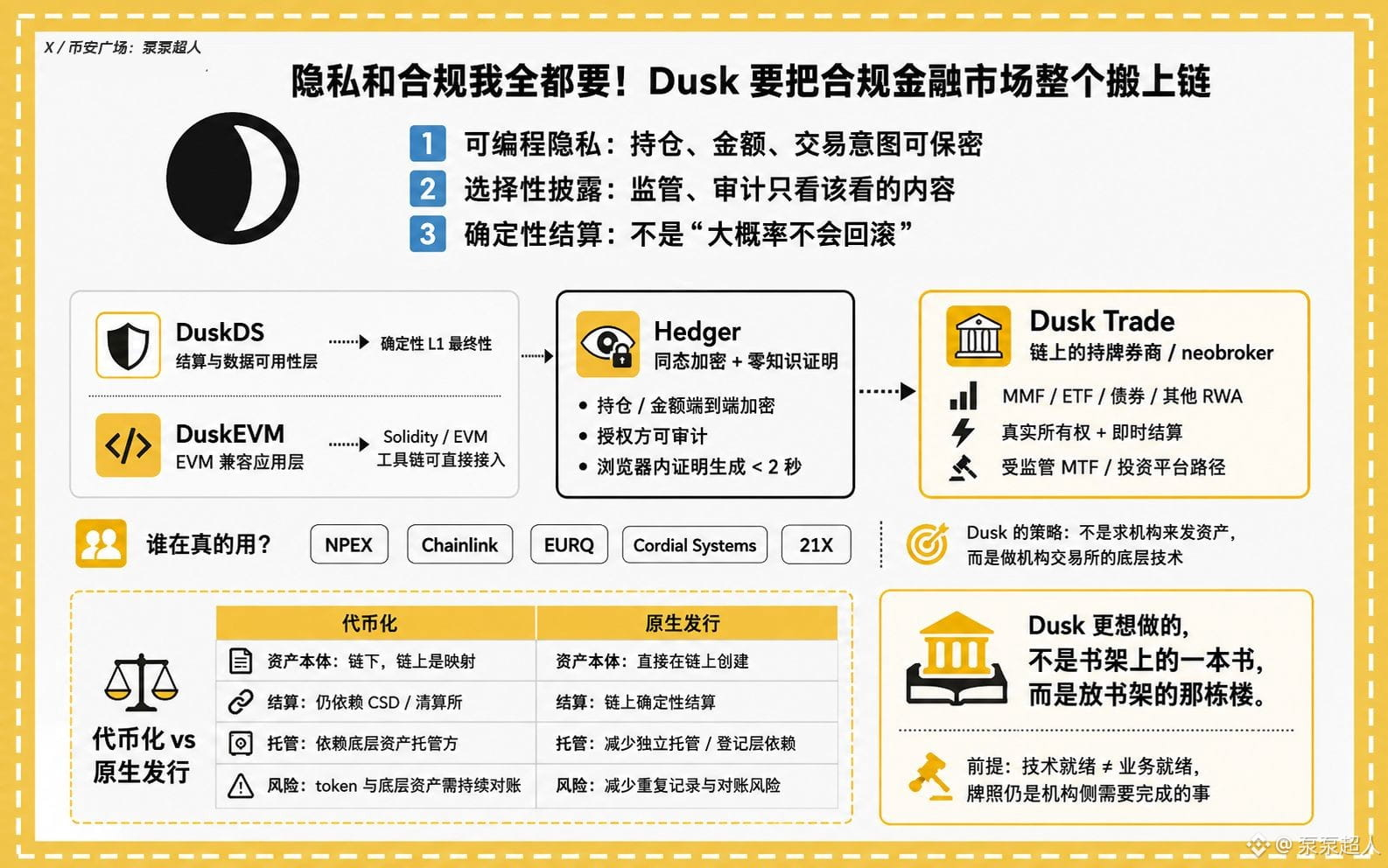

🤔 Compliance and privacy can’t coexist? Dusk @Dusk says you can have both—and it wants to bring compliant financial markets on-chain.
Binance’s slogan is “Exchange the world,” and the hottest narrative in the RWA track is tokenizing assets.
But for licensed institutions, three more fundamental problems block them:
1️⃣ Can my positions and trading counterparties be kept from being seen by the entire network?
2️⃣ When regulators show up to inspect, can we show them only what they need to see?
3️⃣ Is settlement deterministic—could it ever be rolled back?
Full transparency isn’t an issue for DeFi, but for TradFi assets it’s not feasible. This L1 from Dusk is designed to solve these three problems.
👉 What is $DUSK ?
For regulated financial markets, the core value proposition of this L1 is “programmable privacy”: positions, amounts, and trading intents are encrypted; compliance rules and settlement status remain transparent; authorized parties can selectively disclose, and the disclosed data is cryptographically guaranteed to be truthful.
The key term is “selective disclosure,” not “anonymity.” This is institutional-grade information access control—not a privacy coin.
⚙️ Mechanism layer: DuskEVM + Hedger
Dusk is evolving into a dual-layer architecture: DuskDS handles base settlement and data availability, providing deterministic finality;
DuskEVM is an EVM-compatible application layer. The mainnet is about to go live, and developers can connect directly using existing Solidity toolchains—zero migration cost.
The really interesting part is the privacy module, Hedger.
Most on-chain privacy solutions rely solely on ZK. Hedger takes a “homomorphic encryption + zero-knowledge proofs” combined approach: positions and amount data are end-to-end encrypted, but the party authorizing the transaction can still audit. It also supports an obfuscated order book, so when institutions place orders, their intent and exposure aren’t revealed.
🏦 Application layer: Dusk Trade, the on-chain “licensed broker”
DuskEVM is the foundation, and Dusk Trade is the front end for investors: bringing funds, ETFs, bonds, and other RWAs on-chain. Three highlights: true ownership, instant settlement, and DeFi-level composability.
In terms of legal structure, it operates under EU regulations in the form of a regulated MTF and an investment platform—following traditional financial licensing paths.
Dusk CEO’s analogy: while other RWA protocols are fighting for a spot on a bookshelf, #dusk wants to build the whole building where the bookshelf goes.
The strategy isn’t to ask institutions to issue assets on-chain, but to become the underlying technology for institutions’ own exchange.
Binance’s slogan is “Exchange the world,” and the hottest narrative in the RWA track is tokenizing assets.
But for licensed institutions, three more fundamental problems block them:
1️⃣ Can my positions and trading counterparties be kept from being seen by the entire network?
2️⃣ When regulators show up to inspect, can we show them only what they need to see?
3️⃣ Is settlement deterministic—could it ever be rolled back?
Full transparency isn’t an issue for DeFi, but for TradFi assets it’s not feasible. This L1 from Dusk is designed to solve these three problems.
👉 What is $DUSK ?
For regulated financial markets, the core value proposition of this L1 is “programmable privacy”: positions, amounts, and trading intents are encrypted; compliance rules and settlement status remain transparent; authorized parties can selectively disclose, and the disclosed data is cryptographically guaranteed to be truthful.
The key term is “selective disclosure,” not “anonymity.” This is institutional-grade information access control—not a privacy coin.
⚙️ Mechanism layer: DuskEVM + Hedger
Dusk is evolving into a dual-layer architecture: DuskDS handles base settlement and data availability, providing deterministic finality;
DuskEVM is an EVM-compatible application layer. The mainnet is about to go live, and developers can connect directly using existing Solidity toolchains—zero migration cost.
The really interesting part is the privacy module, Hedger.
Most on-chain privacy solutions rely solely on ZK. Hedger takes a “homomorphic encryption + zero-knowledge proofs” combined approach: positions and amount data are end-to-end encrypted, but the party authorizing the transaction can still audit. It also supports an obfuscated order book, so when institutions place orders, their intent and exposure aren’t revealed.
🏦 Application layer: Dusk Trade, the on-chain “licensed broker”
DuskEVM is the foundation, and Dusk Trade is the front end for investors: bringing funds, ETFs, bonds, and other RWAs on-chain. Three highlights: true ownership, instant settlement, and DeFi-level composability.
In terms of legal structure, it operates under EU regulations in the form of a regulated MTF and an investment platform—following traditional financial licensing paths.
Dusk CEO’s analogy: while other RWA protocols are fighting for a spot on a bookshelf, #dusk wants to build the whole building where the bookshelf goes.
The strategy isn’t to ask institutions to issue assets on-chain, but to become the underlying technology for institutions’ own exchange.