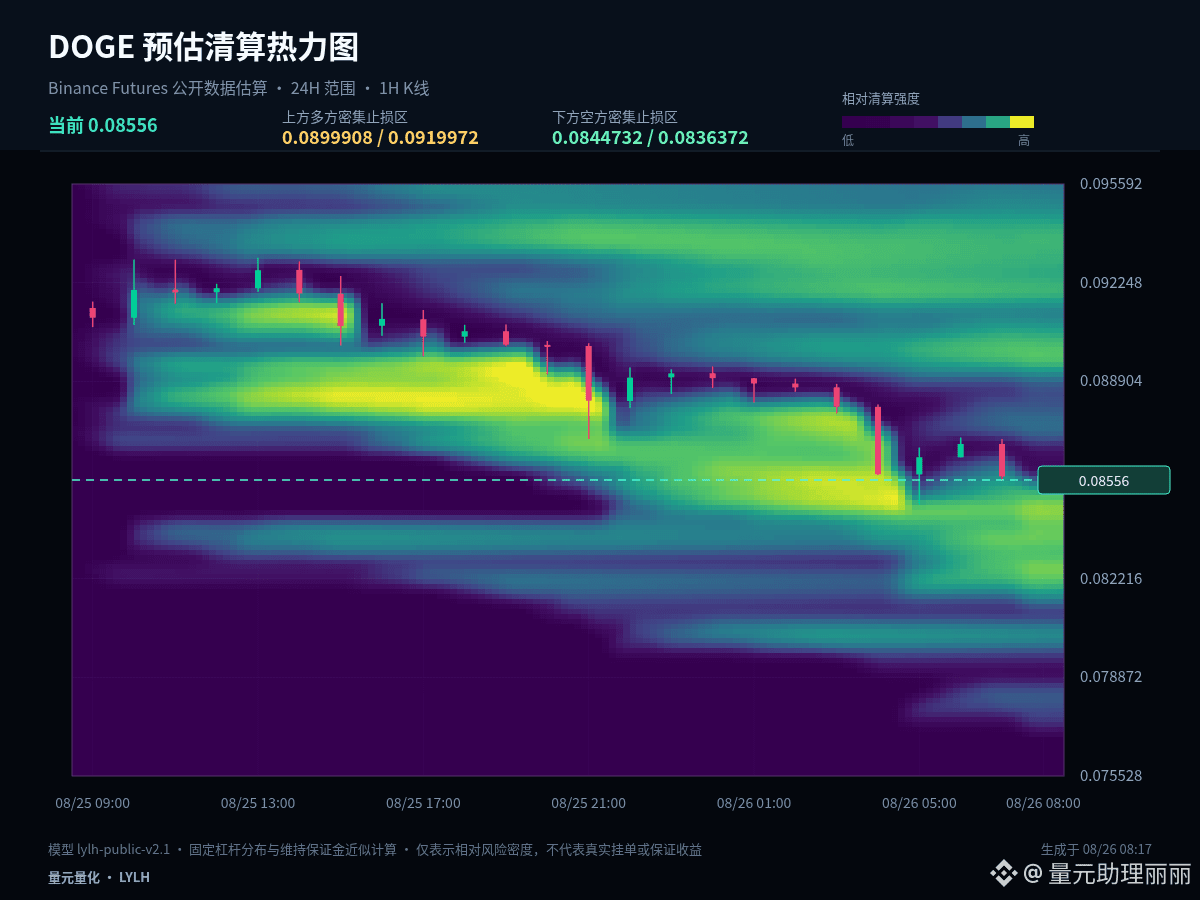
$DOGE #DOGE At this moment, it is more suitable to first confirm a rebound rather than defining a reversal in advance. Current price is 0.0856; 1 hour: -0.12%, 24 hours: -4.79%. Whether the two timeframes realign in the same direction is the key focus going forward.
The current price is near the lower bound of the last 24 hours’ range: 1 hour -0.12%, 24 hours -4.79%. The core of low-level analysis is not to try to bottom too early, but to observe whether it can quickly reclaim after a breakdown. If it can be reclaimed, it indicates selling pressure has been absorbed; if it keeps lingering below the lower bound, it suggests weakness has not ended.
If the rebound can reclaim 0.08896 and further hold above 0.09309, it would mean the bids are starting to change the existing bearish structure. If price moves up toward the midline and then falls again—especially if it drops back toward 0.08483—that looks more like a failed repair, and you should not continue relying on a bullish turnaround expectation.
Even to confirm that the rebound has failed, you need evidence. You shouldn’t jump into a short position just because of one spike-and-reversal. A more reasonable sequence is to watch whether resistance levels are rejected, whether the lows shift downward again, and then decide your action based on whether subsequent pullbacks can reclaim key levels.
For those already holding positions, the focus is to manage based on whether support is invalidated—not to be carried around by every fluctuation. For those who are currently in cash/no position, prioritize waiting for a breakout with a retest or a confirmation of support. Spot can be scaled in batches; for futures, you should shorten the decision chain: first set the stop-loss level, then decide whether to participate.
Risk control is still placed before the conclusion: execute only when conditions are met, and if the price fails, reassess promptly. The larger the volatility, the more restrained you should be with any single position. The above is a scenario analysis based on the current 1-hour and 24-hour data and does not constitute any promise of returns.
#KazakhstanCutsOilOutputForecastTo96MTons
The current price is near the lower bound of the last 24 hours’ range: 1 hour -0.12%, 24 hours -4.79%. The core of low-level analysis is not to try to bottom too early, but to observe whether it can quickly reclaim after a breakdown. If it can be reclaimed, it indicates selling pressure has been absorbed; if it keeps lingering below the lower bound, it suggests weakness has not ended.
If the rebound can reclaim 0.08896 and further hold above 0.09309, it would mean the bids are starting to change the existing bearish structure. If price moves up toward the midline and then falls again—especially if it drops back toward 0.08483—that looks more like a failed repair, and you should not continue relying on a bullish turnaround expectation.
Even to confirm that the rebound has failed, you need evidence. You shouldn’t jump into a short position just because of one spike-and-reversal. A more reasonable sequence is to watch whether resistance levels are rejected, whether the lows shift downward again, and then decide your action based on whether subsequent pullbacks can reclaim key levels.
For those already holding positions, the focus is to manage based on whether support is invalidated—not to be carried around by every fluctuation. For those who are currently in cash/no position, prioritize waiting for a breakout with a retest or a confirmation of support. Spot can be scaled in batches; for futures, you should shorten the decision chain: first set the stop-loss level, then decide whether to participate.
Risk control is still placed before the conclusion: execute only when conditions are met, and if the price fails, reassess promptly. The larger the volatility, the more restrained you should be with any single position. The above is a scenario analysis based on the current 1-hour and 24-hour data and does not constitute any promise of returns.
#KazakhstanCutsOilOutputForecastTo96MTons