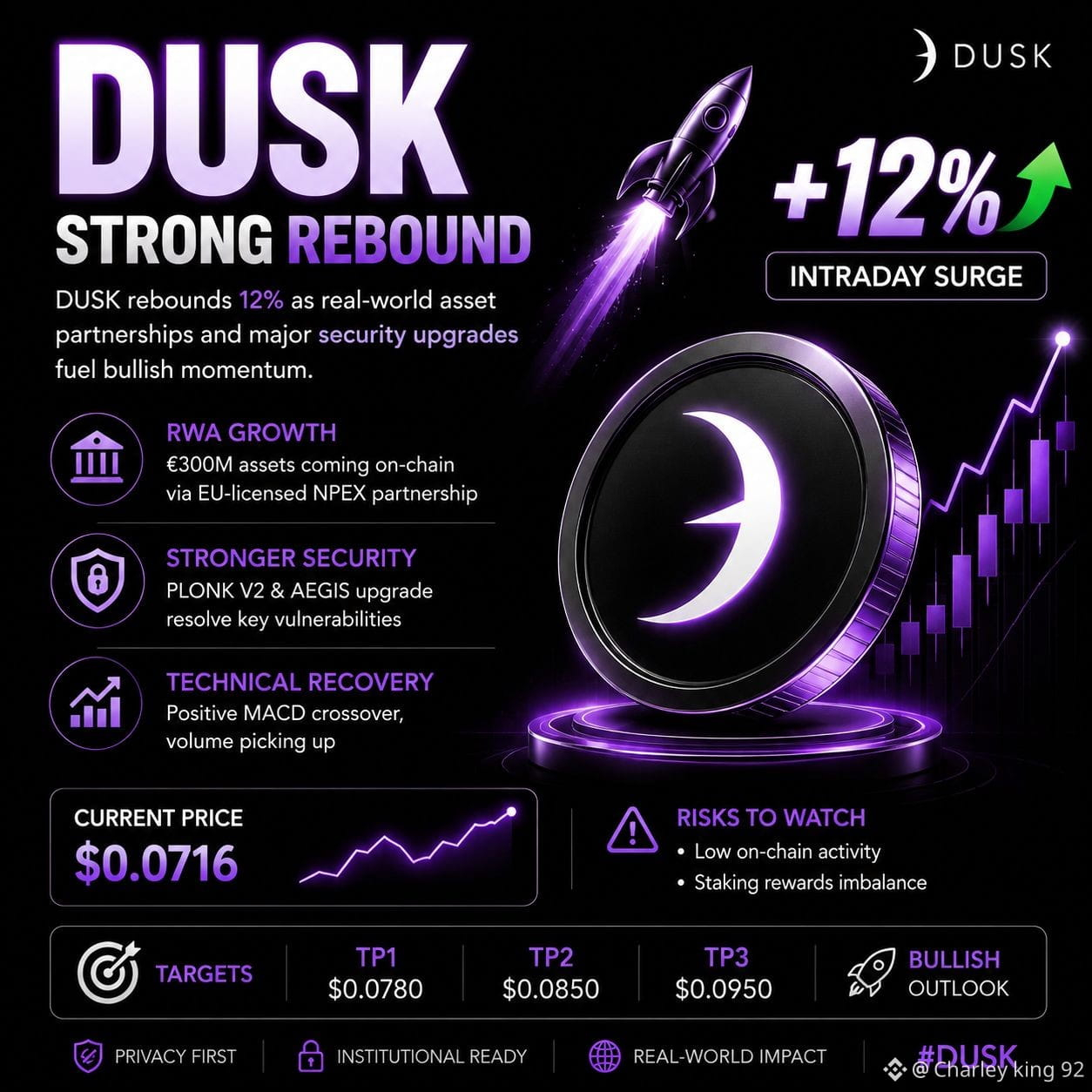
I'have been watching crypto's "institutional adoption" story get told over and over, and at some point you start asking the harder question: not whether a partnership gets announced, but whether the system underneath could actually survive a regulator poking around it.
That's the part most compliant-DeFi projects quietly avoid. Institutions want their trade details private. Public chains exist to make everything visible. Usually something gives.
What made me slow down on Dusk was how it handles that tradeoff .transactions get verified as valid without exposing what's inside them, using proofs built into the execution layer itself rather than tacked on afterward.
My first instinct was to lump this in with every other "privacy chain." Reading further, I noticed the proofs seem shaped around what an auditor would need to confirm, not just what a user wants hidden. That's a much narrower thing to build well.
The NPEX partnership is still young, and writing confidential logic isn't an easy lift for most developers. An idea working on paper and an idea getting used are different things.
Does compliance built into the architecture actually get institutions moving faster than compliance bolted on as policy? I'd like to hear how others see it.
@Dusk
#dusk
$DUSK
That's the part most compliant-DeFi projects quietly avoid. Institutions want their trade details private. Public chains exist to make everything visible. Usually something gives.
What made me slow down on Dusk was how it handles that tradeoff .transactions get verified as valid without exposing what's inside them, using proofs built into the execution layer itself rather than tacked on afterward.
My first instinct was to lump this in with every other "privacy chain." Reading further, I noticed the proofs seem shaped around what an auditor would need to confirm, not just what a user wants hidden. That's a much narrower thing to build well.
The NPEX partnership is still young, and writing confidential logic isn't an easy lift for most developers. An idea working on paper and an idea getting used are different things.
Does compliance built into the architecture actually get institutions moving faster than compliance bolted on as policy? I'd like to hear how others see it.
@Dusk
#dusk
$DUSK