#dusk $DUSK @Dusk Your cousin has been working on cross-border e-commerce lately. During a chat, he casually mentioned—what’s most annoying in doing business now is KYC. Every time you switch to a new platform, you have to submit your ID card and bank statements all over again. The paperwork gets scattered everywhere. In my head, Dusk’s Citadel protocol immediately popped up. I went back to check my notes, and the more I thought about it, the more I felt that this complaint is actually the same kind of problem.
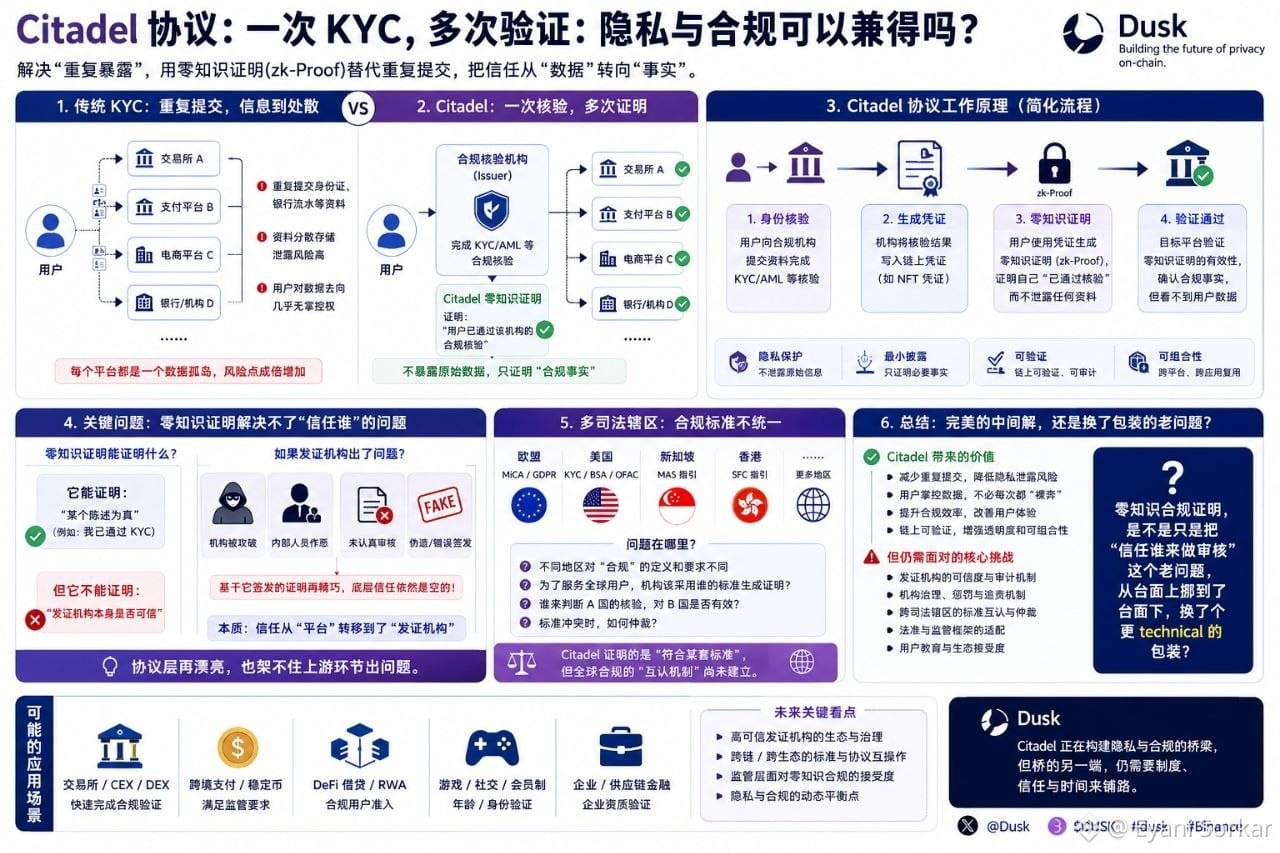
The core issue Citadel solves is “repeat exposure.” Traditional KYC has each platform collect and store your identity data independently. The more scattered the data is, the more risk points there are for leaks and misuse. Citadel uses a zero-knowledge proof approach—you only need to prove the fact that “you passed a compliance check by some institution,” without having to re-submit raw data like your ID, address, and asset details to every new platform. Regulators get the “green light” they want, but your specific information isn’t laid out for everyone to see.
The cousin’s first reaction was: “Then how does the platform know you didn’t cheat?” That’s actually the key question. Zero-knowledge proofs can prove that “a certain statement is true,” but they can’t help you determine whether the issuing institution itself is trustworthy. If the institution that performed the initial verification had problems—say it was compromised, or it didn’t verify seriously—then no matter how clever the proof it issued is, the underlying trust is still empty. This is the same kind of issue I was previously纠结 about in Phoenix/Moonlight cross-account conversions, or with Sozu’s fluid staking credential decoupling. Even if the protocol’s math is beautiful, it can’t overcome problems in an upstream component.
And there’s an even more troublesome real-world issue: different jurisdictions don’t define “compliance” consistently in the first place. The EU’s MiCA, the U.S. KYC requirements, and regulatory interpretations across Asia all differ. Citadel proves “compliance with some set of standards,” but if an institution wants to serve customers in multiple jurisdictions at the same time, then which standard should be used to generate the proof? And who arbitrates which jurisdiction’s verification is valid for another? At the moment, there doesn’t seem to be a clear answer.
I’m still thinking—zero-knowledge compliance proofs sound like a perfect middle solution. But is it really just moving the old question of “who you trust to do the review” behind the scenes, wrapped in a different technical package?
@Dusk $DUSK #dusk #Binance
The core issue Citadel solves is “repeat exposure.” Traditional KYC has each platform collect and store your identity data independently. The more scattered the data is, the more risk points there are for leaks and misuse. Citadel uses a zero-knowledge proof approach—you only need to prove the fact that “you passed a compliance check by some institution,” without having to re-submit raw data like your ID, address, and asset details to every new platform. Regulators get the “green light” they want, but your specific information isn’t laid out for everyone to see.
The cousin’s first reaction was: “Then how does the platform know you didn’t cheat?” That’s actually the key question. Zero-knowledge proofs can prove that “a certain statement is true,” but they can’t help you determine whether the issuing institution itself is trustworthy. If the institution that performed the initial verification had problems—say it was compromised, or it didn’t verify seriously—then no matter how clever the proof it issued is, the underlying trust is still empty. This is the same kind of issue I was previously纠结 about in Phoenix/Moonlight cross-account conversions, or with Sozu’s fluid staking credential decoupling. Even if the protocol’s math is beautiful, it can’t overcome problems in an upstream component.
And there’s an even more troublesome real-world issue: different jurisdictions don’t define “compliance” consistently in the first place. The EU’s MiCA, the U.S. KYC requirements, and regulatory interpretations across Asia all differ. Citadel proves “compliance with some set of standards,” but if an institution wants to serve customers in multiple jurisdictions at the same time, then which standard should be used to generate the proof? And who arbitrates which jurisdiction’s verification is valid for another? At the moment, there doesn’t seem to be a clear answer.
I’m still thinking—zero-knowledge compliance proofs sound like a perfect middle solution. But is it really just moving the old question of “who you trust to do the review” behind the scenes, wrapped in a different technical package?
@Dusk $DUSK #dusk #Binance