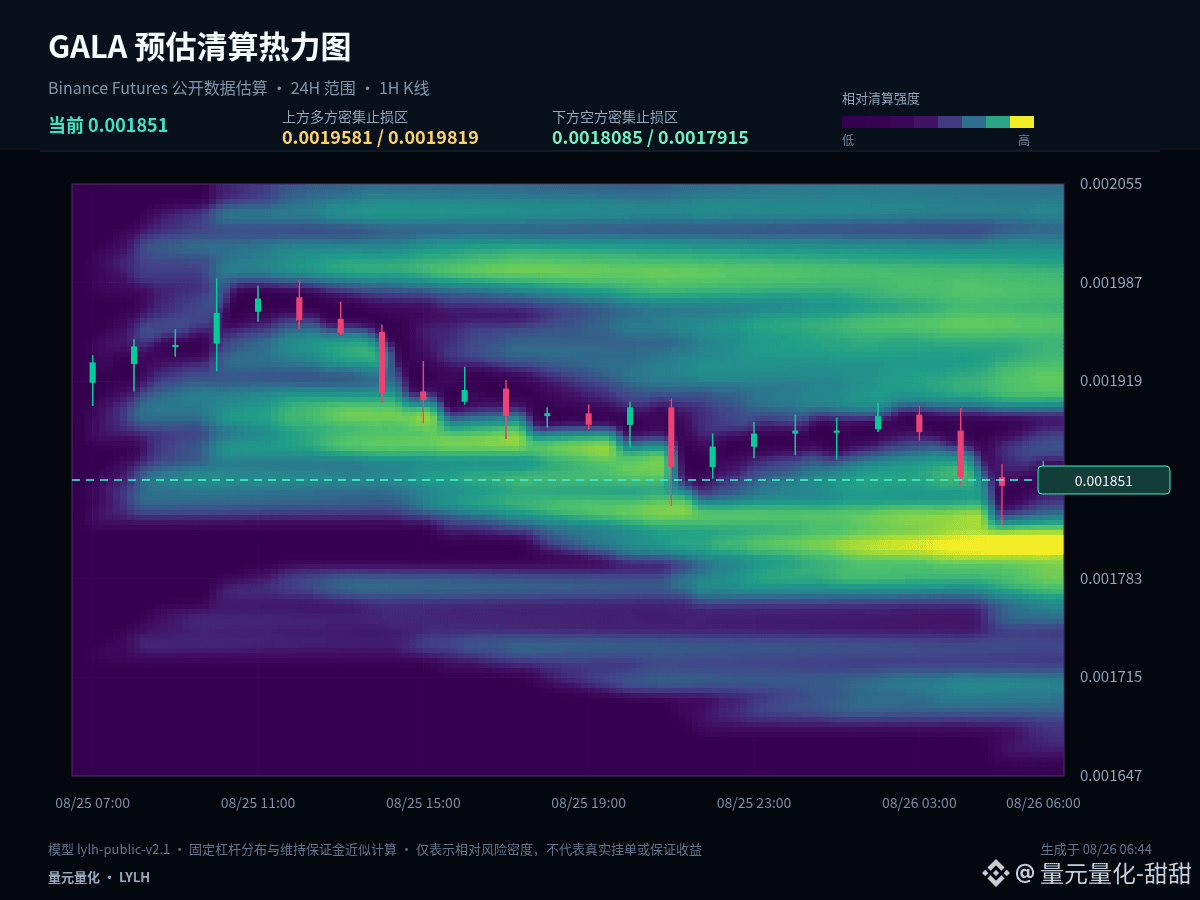
$GALA #GALA Now it looks more like range trading with turnover; there’s no need to explain every 1-hour candlestick as a new trend. Current price: 0.001853, 1 hour +0.32%, 24 hours -3.34%.
Currently, 1 hour is +0.32% and 24 hours is -3.34%; the two timeframes have not formed sufficiently clear directional alignment. In a range market, the tolerance for chasing or panic-selling is lower. It’s better to confirm direction using the upper boundary, confirm support using the lower boundary, and treat the midline only as the strength/weakness divider.
Upper boundary: 0.001989, lower boundary: 0.001822, midline: 0.0019055. Near the upper boundary, observe breakout quality; near the lower boundary, observe how quickly price holds/recovers (support/acceptance). Around the midline, reduce frequent trading—because it’s not far enough from either side, and the direction and risk-reward ratio aren’t clear.
The signals worth acting on are: after breaking the boundary, price is willing to stay within the new range; or after probing the boundary downward, price quickly reclaims it. Without such confirmation, continue treating it as consolidation, and don’t let brief intraday fluctuations change the overall plan.
Position sizing should distinguish between spot and derivatives. If you already hold spot, manage in segments around key levels without frequently flipping your stance due to a single 1-hour candle; if you’re flat, wait for confirmation and then scale in more calmly. Derivatives place more emphasis on entry location and invalidation conditions. When volatility amplifies, actively reduce position size to avoid turning short-term judgment into passive holding.
A trading plan must include invalidation conditions. If you’re correct, you can take profits in stages; if you’re wrong, you must also allow yourself to exit. Don’t use adding to cover the fact that the original logic has changed. The market will update, and your view should adjust according to price evidence.
#JapanNoAdditionalOilReserveReleaseInSepOct
Currently, 1 hour is +0.32% and 24 hours is -3.34%; the two timeframes have not formed sufficiently clear directional alignment. In a range market, the tolerance for chasing or panic-selling is lower. It’s better to confirm direction using the upper boundary, confirm support using the lower boundary, and treat the midline only as the strength/weakness divider.
Upper boundary: 0.001989, lower boundary: 0.001822, midline: 0.0019055. Near the upper boundary, observe breakout quality; near the lower boundary, observe how quickly price holds/recovers (support/acceptance). Around the midline, reduce frequent trading—because it’s not far enough from either side, and the direction and risk-reward ratio aren’t clear.
The signals worth acting on are: after breaking the boundary, price is willing to stay within the new range; or after probing the boundary downward, price quickly reclaims it. Without such confirmation, continue treating it as consolidation, and don’t let brief intraday fluctuations change the overall plan.
Position sizing should distinguish between spot and derivatives. If you already hold spot, manage in segments around key levels without frequently flipping your stance due to a single 1-hour candle; if you’re flat, wait for confirmation and then scale in more calmly. Derivatives place more emphasis on entry location and invalidation conditions. When volatility amplifies, actively reduce position size to avoid turning short-term judgment into passive holding.
A trading plan must include invalidation conditions. If you’re correct, you can take profits in stages; if you’re wrong, you must also allow yourself to exit. Don’t use adding to cover the fact that the original logic has changed. The market will update, and your view should adjust according to price evidence.
#JapanNoAdditionalOilReserveReleaseInSepOct