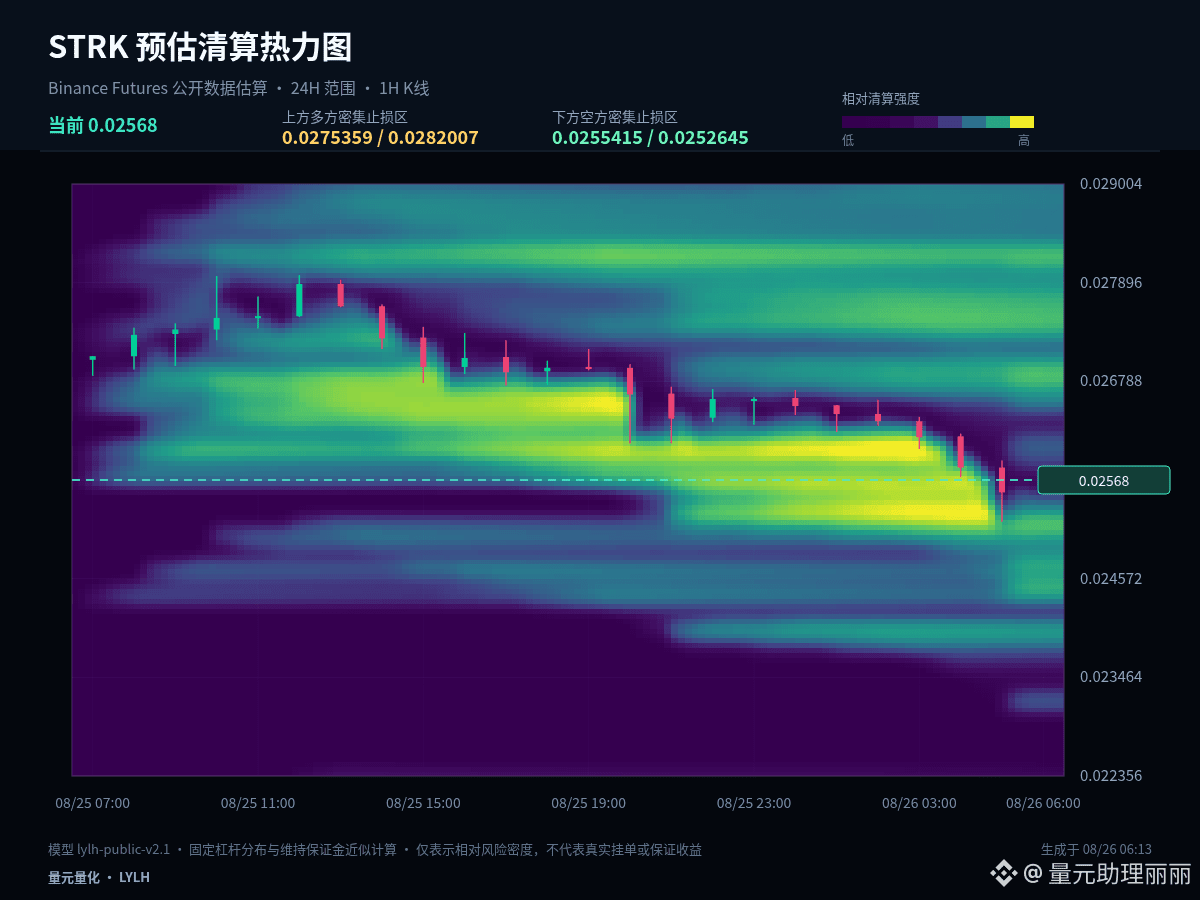
$STRK #STRK After the heat rises, only then is it ready to enter the market—more importantly, it needs to evaluate the position first. Currently, in the past 1 hour: +0.59%, and in 24 hours: -5.24%. The space that has already been used up cannot simply be treated as the next segment of copyable space.
$STRK #STRK has unfolded and repaired from the intraday low, with a rebound of +0.59% over 1 hour. Whether the bounce can upgrade into a trend depends on whether the overhead supply is willing to make way.
For the bulls, the more favorable rhythm is: returning to around 0.026615, with selling pressure weakening, then attempting 0.02795 again. If it accelerates without a pullback, the risk-reward ratio for chasing prices will decline.
My scenario analysis isn’t a single-direction bet. A breakout above 0.02795 and maintaining it means the overhead space has been reopened. Falling below 0.02528 and failing to reclaim it on a retest means the structure weakens further. If it moves within the range between the two, continue monitoring the closing performance on both sides of 0.026615.
In position management, distinguish between spot and contracts. Existing spot holdings can be managed in segments around key levels, without frequently flipping directions due to one 1-hour candlestick. If you are out of the market, wait for confirmation and enter in batches more calmly. Contracts place more emphasis on entry location and invalidation conditions. When volatility increases, actively reduce position size to avoid turning short-term judgment into passive holding.
Missing one segment of the行情 (market move) won’t directly cause losses. It’s the lack of a plan and chasing at the end of a volatility swing that makes the position become passive. Risk control is still placed before any conclusion: execute only when conditions appear, reassess promptly when the price is no longer valid. The greater the volatility, the more restrained each single-position size should be. The above is a scenario analysis based on the current 1-hour and 24-hour data and does not constitute a promise of returns.
#JapanNoAdditionalOilReserveReleaseInSepOct
$STRK #STRK has unfolded and repaired from the intraday low, with a rebound of +0.59% over 1 hour. Whether the bounce can upgrade into a trend depends on whether the overhead supply is willing to make way.
For the bulls, the more favorable rhythm is: returning to around 0.026615, with selling pressure weakening, then attempting 0.02795 again. If it accelerates without a pullback, the risk-reward ratio for chasing prices will decline.
My scenario analysis isn’t a single-direction bet. A breakout above 0.02795 and maintaining it means the overhead space has been reopened. Falling below 0.02528 and failing to reclaim it on a retest means the structure weakens further. If it moves within the range between the two, continue monitoring the closing performance on both sides of 0.026615.
In position management, distinguish between spot and contracts. Existing spot holdings can be managed in segments around key levels, without frequently flipping directions due to one 1-hour candlestick. If you are out of the market, wait for confirmation and enter in batches more calmly. Contracts place more emphasis on entry location and invalidation conditions. When volatility increases, actively reduce position size to avoid turning short-term judgment into passive holding.
Missing one segment of the行情 (market move) won’t directly cause losses. It’s the lack of a plan and chasing at the end of a volatility swing that makes the position become passive. Risk control is still placed before any conclusion: execute only when conditions appear, reassess promptly when the price is no longer valid. The greater the volatility, the more restrained each single-position size should be. The above is a scenario analysis based on the current 1-hour and 24-hour data and does not constitute a promise of returns.
#JapanNoAdditionalOilReserveReleaseInSepOct