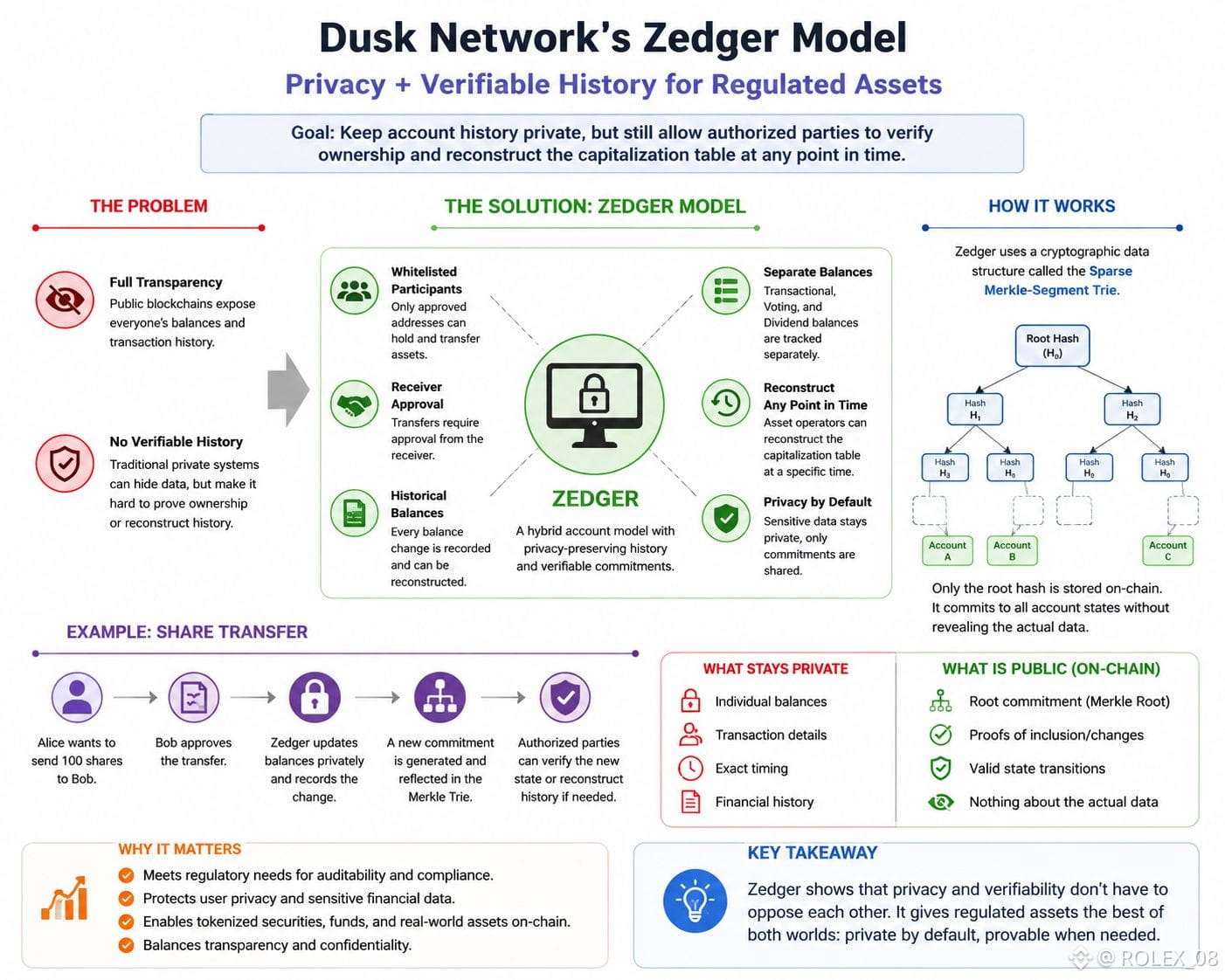
#dusk $DUSK @Dusk I was reading about Dusk’s Zedger model, and I found a simple way to understand why it exists.
Imagine our classroom has 100 students who own different shares of a company.
Now imagine the school needs to know:
“Who owned how many shares on March 1?”
But none of the students want their full financial records written on the classroom wall.
That creates a problem.
You need privacy, but you also need proof.
This is the interesting part of Zedger.
Dusk designed it for regulated assets, where only approved users can transact, the receiver must approve a transfer, and account history needs to be maintained. It also separates transactional, voting and dividend balances.
So think of Zedger like a private school register.
The detailed information stays protected, while a cryptographic structure called the Sparse Merkle-Segment Trie can provide a verifiable record of changes.
The important lesson is this:
Privacy doesn’t have to mean “no one can verify anything.”
It can mean:
“I don’t reveal everything to everyone, but the right party can still prove what happened.”
That’s why I think Zedger is more interesting than simply calling Dusk a “privacy blockchain.”
The bigger experiment is whether regulated markets can have private ownership with reliable verification at the same time.
And that’s the part I’ll be watching.
#dusk
Imagine our classroom has 100 students who own different shares of a company.
Now imagine the school needs to know:
“Who owned how many shares on March 1?”
But none of the students want their full financial records written on the classroom wall.
That creates a problem.
You need privacy, but you also need proof.
This is the interesting part of Zedger.
Dusk designed it for regulated assets, where only approved users can transact, the receiver must approve a transfer, and account history needs to be maintained. It also separates transactional, voting and dividend balances.
So think of Zedger like a private school register.
The detailed information stays protected, while a cryptographic structure called the Sparse Merkle-Segment Trie can provide a verifiable record of changes.
The important lesson is this:
Privacy doesn’t have to mean “no one can verify anything.”
It can mean:
“I don’t reveal everything to everyone, but the right party can still prove what happened.”
That’s why I think Zedger is more interesting than simply calling Dusk a “privacy blockchain.”
The bigger experiment is whether regulated markets can have private ownership with reliable verification at the same time.
And that’s the part I’ll be watching.
#dusk