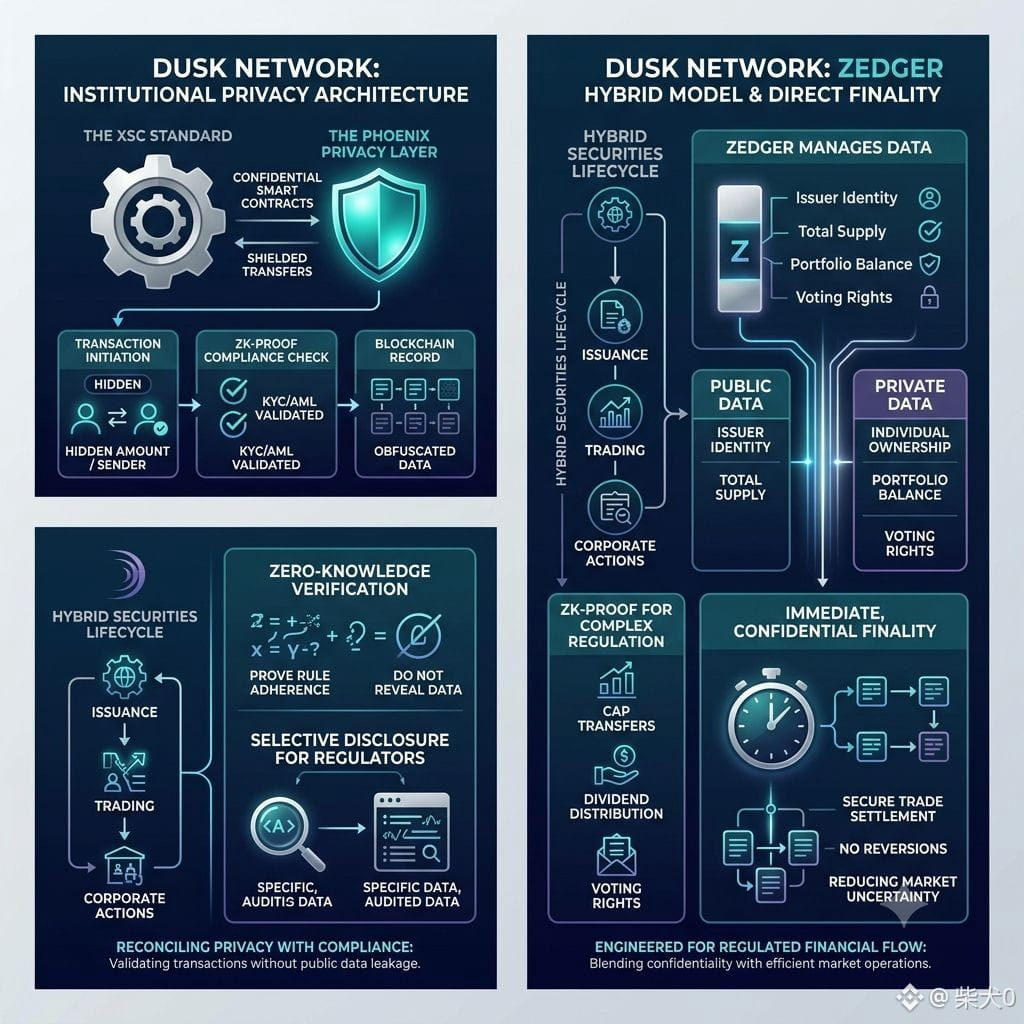
Was digging through some old notes on regulated finance rails last night and Dusk Network kept circling back. Privacy chain for financial apps, layer-1 with the XSC standard, confidential smart contracts, Phoenix for shielded transfers, Zedger for the hybrid model that securities actually need. Sounds clean on paper.
But if they promise institutions can issue and settle tokenized stocks or bonds with real confidentiality while still meeting compliance, how does that actually hold when regulators demand selective disclosure at scale? Phoenix is supposed to keep notes private and still let the network verify without leaking amounts or ownership. Fine in theory. What happens when the first big issuer hits a compliance check that forces more visibility than the protocol wants to give? Does the whole privacy layer start leaking, or do they just refuse the deal?
Zedger claims it can handle dividend distribution, voting, capped transfers and prevent multiple accounts without turning everything transparent. If that breaks under real volume or a stressed market, who eats the loss? The issuer stuck with failed settlements, the investors who thought their positions were hidden, or the token holders watching the narrative collapse? People will not shrug and move on. They will call it another privacy project that talked big and delivered half-measures once the real money showed up.
Direct finality is another line they push hard. Markets hate uncertainty. If a trade settles and then something in the confidential layer gets challenged, the reaction will be sharp. Institutions do not experiment with their capital for long. One public failure and the waitlists empty fast. Dusk has been building this stack for years. The question is whether the claims survive contact with actual regulated flow, or whether the gap between whitepaper and market reality gets paid by the usual suspects again.
#dusk $DUSK @Dusk