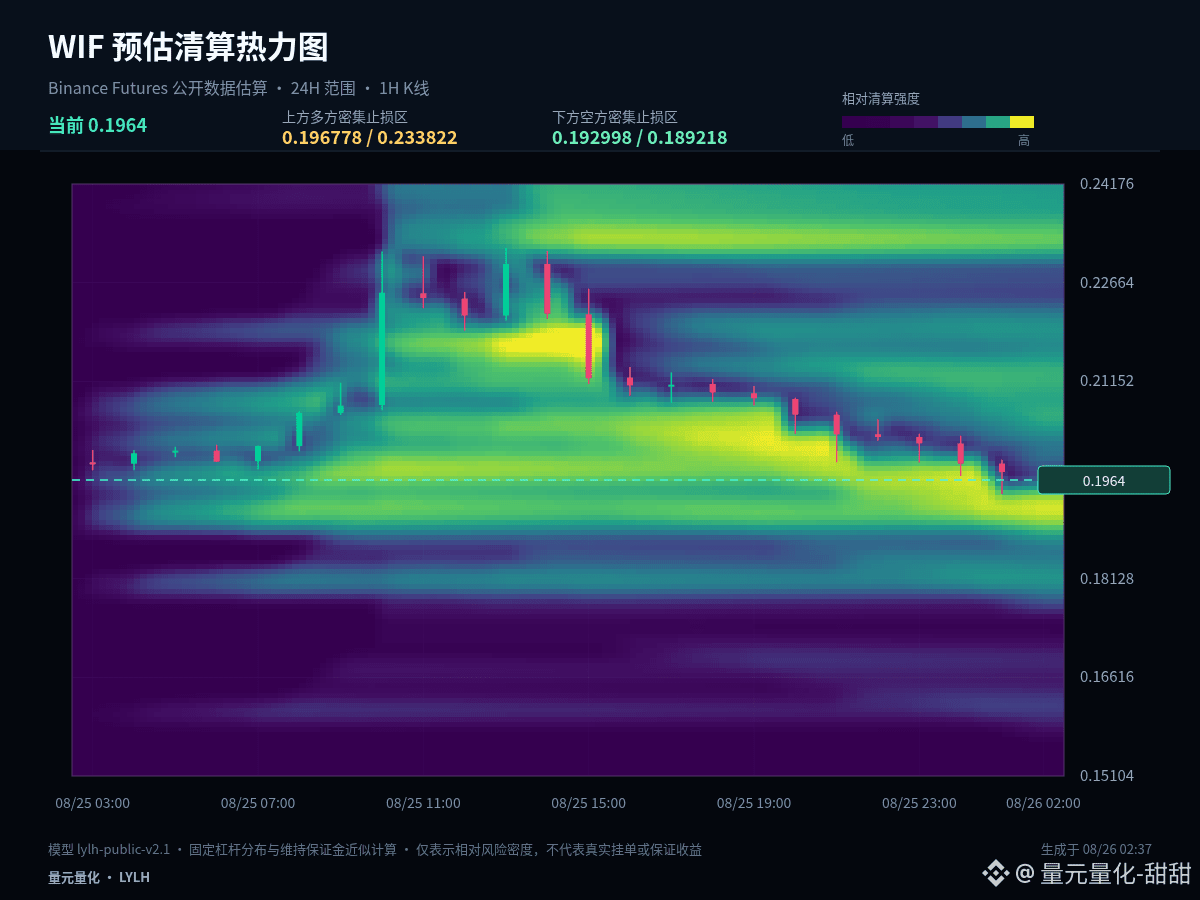
$WIF #WIF In-Session Conclusion First: If you can’t reclaim 0.2134, then you need to keep defending 0.1948. Current price: 0.1966. 1 hour: -0.51%, 24 hours: -1.55%.
The current price is hovering near the lower end of the past 24-hour range, with 1 hour at -0.51% and 24 hours at -1.55%. The core of low-range analysis is not to bottom-fish too early, but to watch whether price can quickly reclaim after a breakdown. Being able to reclaim indicates selling pressure is being absorbed; lingering below the lower band suggests weakness is not over yet.
For the short term, first watch whether 0.1948 can form continuous support, and then whether 0.2134 can be reclaimed again. The former determines whether the down move slows down; the latter determines whether the rebound can strengthen. Without confirmations for both, it’s not advisable to judge opportunities based only on how much the price has fallen.
In execution, set clear conditions: after breaking above 0.232, you need confirmation—not chasing just because of a momentary surge. After dipping to 0.1948, you need to see whether it can be quickly reclaimed—not just buy because it dropped. When the mid-range doesn’t offer enough reward/risk, waiting is itself part of the strategy.
For those already holding positions, the key is to manage based on whether support actually fails, rather than being dragged around by every fluctuation. For those with no position, priority should go to waiting for a breakout-and-retest or for support confirmation. For spot, you can scale in batch by batch; for futures, shorten the decision chain—set the stop-loss level first, then decide whether to participate.
Simplifying the conclusion doesn’t mean simplifying risk control. In real execution, you still need to wait for price confirmation and leave room to exit if your thesis is invalidated. The real disagreement in this market is whether it will continue or return to the range. Will you wait for confirmation of a breakout, or wait for a support retest? Feel free to share the price you’re most focused on.
#SamsungSKHynixLeveragedETFsPostFirstMonthlyOutflow
The current price is hovering near the lower end of the past 24-hour range, with 1 hour at -0.51% and 24 hours at -1.55%. The core of low-range analysis is not to bottom-fish too early, but to watch whether price can quickly reclaim after a breakdown. Being able to reclaim indicates selling pressure is being absorbed; lingering below the lower band suggests weakness is not over yet.
For the short term, first watch whether 0.1948 can form continuous support, and then whether 0.2134 can be reclaimed again. The former determines whether the down move slows down; the latter determines whether the rebound can strengthen. Without confirmations for both, it’s not advisable to judge opportunities based only on how much the price has fallen.
In execution, set clear conditions: after breaking above 0.232, you need confirmation—not chasing just because of a momentary surge. After dipping to 0.1948, you need to see whether it can be quickly reclaimed—not just buy because it dropped. When the mid-range doesn’t offer enough reward/risk, waiting is itself part of the strategy.
For those already holding positions, the key is to manage based on whether support actually fails, rather than being dragged around by every fluctuation. For those with no position, priority should go to waiting for a breakout-and-retest or for support confirmation. For spot, you can scale in batch by batch; for futures, shorten the decision chain—set the stop-loss level first, then decide whether to participate.
Simplifying the conclusion doesn’t mean simplifying risk control. In real execution, you still need to wait for price confirmation and leave room to exit if your thesis is invalidated. The real disagreement in this market is whether it will continue or return to the range. Will you wait for confirmation of a breakout, or wait for a support retest? Feel free to share the price you’re most focused on.
#SamsungSKHynixLeveragedETFsPostFirstMonthlyOutflow