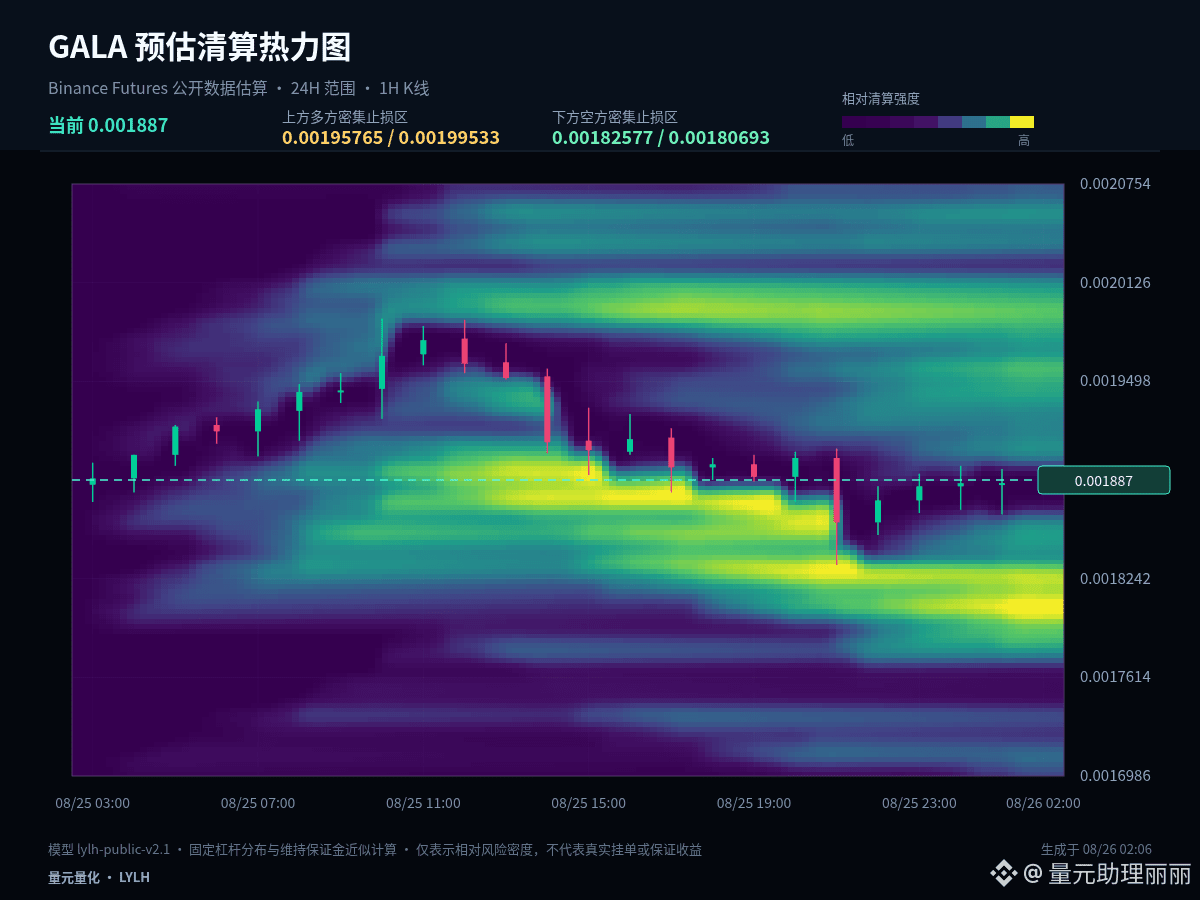
$GALA #GALA From a layout perspective, the key is not to chase already-occurred fluctuations, but to determine in advance the position you are willing to wait for. Current price: 0.001887, +0.11% in 1 hour, -0.32% in 24 hours.
Currently, the 1-hour is +0.11% and the 24-hour is -0.32%; the two cycles have not formed sufficiently clear alignment in the same direction. In a range-bound market, the tolerance for chasing and stop-hunting is lower. It’s more suitable to confirm direction with the upper boundary, confirm support with the lower boundary, and use the midline only as the line dividing strength and weakness.
The first observation zone is 0.001911, used to judge whether a normal pullback has ended. The second observation zone is 0.001833, used to judge whether a deeper retracement can form support. On the upside, pay attention to 0.001989; after a breakout, a pullback confirmation is needed to avoid mistaking a brief pierce for the trend already being opened.
For those who already hold positions, the focus is to manage based on whether support fails, rather than being carried around by every fluctuation. For those with no position, prioritize waiting for a breakout + pullback or a confirmed support. Spot can be scaled in batches; for contracts, shorten the decision chain—first set the stop-loss level, then decide whether to participate.
The meaning of scaling in is not to keep averaging down costs, but to control the pace while the structure remains valid. Once a key support fails, you should stop the original layout plan and wait for a new price range to form.
Risk control is still placed before the conclusion: execute only when conditions appear, and re-evaluate promptly when the price invalidates the premise; the larger the volatility, the more you must restrain the size of each position. The above is a scenario projection based on the current 1-hour and 24-hour data and does not constitute a promise of returns.
#SamsungSKHynixLeveragedETFsPostFirstMonthlyOutflow
Currently, the 1-hour is +0.11% and the 24-hour is -0.32%; the two cycles have not formed sufficiently clear alignment in the same direction. In a range-bound market, the tolerance for chasing and stop-hunting is lower. It’s more suitable to confirm direction with the upper boundary, confirm support with the lower boundary, and use the midline only as the line dividing strength and weakness.
The first observation zone is 0.001911, used to judge whether a normal pullback has ended. The second observation zone is 0.001833, used to judge whether a deeper retracement can form support. On the upside, pay attention to 0.001989; after a breakout, a pullback confirmation is needed to avoid mistaking a brief pierce for the trend already being opened.
For those who already hold positions, the focus is to manage based on whether support fails, rather than being carried around by every fluctuation. For those with no position, prioritize waiting for a breakout + pullback or a confirmed support. Spot can be scaled in batches; for contracts, shorten the decision chain—first set the stop-loss level, then decide whether to participate.
The meaning of scaling in is not to keep averaging down costs, but to control the pace while the structure remains valid. Once a key support fails, you should stop the original layout plan and wait for a new price range to form.
Risk control is still placed before the conclusion: execute only when conditions appear, and re-evaluate promptly when the price invalidates the premise; the larger the volatility, the more you must restrain the size of each position. The above is a scenario projection based on the current 1-hour and 24-hour data and does not constitute a promise of returns.
#SamsungSKHynixLeveragedETFsPostFirstMonthlyOutflow