I was looking over the protocol changes made by #Dusk and one detail in Boreas caught my attention.
Boreas was not a feature.
Boreas was about making sure the network interprets transactions the way.
Boreas introduced boundaries between how transactions are accepted from clients represented inside Rusk and stored in the ledger.
That sounds like engineering.
I think Boreas is more important than it looks.
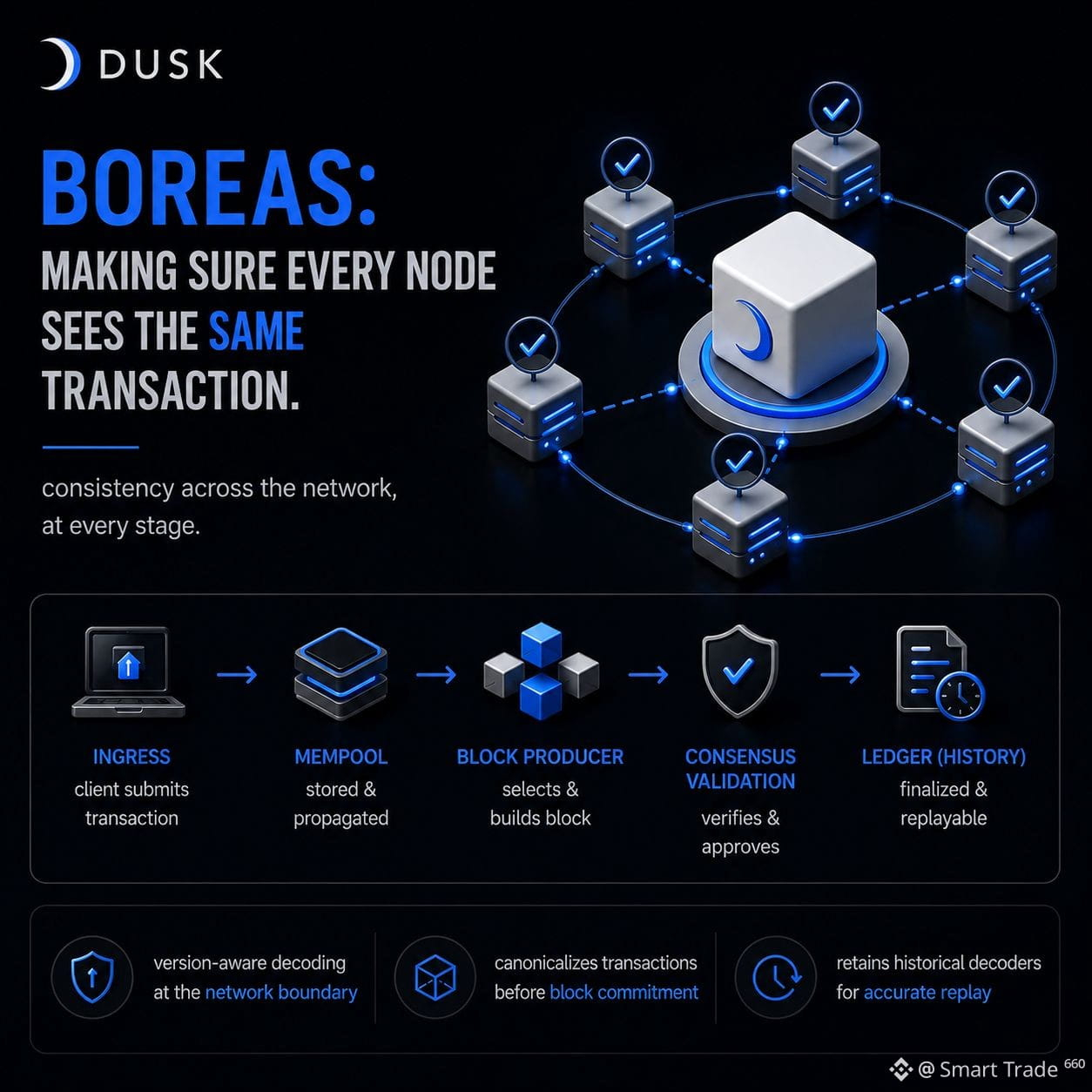
A transaction passes through stages before it becomes part of the historical chain data: ingress, mempool handling, block production, consensus validation and eventually replay.
If different parts of the node interpret the bytes differently the problem is not just a failed transaction.
It can become a consistency problem.
Boreas addresses this by using version‑aware decoding at the network boundary and by canonicalizing transactions before they are committed into blocks.
The interesting part is that Dusk also keeps decoders so older blocks can still be replayed correctly.
So the design is not simply: "change the transaction format."
It is closer to: "change the rules without making old history ambiguous."
That is a requirement for a network expected to handle long‑lived financial infrastructure.
It makes me look at protocol upgrades differently.
A successful hard fork is not about adding new capabilities.
It is also about making sure every layer agrees on what the transaction means.
What I am watching now is whether this kind of protocol discipline remains robust as Dusk adds execution paths and financial applications.
Because complexity does not disappear when you modularize a blockchain.
It just moves to the boundaries, between the modules.
#dusk $DUSK @Dusk
Boreas was not a feature.
Boreas was about making sure the network interprets transactions the way.
Boreas introduced boundaries between how transactions are accepted from clients represented inside Rusk and stored in the ledger.
That sounds like engineering.
I think Boreas is more important than it looks.
A transaction passes through stages before it becomes part of the historical chain data: ingress, mempool handling, block production, consensus validation and eventually replay.
If different parts of the node interpret the bytes differently the problem is not just a failed transaction.
It can become a consistency problem.
Boreas addresses this by using version‑aware decoding at the network boundary and by canonicalizing transactions before they are committed into blocks.
The interesting part is that Dusk also keeps decoders so older blocks can still be replayed correctly.
So the design is not simply: "change the transaction format."
It is closer to: "change the rules without making old history ambiguous."
That is a requirement for a network expected to handle long‑lived financial infrastructure.
It makes me look at protocol upgrades differently.
A successful hard fork is not about adding new capabilities.
It is also about making sure every layer agrees on what the transaction means.
What I am watching now is whether this kind of protocol discipline remains robust as Dusk adds execution paths and financial applications.
Because complexity does not disappear when you modularize a blockchain.
It just moves to the boundaries, between the modules.
#dusk $DUSK @Dusk