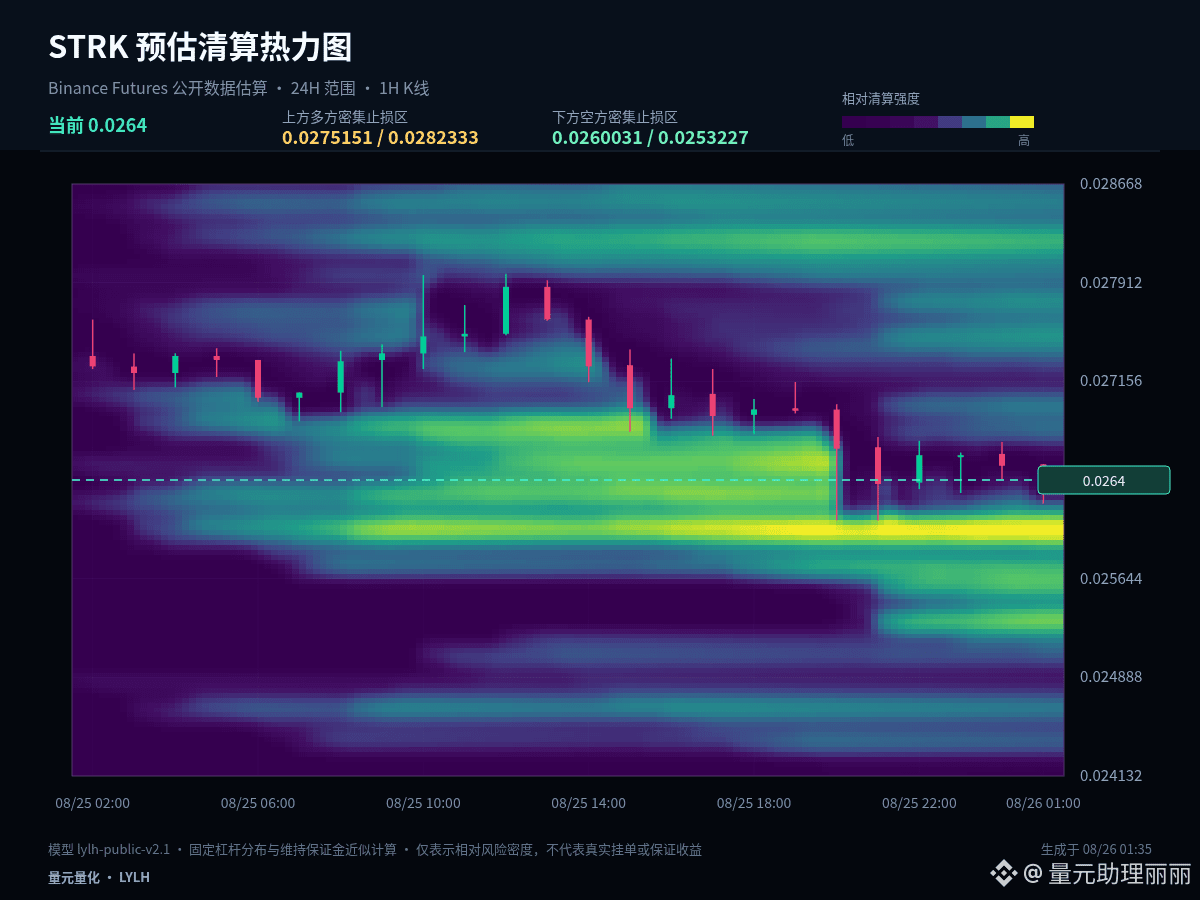
$STRK #STRK If I had to keep only one observation price in this round, I’d pick 0.027025. The current price is 0.02638; over the past 1 hour it is -0.42%, and over 24 hours -2.87%. The gain/loss around the midline can help filter out a lot of intraday noise.
The price hasn’t recovered 0.027025 yet. Treat the current rebound as a weak repair for now; real strength will rely on a stable close for confirmation. If it turns weak again, 0.0261 is the next level to observe whether the sell pressure is fading.
The current price is near the lower bound of the past 24-hour trading range: 1 hour -0.42%, 24 hours -2.87%. The core of analyzing the low isn’t to bottom-pick early, but to watch whether it can quickly reclaim after a breakdown. If it can reclaim, it suggests the sell pressure is being absorbed; if it keeps lingering below the lower bound, that indicates weakness is not over.
Execution requires clear conditions: after breaking above 0.02795, you need confirmation—not chasing just because of a brief spike. After dipping to 0.0261, watch whether it can quickly reclaim—not immediately buying just because it’s falling. If the middle region doesn’t offer enough reward-to-risk, waiting itself is also part of the strategy.
Position sizing should distinguish between spot and contracts. If you already hold spot, manage it in segments around key levels without frequently switching directions based on a single 1-hour candlestick. If you’re in cash, waiting for confirmation and then scaling in is more comfortable. Contracts place more emphasis on entry location and invalidation conditions. When volatility increases, proactively reduce position size to avoid turning a short-term view into passive holding.
Next, I’ll focus on tracking whether 0.027025 holds. Do you prefer testing 0.02795 first, or going back to 0.0261 first? Feel free to share your judgment and reasoning.
#JapanNoAdditionalOilReserveReleaseInSepOct
The price hasn’t recovered 0.027025 yet. Treat the current rebound as a weak repair for now; real strength will rely on a stable close for confirmation. If it turns weak again, 0.0261 is the next level to observe whether the sell pressure is fading.
The current price is near the lower bound of the past 24-hour trading range: 1 hour -0.42%, 24 hours -2.87%. The core of analyzing the low isn’t to bottom-pick early, but to watch whether it can quickly reclaim after a breakdown. If it can reclaim, it suggests the sell pressure is being absorbed; if it keeps lingering below the lower bound, that indicates weakness is not over.
Execution requires clear conditions: after breaking above 0.02795, you need confirmation—not chasing just because of a brief spike. After dipping to 0.0261, watch whether it can quickly reclaim—not immediately buying just because it’s falling. If the middle region doesn’t offer enough reward-to-risk, waiting itself is also part of the strategy.
Position sizing should distinguish between spot and contracts. If you already hold spot, manage it in segments around key levels without frequently switching directions based on a single 1-hour candlestick. If you’re in cash, waiting for confirmation and then scaling in is more comfortable. Contracts place more emphasis on entry location and invalidation conditions. When volatility increases, proactively reduce position size to avoid turning a short-term view into passive holding.
Next, I’ll focus on tracking whether 0.027025 holds. Do you prefer testing 0.02795 first, or going back to 0.0261 first? Feel free to share your judgment and reasoning.
#JapanNoAdditionalOilReserveReleaseInSepOct