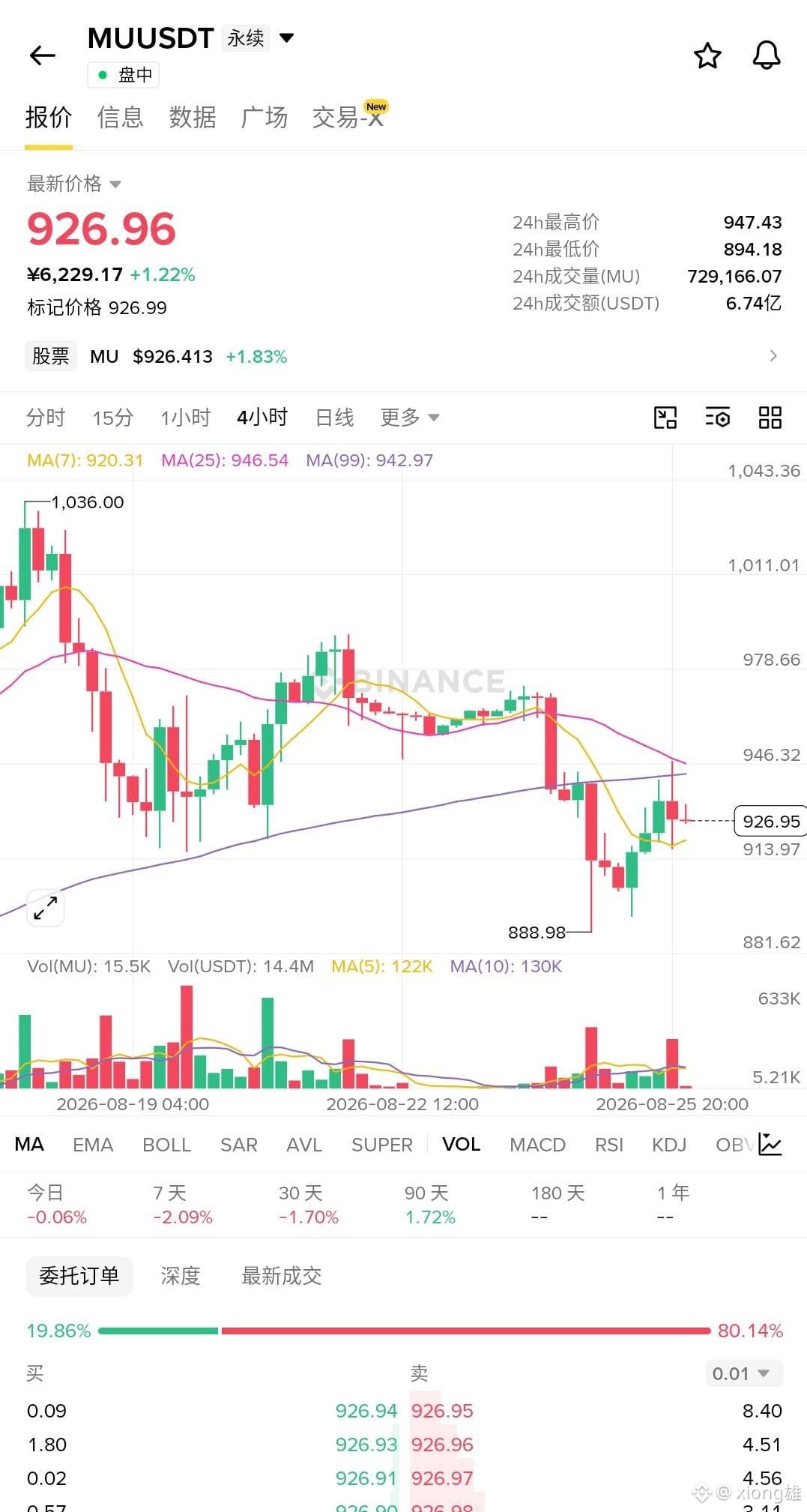
MU climbed all day, but the money is still moving out: +1.56% over 24 hours, and the 4-hour trend still judges as UP. On the same day, contract open interest was cut by 13.96%. The price was pushed up hard by short covering and long-lot liquidation—not by fresh long positions entering the market.
The order book spells it out clearly: in aggressive orders, sells make up 66% while buys are only 34%. The sell wall on the spot market is 1.75 times the buy wall. After a bounce that touched 947, it reversed. Now at 927, the 15-minute double moving averages are pressing it back below the foot of the move—so even this little increase can’t hold.
Don’t take whale longs as a rescue team. The big accounts still have a higher proportion of longs at 61% and they’re indeed rising, but the number of accounts fell by 3.72% in 7 hours. That means chips are concentrating into fewer hands; existing participants are banding together, which can’t solve the problem of insufficient incremental capital.
So this move is a short-covering-style rebound—go short. Enter shorts in the moving-average zone at 929–931. Set a stop-loss above the outer side of the previous high before 947. Here are the three signals that, if they appear together, I’ll admit I’m wrong: open interest stops falling and turns up; aggressive buy volume returns to 50% or more; and the funding rate turns positive—that’s what real new money entering looks like. #mu $MU
The order book spells it out clearly: in aggressive orders, sells make up 66% while buys are only 34%. The sell wall on the spot market is 1.75 times the buy wall. After a bounce that touched 947, it reversed. Now at 927, the 15-minute double moving averages are pressing it back below the foot of the move—so even this little increase can’t hold.
Don’t take whale longs as a rescue team. The big accounts still have a higher proportion of longs at 61% and they’re indeed rising, but the number of accounts fell by 3.72% in 7 hours. That means chips are concentrating into fewer hands; existing participants are banding together, which can’t solve the problem of insufficient incremental capital.
So this move is a short-covering-style rebound—go short. Enter shorts in the moving-average zone at 929–931. Set a stop-loss above the outer side of the previous high before 947. Here are the three signals that, if they appear together, I’ll admit I’m wrong: open interest stops falling and turns up; aggressive buy volume returns to 50% or more; and the funding rate turns positive—that’s what real new money entering looks like. #mu $MU