@Dusk I’ve been looking at Dusk’s infrastructure from a layer that usually gets less attention: the network has to move information efficiently before consensus can do anything with it.
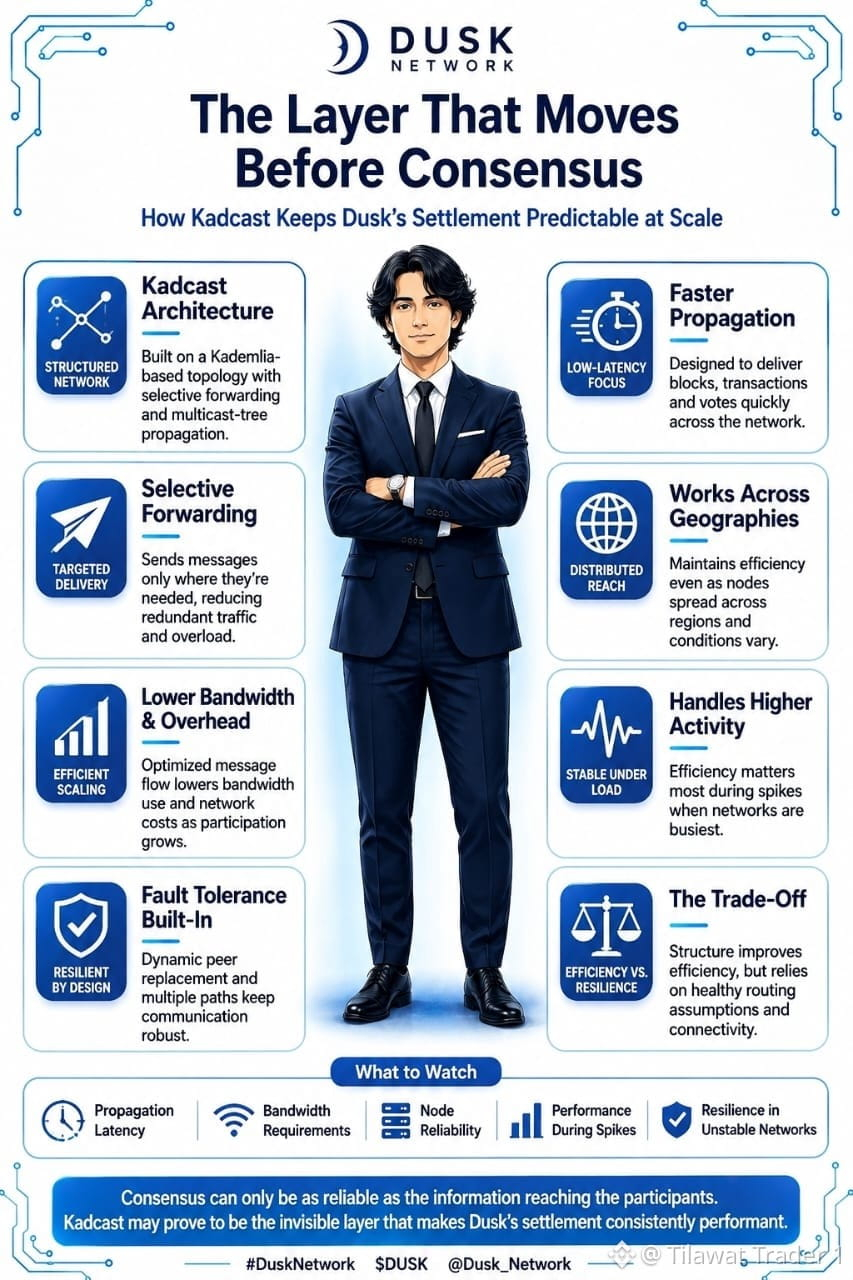
Dusk uses Kadcast as its peer-to-peer communication layer for blocks, transactions and consensus messages. Instead of broadly flooding messages across neighboring nodes, Kadcast uses a structured Kademlia-based topology and selective forwarding to reduce redundant transmissions and bandwidth requirements.
That sounds like an engineering detail.
I think it is more important than that.
For a financial settlement network, predictable communication can become an economic property. If blocks and consensus messages propagate efficiently, the system has less network overhead to absorb as participation and activity increase.
The interesting test is therefore not simply whether Dusk can finalize a block quickly.
It is whether communication remains efficient as the network becomes larger, busier and more geographically distributed.
I’d watch propagation latency, bandwidth requirements, node reliability and how those characteristics behave during periods of elevated activity.
There is also a trade-off.
A structured propagation system can improve efficiency, but it introduces more assumptions about network topology and routing behavior. Efficiency is valuable only if resilience remains strong when nodes disappear, connections degrade or network conditions become uneven.
Consensus can only be as reliable as the information reaching the participants.
For Dusk, Kadcast may eventually matter less as a networking feature and more as part of the hidden infrastructure determining how consistently the settlement layer performs.
#dusk $DUSK $TAC $STAR