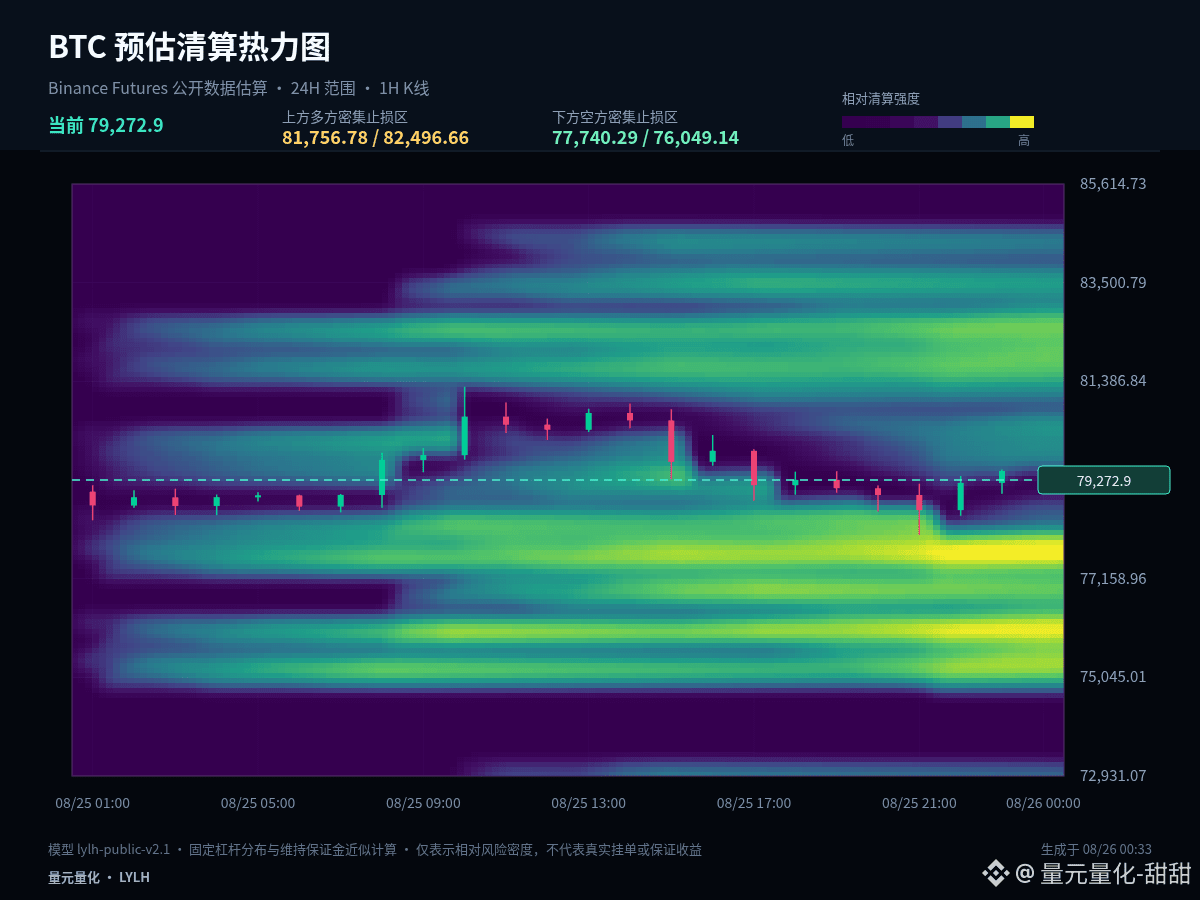
$BTC #BTC Whether this market can continue or not does not depend on how much it has risen beforehand; it depends on whether the trend can complete “advance, consolidate, and then confirm again.” Currently, in the past 1 hour: -0.26%, and in the past 24 hours: -0.45%.
Currently, in the past 1 hour: -0.26%, and in the past 24 hours: -0.45%. The two timeframes have not formed a sufficiently clear, same-direction coordination. In a range-bound market, the tolerance for chasing breakouts and cutting in-and-out is lower. It’s more suitable to confirm direction using the upper boundary, confirm support using the lower boundary, and treat the midline only as the boundary between strength and weakness.
The first condition for the continuation structure is that 79,696.68 is not effectively broken to the downside. The second condition is that the price can retest and hold above 81,272.62 again. If, after the advance, it stays below the midline for a long time, that indicates weakening buy-side momentum. If it then fails further and breaks below 78,120.74, the original continuation assumption needs to be cancelled.
For the next path, there are three ways to handle it: if it effectively holds above 81,272.62, then wait for a pullback that does not break and reassess continuation; if it breaks down below 78,120.74, prioritize risk control and wait for new support; if it continues to oscillate around 79,696.68, treat it as a range with turnover and don’t repeatedly chase direction from the middle area.
For those who already hold positions, the focus is to manage based on whether support has failed, rather than being carried along by every fluctuation. For those with no position, prioritize waiting for a breakout with a retest or for support to be confirmed. For spot positions, you can scale in batches; for derivatives, you should shorten the decision chain—first determine the stop-loss level, then decide whether to participate.
The key for derivatives is not to predict every single candlestick; it’s to ensure that entry, scaling down, and exiting all have a basis. Do less until it’s confirmed. When a key level fails, redo the plan. Control the risk for each trade first, then talk about potential upside/downside space.
#ThailandToExpandSECDigitalAssetProbePowers
Currently, in the past 1 hour: -0.26%, and in the past 24 hours: -0.45%. The two timeframes have not formed a sufficiently clear, same-direction coordination. In a range-bound market, the tolerance for chasing breakouts and cutting in-and-out is lower. It’s more suitable to confirm direction using the upper boundary, confirm support using the lower boundary, and treat the midline only as the boundary between strength and weakness.
The first condition for the continuation structure is that 79,696.68 is not effectively broken to the downside. The second condition is that the price can retest and hold above 81,272.62 again. If, after the advance, it stays below the midline for a long time, that indicates weakening buy-side momentum. If it then fails further and breaks below 78,120.74, the original continuation assumption needs to be cancelled.
For the next path, there are three ways to handle it: if it effectively holds above 81,272.62, then wait for a pullback that does not break and reassess continuation; if it breaks down below 78,120.74, prioritize risk control and wait for new support; if it continues to oscillate around 79,696.68, treat it as a range with turnover and don’t repeatedly chase direction from the middle area.
For those who already hold positions, the focus is to manage based on whether support has failed, rather than being carried along by every fluctuation. For those with no position, prioritize waiting for a breakout with a retest or for support to be confirmed. For spot positions, you can scale in batches; for derivatives, you should shorten the decision chain—first determine the stop-loss level, then decide whether to participate.
The key for derivatives is not to predict every single candlestick; it’s to ensure that entry, scaling down, and exiting all have a basis. Do less until it’s confirmed. When a key level fails, redo the plan. Control the risk for each trade first, then talk about potential upside/downside space.
#ThailandToExpandSECDigitalAssetProbePowers