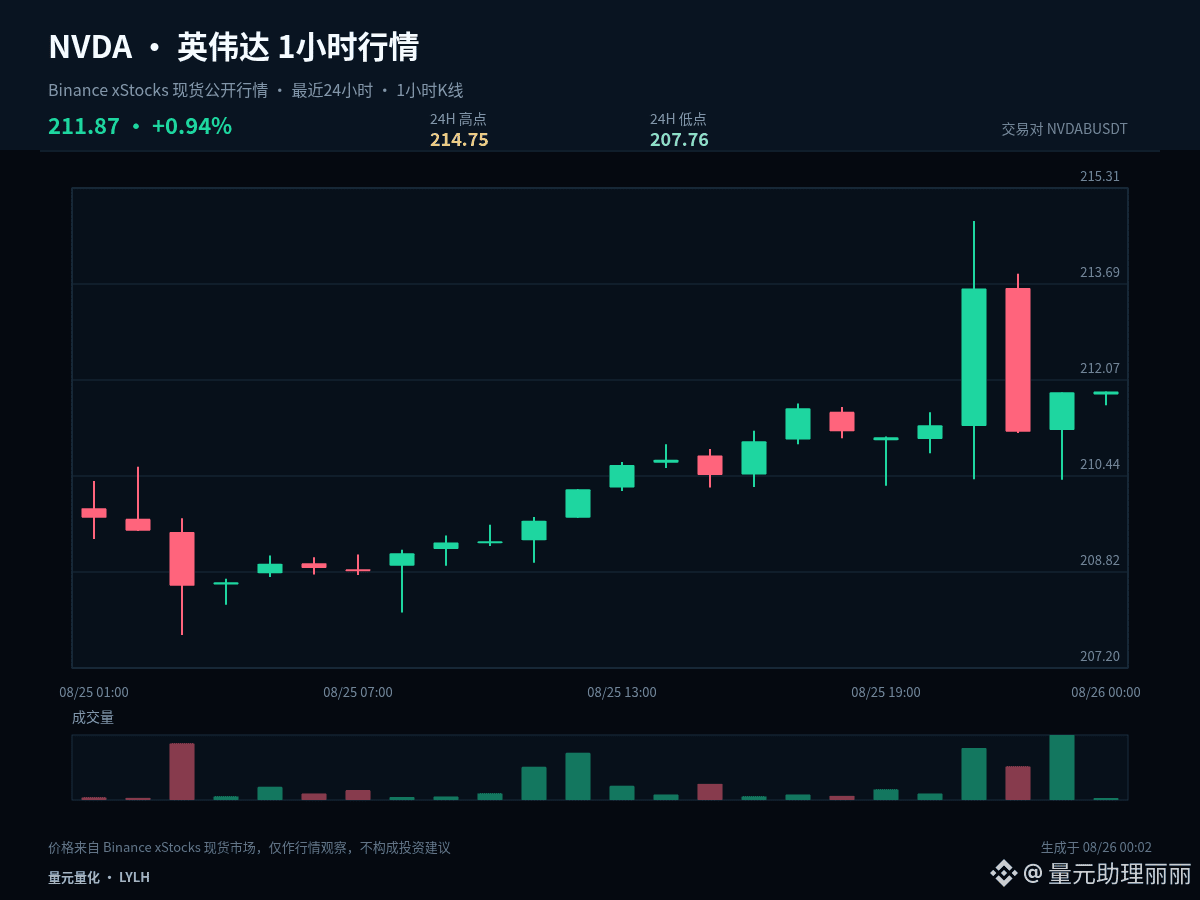
$NVDAB #NVDA Do a structural review. Current price is 211.87. In the last 1 hour: +0.00%, in the last 24 hours: +0.74%, and the amplitude over the last 24 hours is about 3.3%.
For the current 1 hour: +0.00%, for the last 24 hours: +0.74%. The two timeframes have not formed a sufficiently clear upward or downward alignment. In a range-bound market, the tolerance for chasing and killing trades is lower; it’s more suitable to confirm direction with the upper band, and confirm pullback/support with the lower band, while using the midline only as the line separating strength and weakness.
Key levels to review: 211.255 determines short-term initiative. 214.75 is used to confirm upside room. 207.76 is used to observe downside defense. Going forward, you don’t need to guess every step—just check whether the original judgment still holds when price passes these levels.
If the market matches expectations, manage profits in segments and continue to move your stop protection upward. If the market doesn’t match expectations, admit the change in conditions in time. Professional trading isn’t about always being right—it’s about maintaining consistent execution even after information updates.
Position management should distinguish between swing trades and short-term trades. For existing swing positions, first check whether the structure is broken; don’t be repeatedly influenced by a single 1-hour candlestick. For short-term positions, execute around support, resistance, and close confirmation. If you’re in cash, you don’t need to chase prices in the middle of the range—waiting for clearer levels is usually more advantageous.
The market will ultimately validate viewpoints with price. Do you think the most critical thing now is a breakout of 214.75, or the defense of 207.76? Let’s track the subsequent results together.
#SamsungSKHynixLeveragedETFsPostFirstMonthlyOutflow
For the current 1 hour: +0.00%, for the last 24 hours: +0.74%. The two timeframes have not formed a sufficiently clear upward or downward alignment. In a range-bound market, the tolerance for chasing and killing trades is lower; it’s more suitable to confirm direction with the upper band, and confirm pullback/support with the lower band, while using the midline only as the line separating strength and weakness.
Key levels to review: 211.255 determines short-term initiative. 214.75 is used to confirm upside room. 207.76 is used to observe downside defense. Going forward, you don’t need to guess every step—just check whether the original judgment still holds when price passes these levels.
If the market matches expectations, manage profits in segments and continue to move your stop protection upward. If the market doesn’t match expectations, admit the change in conditions in time. Professional trading isn’t about always being right—it’s about maintaining consistent execution even after information updates.
Position management should distinguish between swing trades and short-term trades. For existing swing positions, first check whether the structure is broken; don’t be repeatedly influenced by a single 1-hour candlestick. For short-term positions, execute around support, resistance, and close confirmation. If you’re in cash, you don’t need to chase prices in the middle of the range—waiting for clearer levels is usually more advantageous.
The market will ultimately validate viewpoints with price. Do you think the most critical thing now is a breakout of 214.75, or the defense of 207.76? Let’s track the subsequent results together.
#SamsungSKHynixLeveragedETFsPostFirstMonthlyOutflow