


Polygon (POL) token price rose by more than 50% over the past seven days, finally breaking out of the consolidation range that had been lasting for several months and keeping it near its 2026 lows. The token was trading around $0.12 on August 25, 2026, after rising from roughly $0.08 just a week earlier.
### Background of the rise
The last leg of the rally came after breaking above the $0.09–$0.10 area, which had been acting as repeated resistance since June, with a sharp surge in trading volume during the breakout.
Help drive broader momentum in the cryptocurrency market. Bitcoin rose from about $65,000 to a three-month high above $79,000 on August 21, leading to the liquidation of billions of dollars from short positions. This provided a positive environment for high-beta altcoins, and POL reacted more strongly after months of low prices. The first phase of the breakout also coincided with short-position covering alongside a broader market rebound.
### Polygon-specific developments supporting demand
Polygon co-founder Sandeep Nailwal added extra momentum by announcing plans for a major fix to the staking and tokenomics system in response to community requests. The proposal includes:
- Introducing direct native staking on the Polygon PoS network alongside the current staking on Ethereum.
- Direct Priority Fees to POL staking holders.
- Potentially nearly doubling staking yields, with most of the additional returns coming from network fees rather than further token inflation.
- Other possible incentives such as gas-fee discounts for staking holders, and the ability to issue sPOL (a liquid token) that allows staked tokens to be used in decentralized finance (DeFi).
Naywal pointed to improvements in network economics: Polygon’s revenue is up tenfold this year, and the network reached about 5,000 transactions per second, with block time reduced by 25%. Polygon Labs plans to develop the necessary code before presenting it to the community.
The payments strategy also helped support it. On August 24, the network published additional details about Private Mempool, which allows confidential transactions in areas such as payments, payroll, settlement, trade, and trading. The system prevents exposing pending transactions in the public mempool before confirmation, protecting users from front-running and sandwich attacks. The service was originally launched in April as a private endpoint that can be integrated with an RPC change to submit transactions.
### Technical analysis of POL price
The daily chart shows a crucial change in market structure after POL traded most of the time from June to mid-August in the range of roughly $0.07 to $0.085. The breakout began after it moved above $0.085 and accelerated following a breakout from the high-volume area around $0.09–$0.093 (depending on the Volume Profile Visible Range), which was prior resistance in May and June.
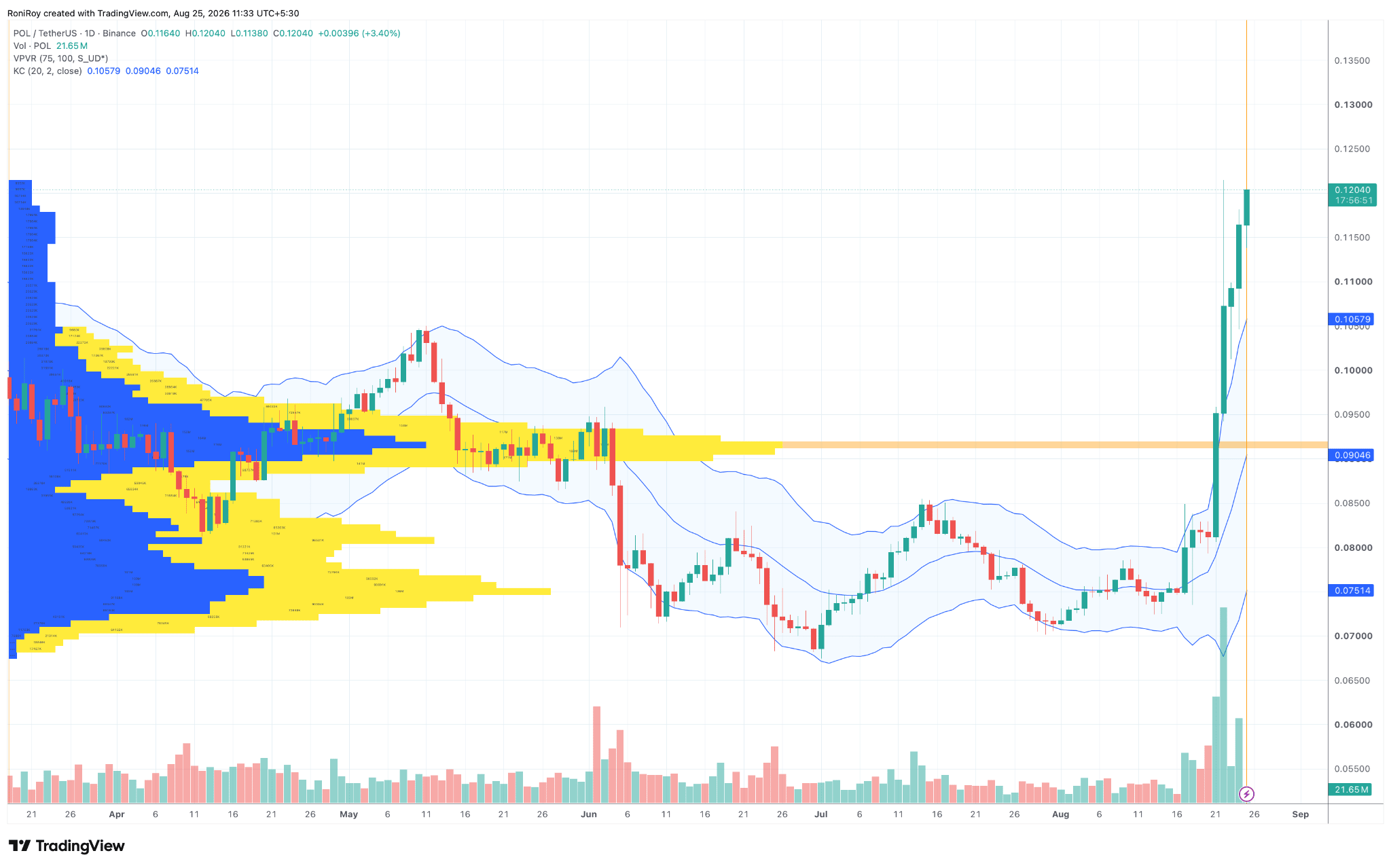
POL is currently trading around $0.12, with the largest historical volume pockets below the current price. Entering a thinner volume zone means less historical activity above price, which could allow the rally to continue quickly if buyers maintain control. But this also creates downside risk: if momentum fades, low volume could trigger a sharper correction.
- The first support area to watch: $0.105–$0.106.
- Then the previous breakout zone: $0.09–$0.093.
Keltner Channels show how far the daily move extends. POL is trading near $0.12, while the upper band of the channel is around $0.1058, meaning the price is far above the upper band. The channel midline is near $0.0905 and the lower band is about $0.0751. This confirms an unusually strong bullish momentum, but it also leaves POL stretched versus its short-term average. Holding above $0.105 keeps the breakout intact, while returning back into the channel increases the chances of consolidation before attempting another rise.
On the four-hour chart, the trend remains bullish. The Supertrend indicator sits around $0.103 (below the current price) and stays in the bullish zone. POL continues to print higher highs and higher lows since the August 21 breakout. As long as the price remains above the $0.103–$0.105 area, the short-term trend stays favorable for buyers.
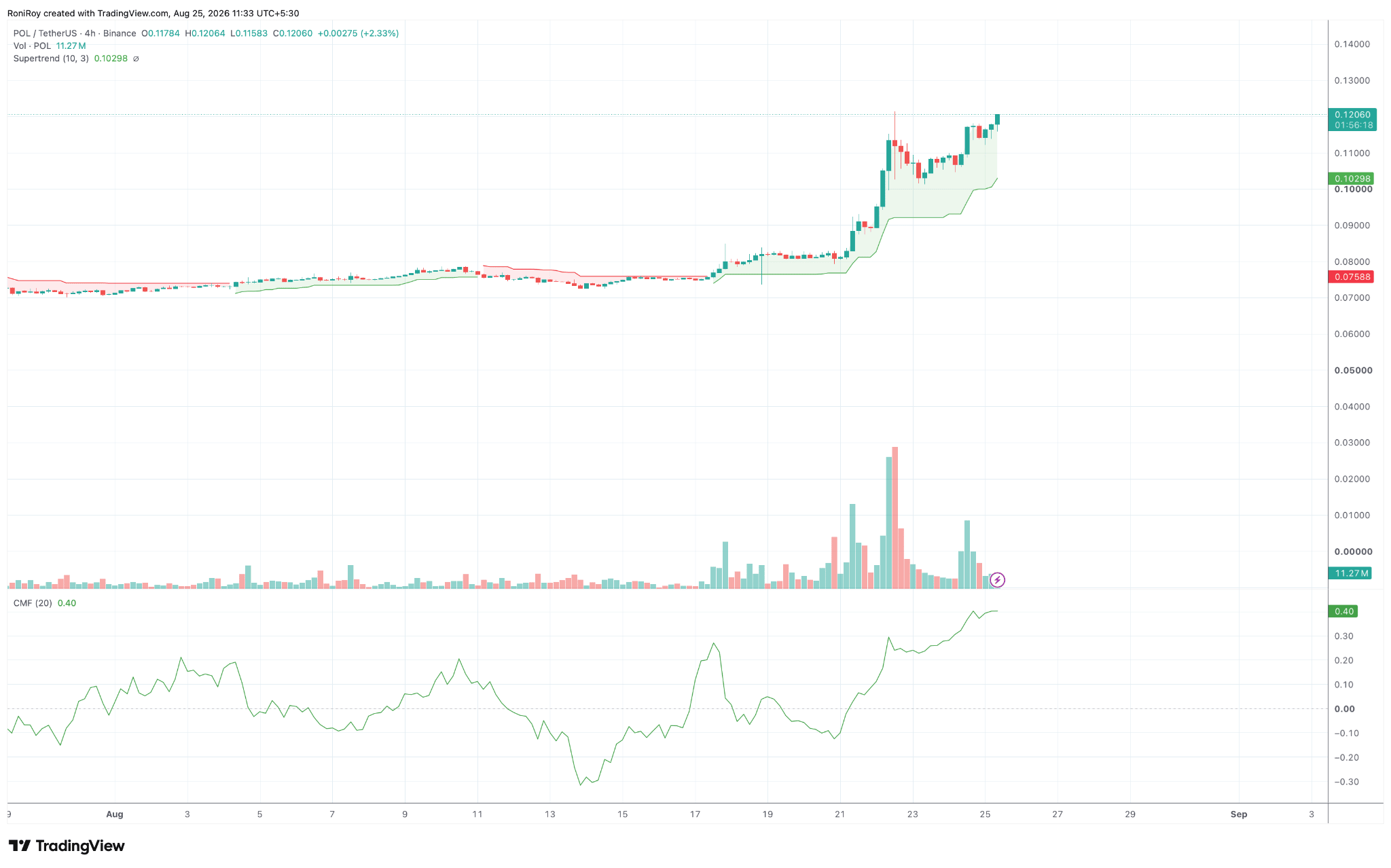
On the 4-hour chart, the Chaikin Money Flow (CMF) indicator is around 0.40—far above the zero line—which suggests strong buying pressure and ongoing capital inflows into POL during the rally.
POL is currently testing the $0.12–$0.121 area. A sustained breakout above it could open the way to $0.125, then $0.13. If momentum remains strong, the next technical target becomes the $0.135–$0.14 zone. Failure to hold the breakout shifts focus back to support at $0.105–$0.103, and a deeper correction could lead to a retest of $0.095, then the high-volume area at $0.09–$0.093, which represents the most important support for the broader breakout structure.
### Quick summary
- POL rose by more than 50% in a week.
- Fixing tokenomics and staking could roughly double staking yields.
- The price is testing $0.12, with next targets at $0.125 and $0.13, then $0.135–$0.14.